My Father Tried to Take Gran’s House Until the Judge Read My Sealed File
PART 3 (FULL STORY)
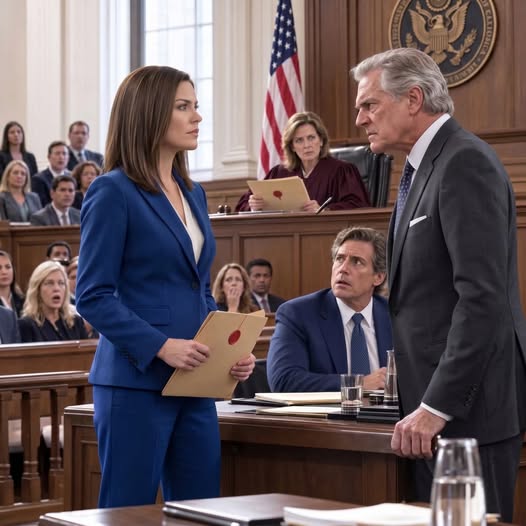
Dad stared at the envelope in my hand as though the paper itself had become dangerous.
“Put that away,” he said.
It was the first time that morning he had spoken to me without sounding certain of himself.
Judge Okafor looked at Foss. “Counselor, sit down.”
Foss slowly lowered himself into his chair.
The judge turned to the clerk and spoke quietly. “Seal the courtroom record for this portion of the hearing. No one leaves until I say so.”
The gallery began to stir, but the clerk moved to the doors and shut them.
I remained standing.
Judge Okafor looked back at the red folder.
“Captain White,” she said, “is this identification code authentic?”
“Yes, Your Honor.”
Dad’s head snapped toward me.
“Captain?”
Lauren covered her mouth.
Foss looked from me to Dad.
Judge Okafor gave him a hard look. “You may want to stop reacting and start listening.”
I had never used my rank in my father’s house.
He had spent years calling me a grunt, a disappointment, a girl playing soldier because she had no better future.
At the courthouse, he had called me a fraud.
The truth was that my military work had placed me in a federal investigative program involving the very type of conduct he had been trying to use against me.
I could not discuss the operational details, and I had never intended to.
But when anonymous complaints began appearing at my command, something immediately bothered the investigators reviewing them.
The letters contained information that should not have been available to an ordinary family member.
Someone had been using my personnel information.
Someone had been attaching altered medical documents to official complaints.
Someone had been trying to make the accusations look as though they came from independent sources.
My command opened an inquiry.
Then the inquiry widened.
I was not suspended because they believed my father.
My access had been temporarily restricted because investigators needed to determine whether someone close to me had obtained protected information and whether any military systems had been compromised.
That distinction mattered.
Dad knew none of it.
He only knew that the pressure was working.
He believed my silence meant fear.
It actually meant I had been told not to interfere with the investigation.
Judge Okafor opened the red folder again.
Inside were certified copies of the original medical records my father had submitted to the court, followed by forensic comparisons with the records obtained directly from the providers.
Dates had been altered.
Signatures had been reproduced.
Two pages contained information that had not existed in the original files.
The alterations were not mistakes.
They were deliberate.
Foss reached for the papers.
The judge pulled them back.
“No.”
He froze.
“These documents were submitted by your client,” she said. “You will not remove them from the bench.”
Dad stood.
“This is ridiculous.”
“Sit down, Mr. White.”
He sat.
Judge Okafor turned another page.
Then she found the document that explained the identification code.
It was not a military commendation.
It was not a secret identity.
It was a federal evidence certification attached to an investigation that had already been referred outside the courtroom.
The red seal indicated that the original material had been preserved and independently verified.
My father had not been suing a helpless daughter.
He had been trying to use a civil lawsuit to destroy the credibility of the person whose evidence was already being examined by federal investigators.
Judge Okafor looked at him.
“Do you know what your daughter is?”
Dad said nothing.
“She is the person who preserved evidence while you were trying to manufacture it.”
His face tightened.
Foss slowly closed his briefcase.
Lauren began crying.
I looked at her, but she would not meet my eyes.
The judge continued.
“The court has received evidence that the plaintiff may have submitted altered medical records, encouraged false testimony, and attempted to interfere with a military investigation involving the defendant.”
Dad shook his head.
“She manipulated my mother.”
“No,” I said quietly.
Everyone looked at me.
“I visited Gran. I didn’t manipulate her.”
Dad’s voice rose.
“She was sick.”
“She was clear.”
“You don’t know what she wanted.”
“I know exactly what she wanted.”
I opened the second envelope.
Inside was a letter in Gran’s handwriting.
I had found it weeks before the trial in the back of an old desk drawer at the house.
The letter was dated six months before her death.
It was addressed to her attorney.
She wrote that she had chosen me because I had never asked her for the property.
She wrote that Dad had repeatedly pressured her to change the will.
She wrote that Lauren had been present during some of those conversations.
And she wrote one sentence that I had read so many times I could remember the shape of every word.
“I am leaving the house to the granddaughter who never made me feel that love had to be purchased.”
Lauren started crying harder.
Dad looked at her.
“You knew about this?”
Lauren shook her head.
“I knew she wanted you to have it,” she whispered. “I didn’t know about the letter.”
Dad stared at her.
“You signed the affidavit.”
“I was scared.”
“You signed it.”
“I thought you were going to lose everything.”
His face changed.
Not because he felt guilty.
Because he finally understood that the person he had expected to protect him had just admitted she had been afraid of him too.
Judge Okafor ordered the letter entered into evidence.
Then she turned to Foss.
“Are you aware that your client’s allegations against the defendant are contradicted by authenticated records?”
Foss swallowed.
“I was relying on the materials provided by my client.”
“That answer may become important later.”
He said nothing.
The judge then addressed me.
“Captain White, I understand there are portions of the federal investigation you cannot discuss.”
“Yes, Your Honor.”
“You have complied with every lawful request for disclosure?”
“Yes.”
“Have you ever altered a military document?”
“No.”
“Have you ever threatened your father?”
“No.”
“Have you attempted to conceal evidence?”
“No.”
She nodded once.
Then she looked at Dad.
“The plaintiff’s request for ownership of this property is denied.”
Dad closed his eyes.
But the judge was not finished.
“Given the evidence presented today, the court is referring the record concerning the alleged document alterations and related conduct to the appropriate authorities.”
Dad stood again.
“You can’t do this.”
Judge Okafor’s voice remained calm.
“You brought this case into this courtroom.”
He looked toward Foss.
Foss would not look back.
Dad turned toward me.
For a second, I saw the man who had stood in our kitchen when I was sixteen, holding a grocery invoice and telling me that everything in his house had a price.
Then I saw something different.
He was no longer looking at his disappointing daughter.
He was looking at someone he had underestimated for years.
“You planned this,” he whispered.
“No,” I said.
“I prepared for it.”
That was all.
The hearing lasted another two hours.
There were procedural arguments, evidentiary rulings, and questions about the documents.
Nothing about it felt cinematic anymore.
It felt administrative.
That was somehow worse for Dad.
His entire strategy had depended on making the case emotional.
He wanted the judge to see a bitter daughter fighting her father over an old house.
Instead, the court saw records.
Dates.
Signatures.
Affidavits.
Preserved evidence.
And a will written by an elderly woman who had been very deliberate about what she wanted.
When we finally left the courtroom, reporters were waiting outside.
I said nothing.
Neither did Dad.
Lauren stopped me near the courthouse steps.
“Can I talk to you?”
I looked at her.
She wiped her face.
“I shouldn’t have signed it.”
“No.”
“I was scared of him.”
“I know.”
She looked toward the courthouse doors.
“Are you ever going to forgive me?”
I thought about Christmas morning.
The jewelry.
The envelope.
The diner.
The military ceremony.
All the small moments that had taught us what our father rewarded and what he punished.
“I don’t know,” I told her.
She nodded.
It was not the answer she wanted.
But it was the first honest answer I had ever given her without trying to protect anyone.
Weeks later, the federal investigation continued without me discussing it publicly.
Dad’s lawsuit disappeared from the headlines.
His attorney withdrew from representing him.
The altered records became part of a separate legal process, and the allegations against me were formally cleared.
My command restored my access.
People who had avoided me in the hallway began speaking again.
Some apologized.
Some didn’t.
I stopped needing either.
I returned to Gran’s house alone.
The place looked exactly as it had before the lawsuit.
The old oak trees stood beyond the porch.
The kitchen still smelled faintly of cedar and Earl Grey.
Her clock still lost three minutes every day.
I found myself standing beside the desk where I had discovered her letter.
On the top drawer sat the old red tea tin she used to keep sugar.
I opened it.
Inside was nothing valuable.
Just a small brass key.
I knew immediately what it opened.
The wooden box beneath her bed.
I carried it into the kitchen and set it on the table.
Inside were photographs, old birthday cards, my first military commissioning program, and a faded note Gran had written when I was nine.
I read it slowly.
“You don’t have to become what people expect you to be.”
I folded the note and placed it back.
For years, I had thought winning meant proving my father wrong.
Standing in that quiet kitchen, I realized I had been measuring my life with his ruler.
I didn’t need to anymore.
I walked to the front door and looked back at the house.
It wasn’t a prize.
It wasn’t evidence.
It wasn’t a battlefield.
It was simply the place my grandmother had chosen to leave me.
I locked the door with the small brass key, slipped it into my pocket, and listened to the old clock continue ticking three minutes behind the world.
For once, I didn’t feel any need to make it catch up.