My Family Swore Under Oath I Faked My Years in Uniform FULL STORY
The folder was not thick. That surprised people. They expect vindication to be heavy.
The truth doesn’t weigh much. It just has to be real.
Inside was my DD-214 — the discharge record the Army gives you, the one that lists every year, every rank, every deployment, every commendation. Below it, my deployment orders. Below that, a single photograph: me at twenty-three, kneeling in the dirt outside a field hospital with my hands still red, because the picture was taken eleven minutes after I’d kept a nineteen-year-old from bleeding out on a stretcher.
My attorney, a quiet woman named Ruth Bauer, handed the documents to the clerk.
Judge Ellison read the DD-214 for a long time. Longer than she needed to. I think she was giving my mother a chance to feel the floor disappear.
Then she said, “Mrs. Coleman, this is an authenticated federal record of your daughter’s eight years of military service, including two combat deployments. You testified under oath, minutes ago, that she never served. Would you like to revise your testimony?”
My mother’s mouth opened and closed.
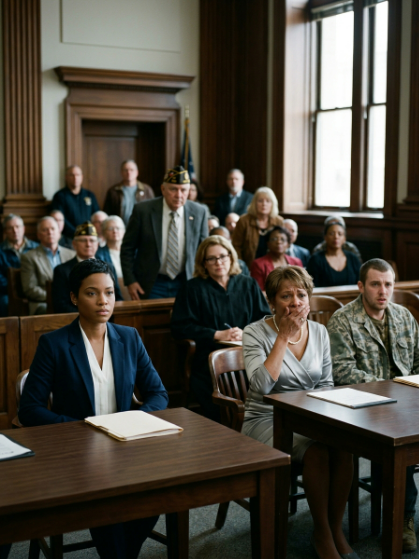
Travis had stopped rustling his jacket.
And then Ruth did the thing she hadn’t told me she’d arranged.
“Your Honor, the defense calls Sergeant First Class Daniel Okonkwo.”
The doors at the back of the courtroom opened, and a man I hadn’t seen in six years walked down the aisle in his dress uniform.
Danny Okonkwo. My platoon sergeant. The man who’d dragged me out of a ditch with shrapnel in my shoulder and told me to keep my hands working, because the kid on the ground still needed them.
He took the stand. He didn’t look at my mother. He looked at me.
“Captain Coleman served under me for three years,” he said. “She is one of the finest combat medics I have ever worked beside. I have personally watched her save lives under fire. Anyone who says she did not serve isn’t mistaken. They’re lying.”
The gallery — full of veterans Ruth had quietly invited, men and women in VFW caps who’d heard what my own family was trying to do — rose to their feet.
Judge Ellison let them stand.
It took her about four minutes to rule.
The trust was upheld in full. The eighty acres were mine. My mother’s lawsuit was dismissed with prejudice — a legal way of saying don’t ever bring this garbage into my courtroom again.
Then the judge did something I hadn’t expected.
She referred my mother’s sworn testimony to the prosecutor’s office for a perjury review. And she ordered my mother and brother to pay my legal fees. Every dollar.
“Lying about the dead is shameful,” she said. “Lying about the living who served so the rest of us could sleep safely is something this court will not subsidize.”
I should have felt like I’d won.
Mostly I felt tired.
Here’s what nobody tells you about being vindicated by your own family’s downfall. The verdict doesn’t give you back the years. It doesn’t give you back the mother who drove you to the recruiter at eighteen and then, somewhere in the money and the resentment, decided you were a liability instead of a daughter.
I gathered my folder. I stood. I walked out into the marble hallway.
And that’s where Travis caught up to me.
He’d taken off the camo jacket — I noticed that. He was holding it balled in his hands like a boy who’d been caught.
“Maya. Maya, wait. Look — I didn’t think it’d go like… Mom said you’d just settle. She said you wouldn’t even show up. I didn’t—”
He kept going. Apology-shaped words. The kind you offer when the consequences arrive, not when the wrong was done.
I looked at my little brother for a long moment.
The medic in me wanted to triage him — to find the part that could still be saved.
But the soldier in me knew something the medic didn’t want to hear. Some wounds you don’t treat in a hallway. Some you just walk away from, so they can’t reach you again.
So I didn’t say anything.
I reached up and squared the lapel of my blazer — the way you straighten a uniform before you leave a room with your head up — and I turned toward the light coming through the courthouse doors.
Behind me, Travis was still saying my name.
I had carried wounded men across open ground. I had run toward the sounds everyone else ran from.
But the bravest thing I ever did was keep walking down that hallway and not turn around.
I drove out to the farm that afternoon. Eighty acres, gold in the October light, the fences my grandfather built still standing straight.
I stood in the middle of the field where he taught me to shoot tin cans off a post, and I finally let myself cry — not for what I’d lost in that courtroom, but for the family I’d already lost years before I ever walked into it.
Then I wiped my face, found a loose rail near the gate, and went to fix it.
That’s what you do with land somebody trusted you to keep.
You keep it.