My Daughter-In-Law Threw My Handmade Blanket Away Until She Learned Its Secret
PART 3 (FULL STORY)
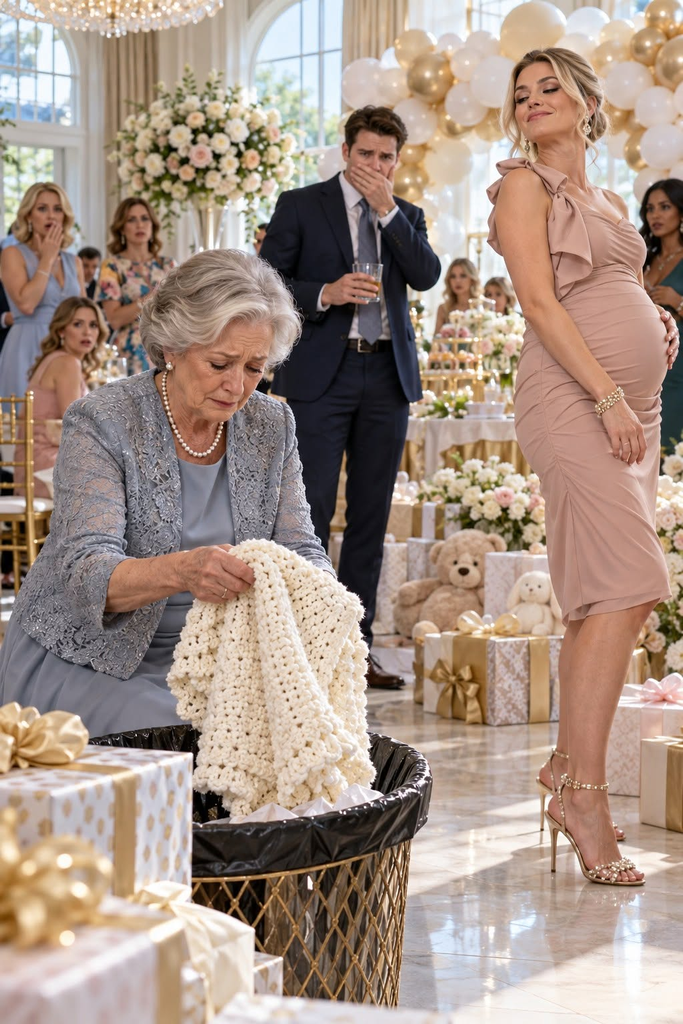
The living room fell into a heavy, suffocating silence. Madison stood frozen between my coffee table and the front entryway, her manicured fingers still poised in midair like a hawk interrupted mid-dive. Her eyes, which had looked at my gift with utter disgust only three hours earlier, were now wide and ravenous, darting between the cream-colored wool and the heavy parchment envelope in my hands. Beside her, Kyle looked as though someone had struck him across the chest. His shoulders were hunched, his face pale and mottled with shame, his eyes fixed on the floorboards where his father had once walked.
“What condition, Darlene?” Madison asked, her voice tight, the sweet veneer vanishing beneath a sharp, demanding edge. “Kyle is Frank’s only child. We are the parents. Whatever Frank left belongs to our family.”
I didn’t raise my voice. I smoothed out the single sheet of yellow legal paper Frank had written on his bedside table in hospice, his handwriting shaky but deliberate.
“To my grandson,” I read aloud, my voice steady despite the ache in my throat. “‘If you are reading these words, it means you are holding something crafted with love by your grandmother’s aching hands. A man’s worth is never measured by the logos on his clothes or the price tag on his stroller, but by the promises he keeps and the people he protects. I have lived a long, full life with very few regrets because I married a woman who knew the difference between what is expensive and what is valuable.'”
Kyle let out a ragged breath, turning his face away toward the window as tears began streaming down his cheeks.
I continued reading Frank’s words. “‘The sixty-five acres of timber and shoreline on Silver Lake, along with the investment trust I established thirty years ago, are my final gift to you. But they are yours alone. The land is placed in an irrevocable trust with your grandmother as the sole trustee. No parent, in-law, or creditor may ever mortgage, subdivide, or sell a single acre. The funds shall be disbursed solely for your education and health until your twenty-fifth birthday, when the deed transfers to your name. If your parents cannot value the stitches that wrap you, they are not permitted to manage the ground beneath your feet.'”
Madison’s jaw dropped in furious disbelief. “That’s absurd! You can’t lock up prime lakefront real estate like that! Do you have any idea what sixty-five acres on Silver Lake is worth right now? Gail told me developers are paying two million dollars for parcels half that size! We could sell thirty acres tomorrow, pay off our mortgage, buy the country club membership, and remodel the nursery with private designers!”
“That land was Frank’s sanctuary,” I said quietly, folding the letter and placing it back inside the envelope. “He spent forty years fishing those waters in an old aluminum boat. He bought it so our grandson could learn how to skip stones, build campfires, and understand what matters in this world. It is not a liquidation fund for your vanity.”
“We are having this baby, not you!” Madison shouted, taking an aggressive step toward me. “Give me that blanket, Darlene! We’ll hire an estate attorney on Monday morning to break that trust. A judge will never uphold a ridiculous clause written on notebook paper by a dying man!”
“Stop it, Madison.”
The words were quiet, but they cut through the room like a blade.
Madison spun around, staring at Kyle as if she couldn’t believe her ears. “What did you just say to me?”
“I said stop,” Kyle repeated, his voice cracking with an agonizing mixture of grief and self-hatred. He looked at his wife, seeing her clearly perhaps for the very first time. “My mother spent four months knitting that blanket with arthritic hands while crying over my father’s death. She sat in your shower with a smile on her face, and you threw my dad’s last gift into a trash can while your mother laughed. And I stood there like a coward and let you do it.”
“I was protecting our aesthetic!” Madison screamed back at him, her face flushed with rage. “I didn’t know there was a multi-million-dollar deed inside it! Your mother should have told us instead of playing games!”
“She tried to tell you,” Kyle choked out, burying his face in his hands. “She tried to tell you twice, Madison. But you didn’t care about anything that didn’t have a designer label on it.”
I stood up from the sofa, holding the folded cream-colored blanket against my chest. The wool felt soft and warm against my fingers.
“Madison,” I said, looking her squarely in the eye. “You threw this blanket into the garbage. And the moment you did, you showed me exactly who you are. This blanket, this letter, and the land trust will stay locked in my safe-deposit box. When my grandson is old enough to understand what love looks like, I will give them to him myself. Now please leave my house.”
Madison glared at me with pure venom, grabbed her designer handbag from the entryway table, and stormed out into the night, slamming the front door so hard the glass panes rattled.
Kyle stayed behind, standing in the middle of the quiet living room, weeping openly. He didn’t ask for the money. He didn’t ask for the blanket. He simply walked over to the armchair his father used to sit in, sank to his knees beside my couch, and rested his forehead against my knees.
“I’m sorry, Mom,” he whispered over and over. “I’m so sorry.”
I placed my hand on his head, running my stiff fingers through his hair just as I had when he was a boy. Forgiveness does not mean forgetting, and trust once broken takes years to rebuild, but he was still Frank’s son, and love does not abandon people when they finally see the truth.
Over the next six months, the consequences of that afternoon transformed our family. Madison attempted to contest the trust, but Frank’s estate attorney, a veteran probate lawyer who had drafted the documents with airtight no-contest provisions, informed her that any legal challenge would immediately forfeit every secondary benefit and trigger massive legal fees. When Madison realized she could not touch a single dollar of Frank’s land, her resentment toward Kyle deepened. The financial strain of maintaining their extravagant lifestyle without family subsidies exposed the hollow foundation of their marriage, leading to bitter arguments and an eventual separation.
Kyle moved into a modest apartment near Bell Street, took a second job, and began visiting my house every Sunday afternoon. We spent hours in the kitchen drinking black coffee, talking about Frank, and looking through old photograph albums. Row by row, conversation by conversation, my son began to find the moral center he had lost.
When my grandson, Leo, was born eight months later, Kyle brought him to my house on a crisp autumn morning. I sat in the rocking chair by the front window, took the tiny bundle into my arms, and looked down at his bright blue eyes—the exact shade of Frank’s.
I reached into the wooden chest beside the fireplace, lifted out the cream-colored wool blanket with the tiny blue sailboats, and wrapped it gently around my grandson’s shoulders. In the bottom corner, the initials FM rested against his tiny chest.
The next summer, Kyle and I drove up to Silver Lake with Leo strapped into his car seat. We walked down to the water’s edge where the pine trees met the clear blue lake. The afternoon breeze carried the clean scent of cedar and water, rustling the tall reeds along the shore.
I bent down, my arthritic fingers dipping into the cool water to pick up a smooth, flat stone from the shallows. I placed it into little Leo’s tiny hand, guiding his fingers to feel the smooth surface before skipping it across the sparkling lake.
I looked up at the towering pines that Frank had preserved with his own sweat and sacrifice, felt the warm sun on my face, and whispered a quiet thank you to the man who had taught us that the things made with love are the only things that truly last.