I Woke With a Date Tattooed on My Wrist and No Memory of Why FULL STORY
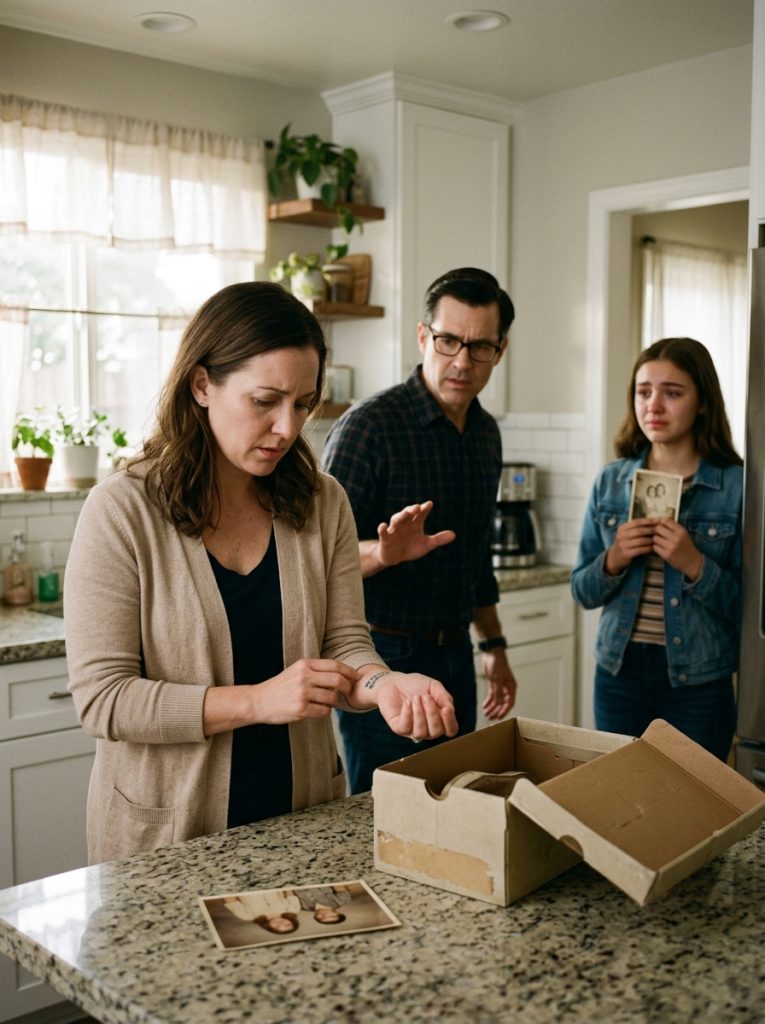
I stood in my own kitchen holding a stranger’s photograph that wasn’t a stranger’s at all, and the date on my wrist finally stopped being a design.
A girl named Maya had just told me she was my daughter, and every cell in my body had answered before my ruined memory could.
“Elena, come inside.” Greg’s hand closed around my arm. Gentle. The way it always was. “She’s confused. I’ll deal with this.”
And for the first time in two years, his gentleness felt like a hand over my mouth.
“Don’t,” I said. I pulled my arm free. “Don’t deal with it. Let her talk.”
Maya was crying on my porch, the photograph trembling in her grip. “I sent you cards,” she said. “Every birthday. Every Christmas. For two years. You never answered. Aunt Carol said you needed space, that the doctors said a teenager would be too much stress while you healed. So I stopped coming. I thought —” Her voice cracked. “I thought you forgot me on purpose. Because it was easier.”
“I don’t remember anything,” I whispered. “Maya, I don’t remember the accident. I don’t remember my own wedding. I woke up two years ago and a man I’d never seen told me who I was, and I believed him because I had nothing else.” I looked at the photo. A younger me, glowing, exhausted, holding a newborn in a yellow blanket. “Nobody ever told me I had a daughter. Nobody.”
Maya’s eyes went past me, to Greg.
And so did mine.
“You knew,” I said.
Greg’s careful calm was cracking at the edges. “Elena, you were fragile. The doctors said to keep things simple. A custody-aged teenager, the whole complicated history with her father — it would have set your recovery back years. I made a hard call to protect you.”
“To protect me,” I repeated. “From my own child.”
“She wasn’t mine to raise,” he said. “And honestly? We were better. Just us. Quiet. You said yourself you liked it quiet.”
“You told me I liked it quiet,” I said. “I never told you anything. I had no past to tell you with.”
That was the moment the room tilted again, except this time it wasn’t vertigo. It was something coming back.
Not a flood. Just a single, sharp image, the way memory works when it’s been buried: a tattoo parlor, years ago. A needle. Me, gripping the chair, choosing a date. And a reason I’d said out loud to the artist, a reason I now heard in my own voice across the gap of two lost years:
“So that no matter what happens to me, I’ll always have her birthday on my body. So I can never forget the day I became her mother.”
I’d tattooed it as a promise to never forget.
And a car accident, plus a husband who found my daughter inconvenient, had almost made me break it anyway.
I called my sister Carol that afternoon. I didn’t scream. I was too hollowed out to scream.
“Tell me the truth,” I said. “All of it.”
And Carol, to her credit, broke. She told me everything between sobs.
After the accident, when I was still in the hospital with no idea who anyone was, Greg had sat the family down and made his case. Elena needs a clean, calm environment. Elena can’t handle a grieving teenager. Maya should come live with you, Carol, just until she’s better. And Carol — frightened, grieving, trusting the husband at the bedside — had agreed. Just until I was better.
Except Greg kept moving the goalposts on “better.” Every time Carol raised bringing Maya back, there was a reason it wasn’t time yet. The cards Maya sent — Carol mailed them. Greg made sure I never saw them. He told Carol I’d read them and asked for “more space,” when I’d never seen a single one.
He’d built me a small, quiet life with no doors in it, and he’d called every locked one love.
“I knew it was wrong,” Carol wept. “Somewhere I knew. But he was so sure, and I was so scared of hurting you, and the longer it went the more impossible it felt to undo. I’m so sorry, Elena. I let him erase her. I let him erase you.”
Here’s what I did.
I didn’t stay to be protected anymore.
I asked Greg to leave the house — my house, it turned out; it had been mine before the marriage, another fact he’d let me misunderstand. He didn’t go quietly. He cycled through all of it: the protector, the victim, the wounded husband who’d “given up everything” for my recovery. For about a day, the old reflex in me wanted to apologize, because that reflex was the only thing he’d ever really taught me.
Then Maya, who was staying with me by then, sat on the end of my bed and showed me the cards.
She’d kept copies of every one. Two years of a daughter writing to a mother who never wrote back, getting shorter and sadder each year, until the last one just said, “I hope you’re happy. I won’t bother you anymore.”
I read all of them in one sitting, and when I finished, the apology reflex was gone. Burned right out of me.
Greg moved out. The marriage is ending in the unglamorous, paperwork way that marriages built on control tend to end once the control stops working. I don’t hate him, exactly. I think he convinced himself he was being kind. But there’s a kind of kindness that’s really just a cage with a soft lining, and I lived in one for two years, and I’m not going back.
Maya lives with me now.
It hasn’t been a movie. You can’t pour sixteen years and two erased ones back into a kid overnight. There were weeks she barely spoke to me, weeks she tested whether I’d disappear again, weeks I wanted to and didn’t. My memory has come back only in pieces — some days a whole afternoon from her childhood surfaces, some days nothing. I’ve had to learn my own daughter twice: once as the baby in the yellow blanket I’ll never fully remember holding, and once as the angry, hopeful, extraordinary teenager standing in my kitchen, refusing to let me forget her a second time.
The memories come at the strangest times. I was braiding her hair one morning — clumsily, out of practice — when my hands suddenly knew a pattern they had no business knowing. A fishtail, fast and sure, the muscle memory of a thousand school mornings I couldn’t consciously recall.
Maya went still under my fingers.
“You used to do it like that,” she whispered. “Every day. Before.”
We both cried into her hair. Then she laughed and told me I’d gotten worse at it, and that was the first time we laughed together as mother and daughter in this new life.
I’ll take getting worse at it. I’ll take a thousand clumsy braids. My hands remembered her even when my mind couldn’t, and somehow that was the proof I needed — that she’d always been in there. That past-me never really let go.
Carol comes around again, slowly. Maya is harder on her than on me, and I understand why, and I don’t push it. Carol earns it back one Sunday dinner at a time. That’s the only way these things come back. One Sunday at a time.
The tattoo is still on my wrist.
I used to run my thumb over it and feel nothing, just numbers I’d been told meant nothing.
Now I know it’s the most important thing I ever did. A woman I can barely remember being looked into a future she couldn’t predict and decided to write her daughter’s birthday into her own skin, where no accident and no man could ever fully take it away.
Past-me was smarter than anyone gave her credit for.
She left a door in the wall after all. A small one. Just a date.
And a sixteen-year-old girl with my eyes finally knocked on it, and I opened it, and I am never letting it close again.