I Watched the Tip Jar Keep Coming Up Short FULL STORY
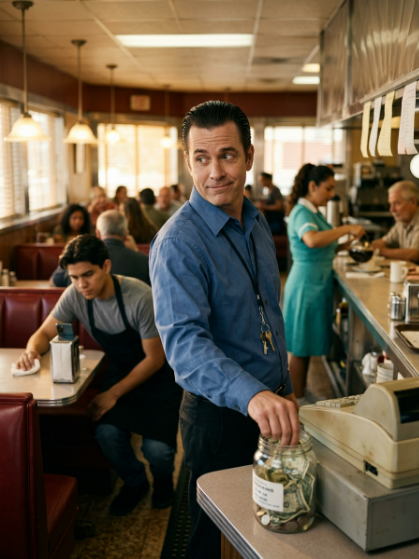
Dale never turned around.
He took the bills, smoothed them into his pocket, and walked back toward his office whistling. The red dot kept blinking. I grabbed my phone with hands that wouldn’t stop shaking and shoved it deep in my apron.
I had him. Forty seconds of clean footage, his face, his hand, the jar.
And then I sat on it for two days, terrified.
Because who was going to believe me? Dale had been there nine years. I’d been there seven months. He’d already convinced the whole floor that one of us was a thief. If I showed the wrong person, he’d spin it, fire me, and Carla right behind me.
So I went over his head. All the way over.
Frank Delgado owns the Sunrise. He’s sixty-three, mostly retired, comes in maybe twice a month to eat pie and check the register tape. Most of the new staff had never even met him. But his name was on the cooler, on the checks, on the little brass sign by the door.
I found his number on an old vendor invoice in the back. I texted him the video with one line: “Mr. Delgado, this is happening to our tips. I didn’t know who else to tell.”
Three dots. Then nothing. For an hour I thought I’d ended my own career.
Then: “I’ll be in tomorrow at six. Say nothing to anyone. Thank you, son.”
Frank came in before the sun did. But he didn’t start with the video.
He started with the books.
Turns out a man who’s been dipping a tip jar for forty seconds at a time is usually doing worse where no one’s looking. Frank sat in that little office with the door shut for three hours, and what he found made the tip jar look like pocket change.
Dale had been skimming the credit-card tip pool for over a year — adjusting the totals before they got split, pocketing the difference. He’d been shaving hours off our paychecks, too. Clocking Carla out early on paper while she was still on the floor. Little cuts. Spread across a dozen people who all just figured they’d counted wrong.
It added up to almost nineteen thousand dollars.
When Dale strolled in at nine, Frank was sitting at the counter with two printouts and the video paused on the screen of my phone.
“Sit down, Dale,” he said.
I’ve never seen a man’s face do what Dale’s did. He tried the smile first. Then the explanation. Then he looked at me — he knew, instantly, that it was me — and the smile came back uglier.
“You’re gonna believe a busboy?”
“I’m gonna believe the numbers,” Frank said. “The busboy just told me where to look.”
The police came that afternoon. Theft of that size isn’t a stern conversation; it’s charges. They walked Dale out past the lunch rush, past every server he’d accused, and the whole floor just stood there holding their order pads.
Carla cried again. Different kind this time.
Frank made every dollar right. He went back through the records and paid each of us what Dale had taken, down to the cent. Carla’s back pay covered three months of the sitter she’d been drowning under. She kept her job. She got the raise Dale had “lost the paperwork” for twice.
And me?
Frank pulled me aside on his way out that first day.
“You had that video for two days before you sent it,” he said. “Why’d you wait?”
“I was scared,” I said. There was no point lying to him.
“Good,” he said. “Means you understood what it cost. Scared and you did it anyway — that’s the only kind of brave worth having.”
He made me a shift lead the next month. Bumped my pay. Put in a new tip system where the totals get logged on camera and split in front of everyone at close, so no one ever has to wonder again.
Then he found out I’d been saving for community college, two semesters at a time, quitting and restarting every time money got tight.
He set up a thing he calls the Sunrise scholarship. I’m the first one on it. I start in the fall — business, because someday I want to run a place where the people in aprons get treated like they’re the reason it works. Because they are.
I still bus tables some shifts. I still watch the room. Old habits.
But now when I watch, it’s not to catch somebody. It’s to make sure the new kid carrying a tray full of dirty plates knows that somebody sees him, and that around here, the quiet ones are exactly who we’re listening for.
The tip jar sits by the register where it always did.
These days, at the end of every shift, we count it together in the light, and nobody’s hand is in it but our own.