I Was Named a Defendant in Front of 200 Gala Guests FULL STORY
Nathan opened the back door of his hardware store, saw me standing there in a gala gown at midnight, and the first thing he said was, “You’re going to ruin those shoes on this floor.”
It was such a Nathan thing to say that I almost laughed and almost cried, and instead I just held up the cream envelope and said, “I need help. You’re the only one who can.”
He looked at the envelope a long time. Then he stepped back and held the door.
“I wondered when this would come,” he said. “Come in, Tess. We’ve got a lot to fix and not much practice.”
The back room was exactly what you’d expect. Shelves of inventory, a workbench, a coffee maker older than both of us. And in the corner, on a steel rack, a battered banker’s box with our father’s company name written on the side in marker faded almost to nothing.
Maren & Sons.
“I kept everything,” Nathan said, following my eyes. “When the company folded, everybody else wanted to burn it all and walk away. I boxed it up. Eight years it’s been sitting there.” He pulled the box down and set it on the bench. “I think I always knew that someday you’d need what’s in here. I just figured you’d never let yourself walk through my door to get it.”
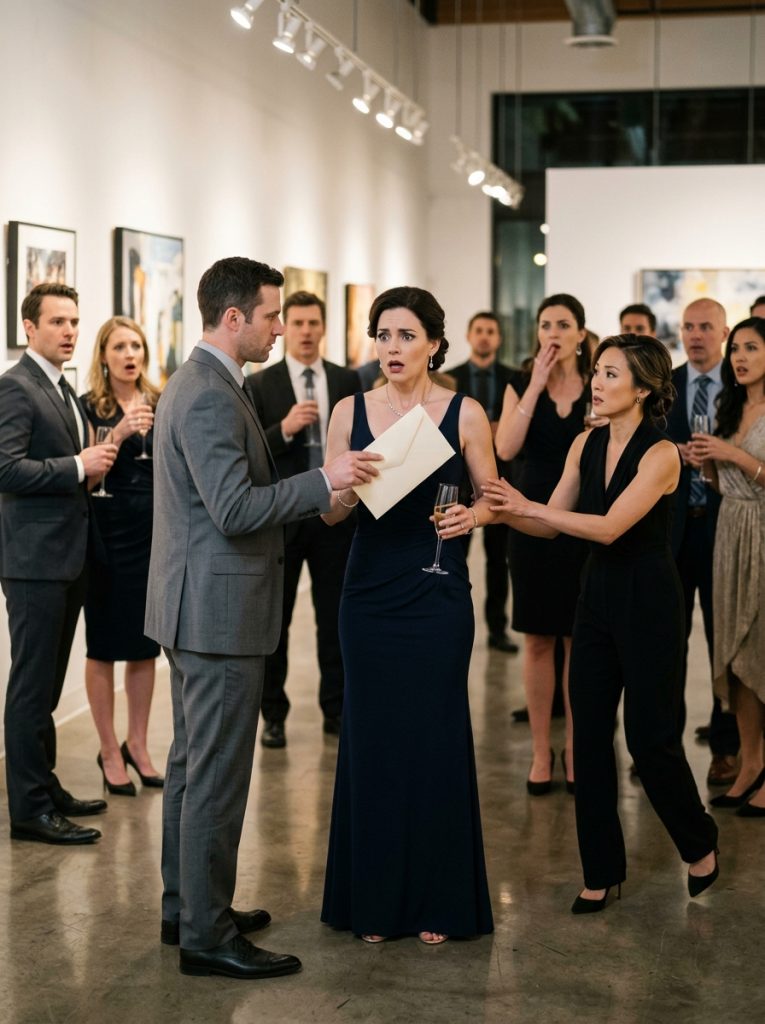
I told him about the lawsuit. The opening, the man in the gray suit, the word defendant landing in the middle of two hundred people. The signatures I’d never made on contracts I’d never seen. The six figures. The way the whole room had stepped back from me like I was contagious.
Nathan listened without a word. Then he opened the box and started pulling out folders, and the truth came out of that box the way water comes through a cracked dam — slow, then all at once.
“The bad deals that sank the company,” he said, laying contracts on the bench. “The fraudulent ones. The ones everyone said Dad signed.” He pointed at a signature. “That’s not Dad’s signature, Tess. Look at the M. Dad looped it. This is flat. I had three of these examined years ago.” He laid down a report beside it. “Forged. All of them.”
“Forged by who?”
He looked at me.
“Uncle Roy.”
The floor did the thing it had done at the gallery. Tilted.
Roy. Our father’s younger brother. The smooth one, the charming one, the one who’d been a “silent partner” in Maren & Sons and who’d shown up at the funeral in a camel coat to tell everyone how much he’d “tried to save the family business.”
“Roy ran the deals Dad didn’t have the stomach for,” Nathan said. “When his side bets went bad, he forged Dad’s name on contracts to cover the holes. By the time it all collapsed, Dad was already sick, already fading, and Roy made sure the story that stuck was that Dad signed the bad paper and I helped him hide it. Roy walked away clean. He even got sympathy.”
“Why didn’t you fight it?” I said. “Why didn’t you tell anyone? Why did you let everyone — why did you let me — think it was you?”
And here it was. The thing my brother had carried for eight years. The thing I’d thrown in his face at the funeral and never once asked about.
“Because you were just getting your architecture license,” Nathan said quietly. “You were a junior name on the company paperwork — Dad put you on as an officer when you were nineteen, just a formality, you probably don’t even remember signing it. If I’d blown the whole thing open back then, you’d have been dragged into a fraud investigation right as you were starting out. Your license. Your career. Everything you were building. Gone, or frozen for years, while lawyers fought about it.”
He sat down heavily on a stool.
“So I made a deal with Roy,” he said. “I’d keep my mouth shut about the forgeries. I’d take the public blame for ‘mismanagement.’ I’d let people think I was the screw-up son who ran Dad’s company into the ground. And in exchange, Roy would leave your name out of all of it. Bury the officer paperwork. Make sure the heat never came near you.” He shrugged, like it was nothing, like it hadn’t cost him everything. “It worked. You got out clean. You built all of it. The gallery, the career, the life. I watched from out here and I was proud of you, Tess. Even when you weren’t speaking to me. Especially then, maybe.”
I thought about the last thing he’d said to me at the funeral. You don’t know what I did for you, Tess. And you never even asked.
I’d called him a liar to his face. I’d accused him of dragging our father’s name through the mud to save himself. And he had stood there and taken it, because telling me the truth would have meant telling me about the officer paperwork, and that was the one thread that could still pull me into the fire.
He’d let his own sister hate him for eight years rather than risk my career.
“Nathan,” I said, and my voice broke on his name. “Why didn’t you tell me. Even after. Even when it was safe.”
“Because there was never a safe day,” he said. “As long as Roy was out there, your name on that old paperwork was a loaded gun. If I’d told you and you’d reacted — confronted him, hired a lawyer, anything — he’d have pointed it right at you to save himself. The only thing keeping you out of it was that you didn’t know enough to do anything.” He almost smiled. “And honestly, Tess? I figured you were happier hating me than knowing your uncle did this and your brother let him. I figured I could carry the hate. I’m built for heavy things.”
The lawsuit, it turned out, was Roy’s loaded gun finally going off.
A creditor from the old days had come back around, and Roy — older now, cornered, still smooth — had pointed the lawyers exactly where Nathan always feared he would. At the heirs. At the officer paperwork. At me. Roy was betting that the dead can’t testify and the estranged don’t compare notes, and that I’d settle in panic to make my gala-night scandal go away.
He bet against the one thing he’d never accounted for.
That Nathan kept the box.
We took it to my lawyer the next morning, the two of us, me still in last night’s gown because I hadn’t slept. The forensic document examiner’s old reports. The forged contracts. The trail of Roy’s deals. The paperwork showing my “officer” role was a nineteen-year-old’s formality with no authority and no knowledge of anything.
It didn’t just clear me. It turned the whole lawsuit around like a key in a lock.
The signatures that named me were demonstrably not mine. The signatures that named our father were demonstrably Roy’s. The fraud everyone had spent eight years pinning on a dead man and his quiet son had a different author, and now there was a box full of proof with that author’s flat, forged M on every page.
I won’t pretend the legal machinery is finished. Fraud, after all these years, is a tangle. But the suit against me was dismissed within months. And the same evidence that cleared me opened something much larger aimed squarely at Roy, who is now spending the charming retirement he built on our family’s ruin talking to attorneys instead of donors.
My father’s name is being corrected in the records, too. Eight years too late for him to know it. But Nathan and I know it. That counts for more than I expected.
Here’s the part that isn’t in any filing.
I got my brother back.
It didn’t happen in a courtroom. It happened slowly, over the months that followed, in that back room with the ancient coffee maker. I’d drive out on Sundays. We’d go through the rest of the box together — not just the fraud, but the photos, the old job-site Polaroids, Dad in a hard hat grinning at a foundation pour. We grieved the man together, finally, the way we should have at the funeral, instead of across a chasm I’d dug with one cruel sentence.
I asked him once if he resented me. Eight years of taking the blame, alone, while I built a shining life on the protection he gave me without my knowing.
He thought about it honestly, the way Nathan does.
“No,” he said. “I’d do it again. But Tess — do me one favor. Next time something doesn’t add up about me, before you decide I’m the villain?” He looked at me. “Ask. Just ask. That’s all I ever wanted. For you to ask.”
So I’m asking now. About everything. Eight years of it.
The gallery’s doing fine, by the way. Better than fine. It turns out a public scandal followed by a public vindication is its own kind of marketing, and the buyers who stepped back from me that night are very interested again. I let them buy. I’m not too proud for that.
But the piece I’ll never sell hangs in the back office, where only I see it.
It’s not a painting.
It’s a framed photograph Nathan dug out of the box. Our father, in his hard hat, one arm around a gangly teenage Nathan, one around a little girl in pigtails — me — both of us squinting into the sun on a job site thirty years ago.
A family that built things.
Before one man forged a name, and another man carried the weight in silence, and a sister finally drove four hours through the dark to knock on a door she should never have let close.
I look at it every morning before the gallery opens.
And every morning, before I do anything else, I call my brother.
I don’t always have a reason.
That’s sort of the point.