I Thought the Pickup-Line Moms Ran This School FULL STORY
Brooke recovered fast. I’ll give her that.
She set her latte down on the public-comment table, pasted on the smile she used in the pickup line, and walked toward the dais like she could reframe the last six weeks by sheer confidence.
“Madam President,” she began. “I didn’t realize — I’m Brooke Hadley, I’m very involved at the school, and I actually came tonight about the pickup-loop safety issue—”
“I know who you are, Ms. Hadley,” I said. “We’ve met. At the loop. You told me nannies wait in the side lot.”
The chamber went quiet. A couple of parents in the folding chairs sat up.
“I— that was a misunderstanding,” she said.
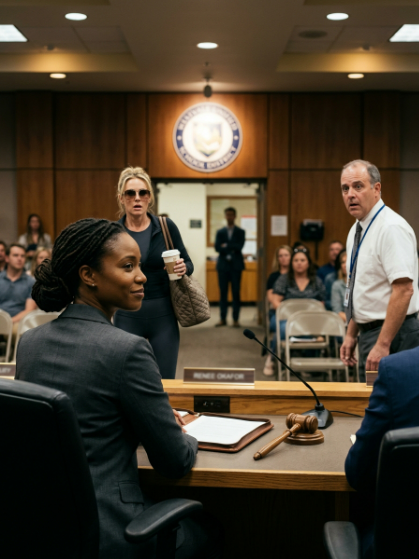
“It was very clear, actually.” I kept my voice even. The prosecutor in me never fully retires. “You reported me to the front office last week for loitering. Mr. Dunphy took the complaint.” I glanced at the clerk, who looked like he wanted to evaporate. “The woman in the dented hatchback you’ve been mocking since August is my daughter’s mother. And as of three weeks ago, the president of this board.”
Brooke’s mouth opened and closed.
“I’m not telling you this to embarrass you,” I said. And I meant it. “I’m telling you because you came here tonight to push a rule about who ‘belongs’ in the pickup loop. And I want every parent in this room to understand how those rules get made, and who they get aimed at.”
I turned to the room.
“Here’s the agenda item Ms. Hadley wanted. A proposal to restrict the pickup loop to ‘verified primary parents’ with windshield placards — a placard you pay for, that requires documentation a lot of our families don’t have. Foster parents. Grandparents raising kids. Working parents who share a car. The ‘nanny’ problem, as it was described to me.”
A grandmother in the third row said, “I pick up my grandbabies every day,” loud enough to carry.
“I know you do, ma’am,” I said. “And no one is going to hand you a form to prove you’re allowed to love them.”
I tabled Brooke’s proposal. Permanently. In its place I opened the floor to what the loop actually needed — a second exit lane and a crossing guard, which we funded that night out of a surplus the previous board had been sitting on.
Brooke didn’t stay for the vote. She gathered her tote and her cold latte and left, heels clicking, the door sighing shut behind her.
I didn’t feel triumphant. I felt tired. There’s no win in watching a grown woman realize she’s been cruel to someone she decided didn’t count.
But the story didn’t end in that chamber.
Two days later, Brooke was waiting by my hatchback at pickup.
No sunglasses this time. No latte. No friends.
“I owe you an apology,” she said. “A real one. Not because you turned out to be somebody. Because I treated you like nobody, and I’d have kept doing it if you’d actually been the nanny.”
That, I didn’t expect.
“That’s the most honest thing you’ve said to me,” I told her.
She nodded. Looked at her own SUV, then back at me. “My son’s father has him every other week. People at this school think we’re the perfect family. We’re not. I think I make other people small so nobody looks too close at me.” She laughed, wet and embarrassed. “Therapy thing. Sorry. You’re not my therapist.”
“No,” I said. “But I am the board president. And I could use parents who tell the truth out loud. Even the ugly kind.”
I didn’t become Brooke Hadley’s friend overnight. Real life doesn’t tie up that clean.
But she showed up to the next meeting. Sat in the front row. Spoke in favor of the crossing-guard budget. And when a newer mom in a beat-up Corolla got side-eyed in the loop that fall, Brooke was the one who walked over and waved her into the line like she’d been there all along.
My daughter asked me later why those ladies used to be mean and now they weren’t.
I told her the truth, the kid version of it.
“Some people decide who matters before they bother to ask,” I said. “And every once in a while, life sits them at a table where they have to find out they were wrong.”
She thought about that the way eight-year-olds do — completely, for about four seconds.
“Is that why you’re the boss of the school now?”
“I’m not the boss,” I said. “I just get to make sure the rules are fair.”
“Same thing,” she said, and climbed into the dented hatchback that, I’ll admit, I have not replaced.
I kind of like what it teaches people to assume.
And I love watching them learn they were wrong.