I Thought My Father Forgot Me FULL STORY
For a moment neither of us moved while the opening swirled on around us, oblivious, glasses clinking, somebody laughing too loud by the door.
Then my father took one step toward me, stopped, and held up the rolled catalog like a small white flag.
“I didn’t think you’d want me to come,” he said. “I’ve gotten good at the back of rooms.”
“You’re R. Stone.” It came out flat. Accusing. “You’ve been buying my paintings.”
“Stone was your grandmother’s maiden name,” he said. “Ruth Stone. I didn’t think you’d sell to Walter Bennett.”
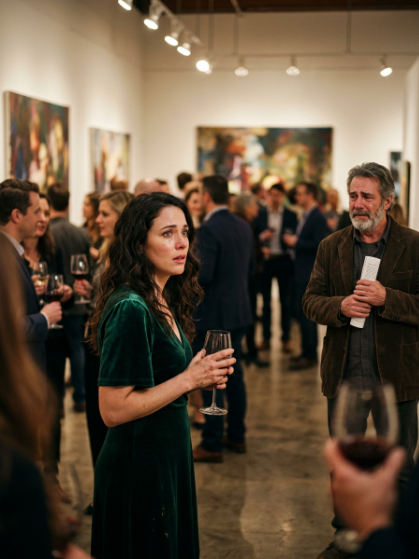
I had a hundred furious questions and they all collapsed into one.
“Why did you leave?”
And right there, by my self-portrait, in front of strangers sipping cheap chardonnay, my father finally answered the question I had built my whole life around.
He didn’t leave the way I was told. Not exactly.
When I was eight, his small contracting business collapsed and took the house with it. The debt was the kind that follows you. My mother, he said, gave him a choice that felt like mercy at the time: disappear, let her file as an abandoned spouse, and the creditors and the courts would chase a ghost instead of touching what little was left for me.
“I signed away the right to be your father on paper,” he said, “so the bank couldn’t take the roof over your head. I thought I was protecting you. I was thirty-six and stupid and scared, and I believed her when she said a clean story would hurt you less than a broken man hanging around.”
“You could have called,” I said. My voice shook. “Twenty-four years. You could have called once.”
“I did,” he said quietly. “Every birthday I called the house. After the third year the number was changed. I wrote letters to an address that started coming back. By the time I had any money again, you were grown, and your mother told me you hated me, and I decided I had lost the right to argue.”
I learned later that part was true and not true. My mother, who I love, who raised me alone and tired, had made a frightened choice of her own and then could not find a way back from the lie. She told me he never called because admitting he had would have meant admitting she had hung up.
We are still untangling that, she and I. Quietly. It is its own slow painting.
“So how did you find my work?” I asked him.
He almost smiled. “A coffee shop in Eugene. Six years ago. There was a group show in the window and one painting stopped me cold. A door, half open, light coming through it. I didn’t even read the name on the card until I’d been standing there ten minutes.”
The door painting. My first sale. I’d made it at twenty-six and told myself it meant nothing.
“It was your hand,” he said. “I’d know it anywhere. You used to draw on the back of my work orders. Same line.”
He bought it that day. Then he set up the Stone name, found a dealer, and quietly bought every piece of mine that came to market for six years. Not to own me. To keep a thread.
“I never hung most of them in a place anyone would see,” he admitted. “They’re in a small apartment in Salem. I just wanted to know where they were. I wanted to be near the part of your life I was allowed near.”
The self-portrait he had asked about, the one not for sale, was a painting of me at eight, from memory, sitting on a front step.
“That’s the year I left,” he said. “I look at that step every day in my head. I wanted to ask if I could buy the one thing I have no right to.”
I did not sell him the painting.
I gave it to him.
We did the careful, unglamorous work after that. DNA, because his name was off every legal document and we both wanted the record clean. It came back the obvious answer. Father.
I did not move him into my life overnight. Twenty-four years does not close like a door; it closes like a wound, slow, with care, sometimes reopening.
But he comes to the studio now on Thursdays. He doesn’t talk much. He sits in the corner in that terrible corduroy jacket and reads while I work, and sometimes he tells me about my grandmother Ruth Stone, who painted too, on butcher paper, because canvas cost money they never had.
The gallery sold out the show. Every piece but two.
The self-portrait went home with my father.
And the door painting, the half-open one with the light coming through, I took down off the wall before anyone could buy it.
I hung it in my own hallway instead, where I see it every morning.
For twenty-four years I thought that door was him leaving.
I finally understand it was always him about to walk back in.