I Followed My Late Wife’s Dusk Trail to a Second Cabin FULL STORY
He said her name again, softer.
“Helen?”
“No,” I managed. “I’m — Daniel. I’m Helen’s husband.”
The word husband did something to his face. Not jealousy. Recognition. As if a piece he’d been missing for a long time had finally clicked into a slot.
“You’re Daniel,” he said. “She told me about you. You build things in the city. You don’t like the cold.”
I gripped the doorframe.
Behind me, footsteps on the trail. A woman came up out of the dark with a basket of firewood, sixties, sharp-eyed, a quilted vest and reading glasses. She saw me and stopped dead, then set the wood down slowly, the way you do when you don’t want to startle anyone in a small room.
“You must be the husband,” she said. “I’m Rosa. I think you’d better sit down.”
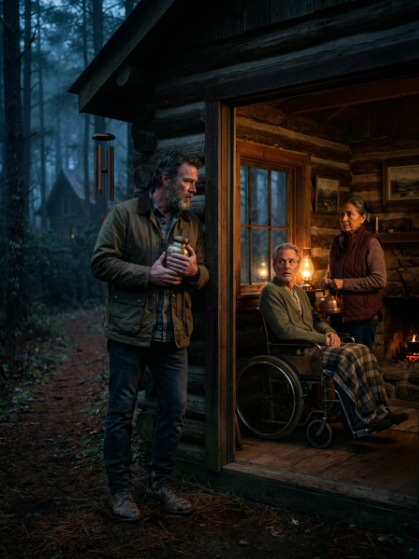
I didn’t sit down.
“Who is he?” I asked. “Whose paintings are those? Why is my dead wife’s lamp lit in a cabin I never knew existed?”
Rosa looked at the old man with a tenderness that answered part of it before she spoke.
“This is Caleb,” she said. “Caleb Wren. He’s Helen’s brother.”
“Helen didn’t have a brother.”
“Helen had a brother for fifty-eight years,” Rosa said gently. “You just weren’t told. Almost nobody was.”
She made tea I didn’t drink, and she told me the rest while Caleb hummed to himself and turned the pages of a paperback he wasn’t reading.
Caleb was the older one. When he was nineteen and Helen was twelve, there was a car accident on a wet road outside Asheville. He survived it. But the Caleb who came home needed a wheelchair and a quiet routine and patience their parents, it turned out, did not have.
They were proud people. Frightened people. Within two years they’d moved him into a state facility three counties over and started telling neighbors he’d “gone to live somewhere better suited to him.” Eventually they stopped mentioning him at all. In the family photographs, there simply stopped being a boy.
Helen never forgave it. She was a child when it happened and could do nothing, and I think the doing-nothing lived in her for the rest of her life.
So when her parents passed and left her a little money, she didn’t buy a bigger house or a trip abroad. She bought this cabin, a hundred yards down a hidden trail from the cottage we already owned. She moved Caleb out of a facility that was closing, hired Rosa, and built him a small, warm, steady world at the end of a path she could reach on foot.
And every evening, rain or clear, she walked down to sit with her brother.
“Just to check on things,” she told me. For fifteen years.
I thought of all those dusks. The mud on her boots. The softness in her face when she came back up the trail. I’d been jealous of it once — that private peace I couldn’t share — and the truth was she’d been spending it loving someone the world had thrown away.
“Why,” I said, and my voice broke on the word. “Why wouldn’t she tell me? I would have helped. I would have built him a ramp with my own hands.”
“She knew that,” Rosa said. “She told me once she didn’t keep it from you because she thought you’d be cruel. She kept it because Caleb spooks around new people, and because she’d promised him one thing the day she got him out.” Rosa nodded at the old man. “That he’d never again be somebody’s secret to be ashamed of. Only somebody’s secret to be protected. She was going to tell you. She kept saying — after the next season, when he’s settled.”
There is no crueler arithmetic than the things people meant to do later.
“The lamp,” I said. “Tonight. It was warm.”
Rosa’s eyes filled.
“I light it at dusk,” she said. “Every dusk. At the time she used to come down the trail. Caleb watches the window for her. He still thinks, some evenings, that she’s just running late.” She wiped her face with the heel of her hand. “There’s a trust. She set it up before she died. It pays me to stay, pays for his care, keeps the cabin warm. You were never meant to find out by accident. There’s a letter for you with the lawyer. I suppose now you’ll get it sooner.”
Caleb looked up from his book then, straight at me, with my wife’s exact gray eyes.
“Is Helen coming Friday?” he asked.
The brass urn was still in my jacket. I’d carried it up the mountain to scatter her and finally be free of the weight.
I sat down across from her brother instead.
“No, Caleb,” I said. “Helen’s not coming Friday. But I’m Daniel. I don’t like the cold. And I’d like to come sit with you, if that’s all right.”
He considered me with great seriousness.
“She said you’d come,” he said. “She said it might take you a while.”
I stayed the night in the second cabin. In the morning I walked back up for my bags instead of my car keys.
I never scattered her on that trip.
It didn’t feel like letting her go anymore. It felt like she’d left me one last thing to hold — a warm lamp, a hidden cabin, and a brother who still watches the window at dusk.
So now I’m the one who lights it.