I Drove to My Dead Wife’s Mountain Cabin to Finally Let Her Go FULL STORY
“She said you’d come on a Friday.”
I knelt there in the snow and tried to make the words mean something.
My wife had been dead for three years. She had never met these children. I was certain of that.
And yet the little girl said Hannah’s name like a prayer she’d been taught.
I got them inside first. That was the only thought my brain would hold. Warm. Inside. Now.
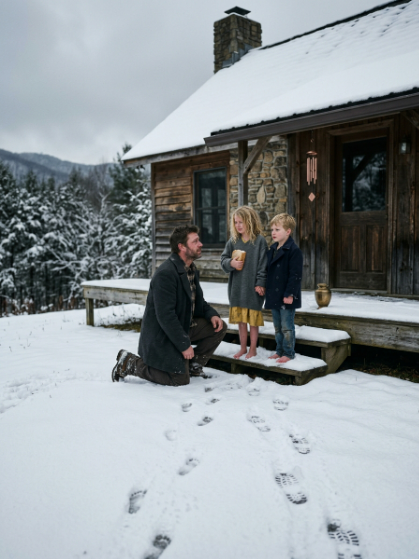
I wrapped them in every blanket the cabin had and built a fire with hands that wouldn’t stop shaking. I heated soup from a can. The boy, Noah, ate like he’d forgotten food was allowed. The girl, Lily, still wouldn’t touch her bread. She set it on the hearth like an offering.
“You can eat now, sweetheart,” I told her. “There’s more. I promise.”
She studied me a long time. Then she ate.
While they slept, I followed the boot prints.
They led from the porch into the treeline, along the trail only Hannah used to walk, down to the old caretaker’s shed I’d forgotten existed. The padlock was broken. Inside: a camp stove, a stack of canned goods, two sleeping bags, and a cardboard box of papers.
On top of the box, in handwriting I would know anywhere, was an envelope.
For Daniel. When you finally come back.
I sank onto an overturned crate and read my dead wife’s letter by phone light.
Hannah had a sister. Robin. Younger, troubled, in and out of bad situations. I’d met her twice, years ago, before she vanished from our lives. I never knew the half of it.
Robin had two kids she couldn’t keep safe. Hannah had been quietly helping for years — money, groceries, a phone she paid for. She’d kept it from me because she knew I’d want to fix it loudly, with lawyers, and she was afraid that would scare Robin into running with the children.
So she handled it the only way she trusted. Softly. Privately.
The last lines of the letter were dated three weeks before the accident that killed her.
If anything ever happens to me, and Robin can’t cope, she knows about the cabin. I told her you’re a good man, even when you’re a stubborn one. I told her you’d come here eventually to say goodbye to me. I told her if it ever came to it, to wait for the man who shows up on a Friday with my ashes. That’s you, my love. That’s always been you.
I don’t remember walking back to the cabin.
I remember standing over those two sleeping children and understanding that my wife had reached three years past her own death to put them in my path.
Robin came back at dawn.
The large boot prints had been hers — a man’s pair, two sizes too big, the only boots she owned. She’d walked the kids to the porch and then walked away, not to abandon them, but because she’d run out of every other option and remembered the one promise her sister made her.
She stood in the doorway, gaunt and terrified, certain I was going to call the police.
“I wasn’t leaving them,” she said, her voice cracking. “I was leaving them with you. There’s a difference. Hannah said there’d be a difference.”
I looked at this woman my wife had loved and protected in secret.
“Come in,” I said. “It’s freezing.”
It wasn’t simple after that. Nothing real ever is.
There were caseworkers. Forms. Hard conversations about what Robin could and couldn’t do. She checked herself into a program two towns over — her idea, not mine. She calls the kids every Sunday. Some weeks she’s strong. Some weeks she isn’t.
But Lily and Noah live with me now. In the cabin Hannah loved.
I kept her copper wind chime on the porch. The kids think it talks to them. Maybe it does.
Lily doesn’t hide bread anymore. She leaves a slice out on the windowsill some nights, though, “for the birds, and for Aunt Hannah.” I don’t correct her.
The first month was the hardest. Noah woke screaming some nights, certain the warm food would be gone by morning. I’d sit on the floor by his bed until he believed me that the kitchen would still be full when the sun came up. Lily watched me do it, every time, like she was deciding whether the world could really be trusted again.
One night she crawled out of bed, padded over in her socks, and put her cold little hand in mine.
“You really came on a Friday,” she whispered. “Just like she said.”
I didn’t trust my voice. I just nodded.
“Was she nice?” Lily asked. “Aunt Hannah?”
“The nicest person I ever met,” I said. “She would have loved you both so much it would’ve scared me.”
Lily smiled at that, the first real smile I’d seen from her, and went back to sleep.
I never got to scatter the ashes that Friday. The urn still sits on the mantel, and somehow that feels right. I came up that mountain to let my wife go.
Instead she handed me the last two pieces of her heart and asked me to keep them warm.
So I will.
For as long as the wind chime sings.