His Footlocker Came Home Without Him FUL STORY
I lifted the first envelope out of the lining, and Scout went quiet.
Just like that. The screaming stopped. He laid his big head down on the canvas, let out one long breath, and watched my hands the way he used to watch the door at the exact minute Eli’s video calls came in.
There were fourteen envelopes, wrapped flat in a square of oilcloth and stitched into the floor of the footlocker with the same neat seam Eli used on his gear so nothing would rattle. He’d sewn them in himself. Quietly. The way you do a thing you pray nobody will ever need to find.
Each one had a name on the front in his careful block print.
Twelve were for Lily.
TO LILY — 7TH BIRTHDAY. TO LILY — 8TH. Nine. Ten. All the way up to her eighteenth.
One said: TO MOM & DAD.
And the last one said: TO HANNAH — READ ME LAST.
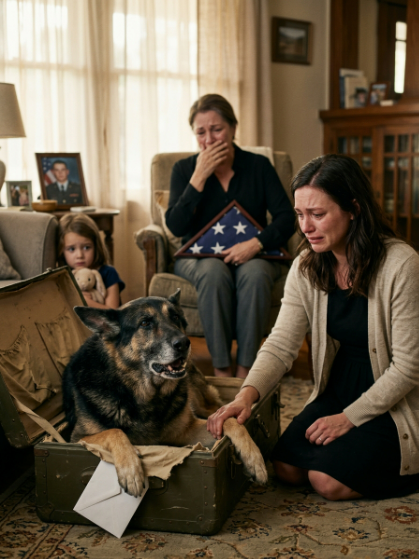
My mother-in-law made a sound and pressed the folded flag to her chest. Lily crept out from behind the couch and stood at my elbow, because children always know when the room has changed weight.
“Are those from Daddy?” she whispered.
“Yeah, baby,” I said. “I think Daddy wrote you some letters.”
I gave her the one that said SEVENTH BIRTHDAY, because she’d turned seven in October, three weeks before the footlocker came home. She couldn’t read all the words yet. I read it to her sitting right there on the rug, with Scout’s chin on the chest between us.
It was not a sad letter. That’s the thing that broke me.
It was Eli being Eli. He told her to be brave but not reckless. To let her mother win at cards sometimes because it made her happy. To watch out for Scout’s hips when he got old. To remember that he loved her in every time zone there was, all at once, even the ones where it was already tomorrow.
He’d written one for every birthday he was afraid he might miss, up to the day she became an adult. He couldn’t be there. So he found a way to still show up — twelve times, one envelope at a time.
The letter to his parents, I gave to Marta unopened. She took it out to the porch and read it alone, and when she came back her eyes were red but her shoulders had come down from around her ears for the first time in three weeks. Whatever he wrote his mother, it set something down that she’d been carrying. She still won’t tell me what it said. I’ve never asked.
I read mine that night, alone, after the house emptied and Lily finally slept.
I won’t share most of it. Some of him is just mine. But he’d written one line near the end that I’ve thought about every day since.
“If you’re reading this, then the worst thing happened, and I need you to know it wasn’t your job to keep me safe — it was mine to come home, and I tried. Live loud. Don’t guard the door. That’s the dog’s job.”
The dog’s job.
That’s when I understood Scout.
He’d been on a hundred video calls. He knew Eli’s voice, Eli’s laugh, the particular way the canvas of his gear smelled. When that footlocker came into the house, it was the last thing on earth that still smelled like the man who left, and the rest of us were about to close it and carry it away.
So the dog did the only job he had left. He kept us from sealing it up before we found what Eli hid for us.
The Army couldn’t tell us how he knew letters were inside. He didn’t. He just knew Eli was in there, somehow, one last time, and he wasn’t going to let us miss him.
Lily is nine now. We’ve opened three of the birthday letters. They live in a cedar box on the mantel, and on the night before her birthday she sets one out without being asked, and we read it together at breakfast. She has started writing him back, in purple marker, and we keep her letters in the same box. A correspondence across a distance neither of us can name.
Scout is grayer in the muzzle. He sleeps by the front door still, out of habit, guarding a man who isn’t coming through it.
But I don’t guard that door anymore.
Eli told me not to. He told me it was the dog’s job.
Some evenings I catch Scout lift his head and look at the door at the old video-call hour, ears up, certain. And for one second I let myself believe he hears something we can’t.
Then he sighs and lays back down, and the cedar box waits on the mantel, one more letter closer to the day my daughter grows up loved by a father who found a way to stay.