Heavy Kid Picked Last Every Field Day FULL STORY
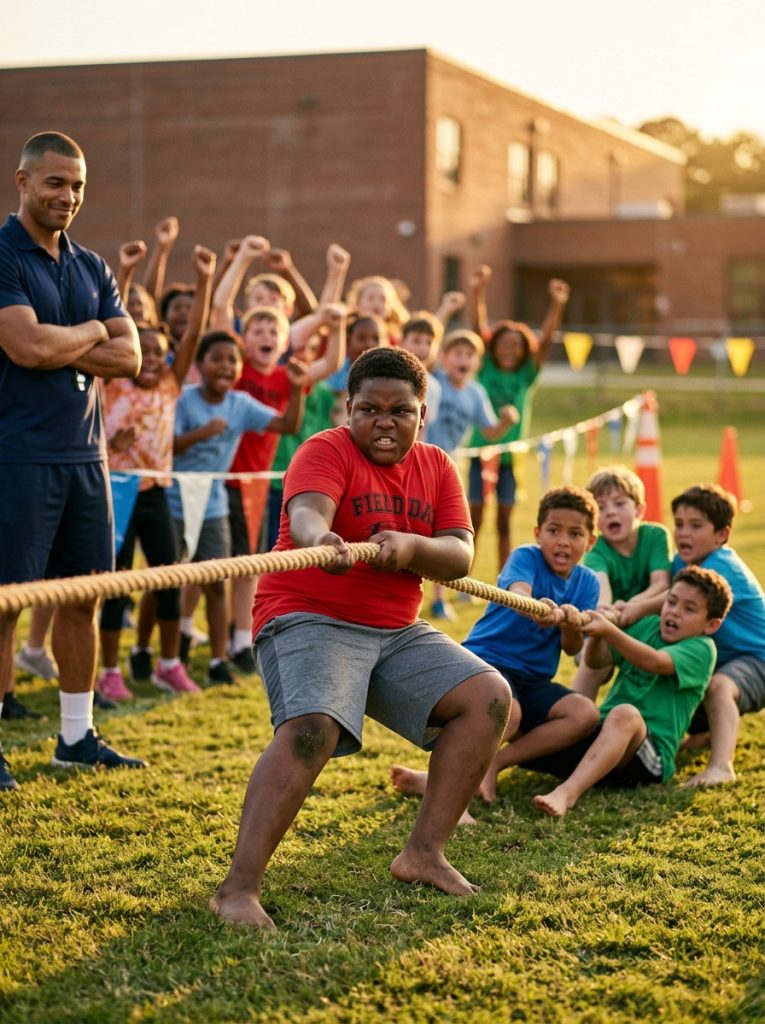
In the final twenty seconds of the Anchor Pull, Tyler tried to throw his entire body backwards onto the rope as a last-ditch hail Mary, and his teammates, exhausted, collapsed in a pile behind him.
The rope went slack.
I held my position because Coach Daniels had told me, in March, that the second the rope goes slack is the second the unprepared anchor falls forward.
The unprepared anchor doesn’t lose the pull.
The unprepared anchor wins the pull and then face-plants in the grass and the crowd remembers the face-plant.
I kept my feet planted.
I kept my hips low.
I let the rope go slack against my chest.
I did not move.
The whistle blew.
The crowd of eight hundred kids on the bleachers of Westview Elementary lost their minds.
I had never heard the gym, or the cafeteria, or the field, sound like that.
I have been at Westview since first grade.
I had never been the noun of a sentence the whole school was screaming.
It was different than I had imagined.
I had imagined I would feel triumphant.
I had imagined I would feel like a different person.
What I felt was small, and warm, and steady.
I felt like the kid who had quietly practiced lowering his hips in his backyard for nine months.
I felt like the kid Coach Daniels had told, in November, that the goal was not to win Field Day.
The goal was to be ready.
If you were ready, the win would take care of itself.
The principal of Westview Elementary, a woman named Dr. Lillian Brooks, had nearly cancelled the new event in April.
She had read Coach Daniels’s proposal and she had worried about liability.
She had worried about a kid getting hurt.
She had worried about a parent calling.
She had been overruled by the school board, after Coach Daniels had presented her with a four-page risk-mitigation plan and the signed approvals of every fifth-grade homeroom teacher.
She had agreed to allow the Anchor Pull, but she had reserved the right, in writing, to “evaluate the event after one cycle and determine its appropriateness.”
She had stood at the edge of the field with her arms crossed for the entire pull.
She had not smiled.
When the whistle blew and the crowd erupted, she did something she had not been planning to do.
She walked across the field to where I was standing on the rope.
She put one hand on my shoulder.
She said, in her clear, small principal’s voice, “Mr. Monroe. Well done.”
She turned to the crowd.
She raised her free hand.
The bleachers went silent.
She said, into the small microphone clipped to her blazer, “I want everyone in this building to remember today. Field Day at Westview Elementary will, going forward, include the Anchor Pull as a permanent annual event. Coach Daniels’s proposal has been adopted as a school standard.”
She turned back to me.
She added, more quietly, only for me to hear, “Elijah. I am very sorry it took until your fifth grade year to find the event for you.”
I did not know what to say to that.
I just nodded.
She squeezed my shoulder once and walked away.
Halfway through Field Day, my mother showed up.
She works as a home health aide.
Tuesdays through Saturdays.
She had explained to me, in the kitchen the night before, that she could not get the day off.
She had told me that if I won a ribbon, she would put it on the fridge that night.
She had not been planning to come.
She had been planning to call her mother in Macon afterward and listen to the recap on the phone.
What I did not know is that Coach Daniels had emailed her at 9 a.m.
He had not said anything dramatic.
He had said only, “Mrs. Monroe, today is Field Day. I think it might be worth seeing in person. If you can come, I will be here at the gate.”
She had read the email at 10:30 in a parking lot during a client visit.
She had clocked out two hours early.
She had driven across town in her work scrubs because she had not had time to change.
She had run from the parking lot in her white nursing shoes.
She arrived at the field at 1:48 p.m.
She arrived in the wrong clothes.
She arrived twelve minutes before the Anchor Pull.
She found Coach Daniels at the gate.
He walked her to the bleachers.
He sat her in the front row.
He did not tell me she was there.
I did not see her until I was on the rope.
I saw her on the third tug.
She was crying with her hands over her mouth.
She was wearing her blue scrubs and her white shoes and she had her hair tied up in the same kerchief she always wore to work.
She did not look like the other mothers in the bleachers.
She did not care.
She did not stop crying for the entire two minutes and seventeen seconds of the pull.
When the whistle blew, she stood up so fast she dropped her phone in the grass.
She climbed down out of the bleachers and ran across the field in her work shoes.
She wrapped both arms around me.
She did not say anything.
She just held me on the field of Westview Elementary in front of half my grade.
I did not pull away.
I held her back.
After the closing assembly, in the back of the parking lot, after the parents had picked up the other kids, after the orange cones had been collected, after the buses had pulled out, Coach Daniels walked over to my mother and me.
He shook my mother’s hand.
He told her her son had a body she should be proud of and a coach who would not be his coach next year because Coach Daniels was a fifth-grade teacher and I was going to middle school.
He pulled a folded piece of paper out of his pocket.
He handed it to my mother.
It was a typed letter on Westview Elementary letterhead.
It was a recommendation, addressed to the wrestling coach at Riverside Middle School, a man named Coach Ortiz, whom Coach Daniels had played football with at Florida State.
The letter recommended that I be invited to try out for the seventh-grade wrestling team a year early.
The letter described, in three paragraphs, what Coach Daniels had observed about my body in nine months of gym class.
The letter used phrases like “elite leverage at sub-thirteen body weight,” “natural low-center mechanics,” and “an unusual capacity to stay calm under sustained physical pressure.”
I did not understand all of it.
My mother read it twice.
Then she pressed it to her chest and cried again.
Coach Daniels said, very quietly, “Eli. I will tell you something I do not tell most kids your age. There are sports that punish bodies like yours. There are also sports that reward bodies like yours. Wrestling is one of the second kind. Boxing is one of the second kind. Powerlifting is one of the second kind. The world is a lot bigger than kickball, son.”
I did not say anything.
I just nodded.
He shook my hand.
He went home.
I did not see him at school again until graduation, two months later, where he hugged my mother in the front of the auditorium and signed my fifth-grade memory book on the back page in Sharpie.
I still have the book.
His note says: “Eli — anchors don’t move. Coach D.”
I tried out for the seventh-grade wrestling team at Riverside Middle School the following August, as a sixth-grader, with Coach Daniels’s letter in my hand.
Coach Ortiz read the letter.
He looked at me.
He had me drill takedown defense for fifteen minutes.
He smiled the smile of a coach who is realizing he has just been handed something useful.
He put me on the team.
I wrestled at 195 pounds as a sixth-grader against eighth-graders in my first season.
I went 14-3.
I qualified for the regional tournament.
I did not win regionals.
I placed fourth.
I came home with a medal anyway.
My mother put it on the fridge next to the ribbon from Field Day.
The ribbon was from a fifth-grade Anchor Pull.
The medal was from a regional middle-school wrestling tournament.
Two pieces of metal that, taken together, told the entire story of the kid who used to be picked last.
I am in eighth grade now.
I weigh 224 pounds.
I am the team captain.
I have a 22-1 season record going into regionals next month.
College recruiters do not come to eighth-grade matches.
That is fine.
I do not need them yet.
I have a kid in fourth grade at Westview, a chubby quiet kid named Jamarcus, who his older sister tells me is the kid the captains never pick.
I drove with my mother to Westview last Field Day.
I asked Coach Daniels if I could anchor a demonstration round of the Anchor Pull.
He said yes.
He let Jamarcus stand next to me at the rope.
He let Jamarcus put his hands on the rope just behind mine.
He did not let Jamarcus take any of the strain.
He just let Jamarcus be on the rope, with me, in front of the entire fifth grade, while five eleven-year-olds tried and failed to pull us across the line.
When the whistle blew, I crouched down to Jamarcus’s level.
I said the same thing Coach Daniels had once said to me.
I said, “Buddy. Your body is not a problem. Your body is a weapon nobody has bothered to teach you how to hold yet. Find your coach. He’s already looking for you.”
Jamarcus did not say anything.
He just nodded once.
His mother was crying in the bleachers.
Coach Daniels was at the edge of the field, arms crossed, half a smile.
He nodded at me from across the grass.
He did not need to say anything.
I nodded back.
Anchors do not move.