He Chose Our Future Over My Brothers, So I Let Him See What He Lost
PART 3 (FULL STORY)
Derek lowered the phone slowly.
“What did you tell my mother?” he asked.
“Nothing,” I said. “I told you, I didn’t call her.”
He covered the microphone and looked at me.
“She says you called off the wedding.”
“I did.”
“She says she heard you’re keeping the twins.”
“I am.”
His eyes narrowed.
“Then why is she asking me why I didn’t know this sooner?”
I almost laughed, but there was nothing funny about it.
Because that was the problem with Derek.
He had known.
He had simply chosen not to listen.
He had been there when my parents died. He had sat beside me in the hospital while Eli and Finn were treated for their injuries. He had held my hand when I signed the guardianship papers.
He knew exactly what had happened.
What he hadn’t understood was that grief didn’t come with an expiration date.
Neither did family.
Derek ended the call and stared at the folder between us.
“What is this supposed to prove?”
“That I didn’t throw away our future.”
“You did.”
“No. You gave me a choice between the man I loved and the children who had already lost everything.”
His jaw tightened.
“And you chose them.”
“Yes.”
He leaned back.
“So that’s it?”
“No,” I said. “That’s the part you still don’t understand.”
I opened the folder again.
“You didn’t lose me because my brothers needed a home.”
He looked at me.
“You lost me because you were willing to make five-year-old children pay the price for keeping yours.”
For the first time since we had sat down, Derek didn’t have an answer.
I pushed the papers toward him.
The first page showed our original wedding budget.
The second showed the deposits I had canceled.
The third showed the house we had planned to buy.
Then came the medical expenses, the guardianship costs, the therapy bills, and the payments I had made while trying to keep everything stable for Eli and Finn.
Derek read them in silence.
“You paid for all of this yourself?”
“Most of it.”
“Why didn’t you ask me?”
“Because you offered to help.”
“I would have helped.”
“You did.”
He looked up.
“I brought groceries.”
“You did.”
“I helped with paperwork.”
“You did.”
“I was there.”
“You were.”
I closed the folder.
“And then you realized being there meant more than carrying groceries.”
His face hardened again.
“I wasn’t prepared to become a father at twenty-two.”
“I never asked you to become their father.”
“You expected me to live with two children for thirteen years.”
“I expected you to decide whether you could love the woman you claimed to love without demanding that she abandon her family.”
He looked toward the window.
Outside, people moved between tables, carrying coffee and breakfast plates, completely unaware that our entire relationship had ended over a conversation that would probably have sounded impossible to them.
Derek finally said, “My mother thinks I made a mistake.”
“She may be right.”
“She says your brothers are family.”
“They are.”
“She says my father would be ashamed if I married a woman who abandoned her own family.”
I looked down at the table.
“That isn’t why I wanted her to call you.”
He looked back at me.
“I didn’t ask her to.”
“Then who did?”
I paused.
“Your mother called me last night.”
Derek stared.
“She wanted to know what happened.”
I remembered that conversation clearly.
She had cried when I told her about the ultimatum.
Not because the wedding was ending.
Because she had once raised a son who used to spend every Saturday morning helping his younger cousins build blanket forts in her living room.
She had asked me whether Derek had really said what I claimed.
I told her exactly what he said.
Then she asked me one question.
“What would you have done if they were his brothers?”
I didn’t answer.
I didn’t need to.
She understood.
And that was why she called him that morning.
Not to punish him.
To make him hear what he had refused to hear from me.
Derek rubbed both hands over his face.
“I was scared.”
“I know.”
“I thought our life was disappearing.”
“I know.”
“I wanted one thing that was ours.”
“So did I.”
He looked at me.
“Then why does it feel like you don’t care about us anymore?”
“Because there is no us anymore.”
He flinched.
I hated seeing it.
But I had learned something during the weeks after my parents died.
Sometimes loving someone didn’t mean saving the relationship.
Sometimes it meant refusing to let their fear become your responsibility.
Derek sat there for another few minutes.
Then he asked, “What happens to the wedding?”
“It’s canceled.”
“The deposits?”
“I canceled them.”
“The house?”
“I walked away.”
“The trips?”
“Canceled.”
He nodded slowly.
“And the future?”
I looked at him.
“You’re going to have one.”
He seemed surprised.
“So are Eli and Finn.”
He lowered his eyes.
“I didn’t mean for any of this to happen.”
“I believe you.”
That seemed to hurt him more than anger would have.
Because I wasn’t calling him a monster.
I wasn’t trying to destroy him.
I was simply accepting that he had shown me something important about himself.
We left the restaurant separately.
I drove home with the folder on the passenger seat.
When I opened the front door, I found Finn sitting on the floor surrounded by toy cars.
Eli was at the kitchen table drawing something with a blue crayon.
They both looked up.
“Did you get Derek back?” Eli asked.
I took off my coat.
“No.”
Finn’s face fell.
“Is he still mad?”
I knelt beside them.
“He isn’t mad at you.”
“Then why did he leave?”
I thought about all the complicated answers I could give a five-year-old.
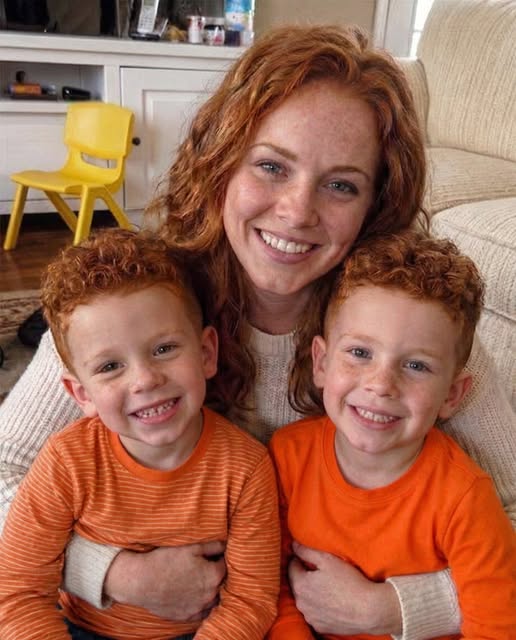
Instead, I gave them the truth they could understand.
“Sometimes grown-ups want different things.”
Eli studied my face.
“Are you sad?”
“Yes.”
He reached across the table and took my hand.
“But we’re here.”
I squeezed his little fingers.
“Yes.”
Finn climbed into my lap.
For several minutes, none of us said anything.
Then he whispered, “Are we staying here?”
I looked around the house.
My parents had chosen the blue curtains in the living room.
My mother had painted the little stars above the twins’ bedroom doors.
There were photographs on the hallway wall from birthdays, vacations, school plays, and ordinary Sunday mornings that suddenly felt more precious than anything I had ever owned.
“Yes,” I said.
“We’re staying.”
The months that followed were difficult.
There was no magical recovery.
I still had bills.
I still had paperwork.
I still woke up some mornings expecting to hear my mother’s voice downstairs.
Eli had nightmares for a while.
Finn became afraid whenever someone drove too fast.
We went to therapy.
We learned how to talk about our parents without pretending we weren’t hurting.
I learned how to be a guardian.
How to pack lunches.
How to remember appointments.
How to sign school forms.
How to braid hair badly enough that Finn laughed every time I tried.
I learned that raising children was not a single heroic decision.
It was hundreds of small ones made every day.
Some were exhausting.
Some were boring.
Some were beautiful.
And none of them felt like a sacrifice.
About six months after the wedding was canceled, I received an envelope from Derek.
I almost threw it away.
Instead, I opened it.
There was no dramatic confession.
No request to take him back.
Just a short letter.
He apologized.
Not for losing me.
For making me choose.
He wrote that he had spent months thinking about the night in my kitchen and finally understood that the choice had never really been between him and my brothers.
It had been between the kind of man he wanted to become and the kind of man he had been willing to be.
He said he had chosen badly.
I folded the letter and put it away.
I didn’t respond.
Not because I hated him.
Because I didn’t need anything from him anymore.
A year after my parents’ accident, Eli and Finn started kindergarten.
I stood outside their classroom on the first morning, watching them walk through the doorway with oversized backpacks.
Finn turned around.
“Are you coming?”
“I’m right here.”
He nodded and ran inside.
Eli stopped beside him.
He looked back at me and smiled.
Then they disappeared into the classroom.
I stood there for another moment.
A year earlier, I had been twenty-two years old, planning a wedding and imagining the life I thought I wanted.
Then one phone call destroyed it.
At first, I thought that meant my life had fallen apart.
I was wrong.
Some things had ended.
The wedding ended.
The relationship ended.
The future I had planned ended.
But my family remained.
And every evening when I came home, there were two little boys waiting at the door.
One afternoon, years later, I found the two dinosaur and rocket-ship cups from that night still sitting in the back of a kitchen cabinet.
The dinosaur cup belonged to Eli.
The rocket ship belonged to Finn.
They were scratched now, faded from years of washing, but I couldn’t bring myself to throw them away.
I set them on the counter and smiled.
Then I heard the front door open.
“I’m home!” Eli shouted from the hallway.
Finn’s voice followed.
“Me too!”
I picked up the two old cups and carried them toward the sink.
For a moment, I thought about that night in the kitchen when Derek had told me to choose.
I had thought he was asking me to decide between two futures.
He wasn’t.
He was asking me whether I was willing to abandon the only family I had left.
And the answer had never been difficult.
I filled the dinosaur cup with water and handed it to Eli.
Then I filled the rocket-ship cup and handed it to Finn.
They drank, argued over whose cup was bigger, and ran back down the hallway.
I watched them go.
Then I turned off the kitchen light.
The house was noisy again.
It was messy again.
It was ours again.
And for the first time since that terrible phone call, it felt like home.