He Came to Scatter His Wife’s Ashes FULL STORY
The second room was a small back bedroom, and on the cot was a made-up bed nobody had slept in for a while, and a woman’s coat folded over the chair.
It wasn’t Marian’s coat. My wife had been gone three years.
This coat was newer. A woman’s. And on the nightstand, a prescription bottle, the label run through with damp, and a paper-clipped stack of notes in handwriting I didn’t know.
I came back out to the boy.
“What’s your name?” I asked.
“Sam,” he whispered.
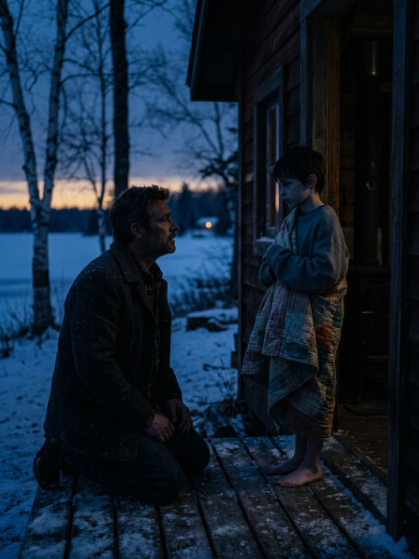
“Sam, where’s your mom now?”
He pointed, not at the woods this time, but at the floor. At the cabin itself. At a closed door I hadn’t opened.
I told him to wait by the stove. I went and looked.
I won’t put the worst of it on this page. She was gone. She had been gone for some time. The cold had kept the cabin still, the way the cold does up there.
Her name, I’d learn, was Dana Mercer. Marian’s younger sister — the one the family stopped speaking of after the bad years, the addiction, the disappearances. The one my wife drove “to go check on” so many weekends I lost count and stopped asking.
I thought Marian had been visiting a grave. She’d been visiting a sister. And a nephew I never knew I had.
I called it in from the one spot on the porch with a single bar of signal. Then I sat on the cold boards and held that little boy until the county trucks came grinding up the road with their lights turning.
The deputy was kind. He took my statement at the counter the next morning. That’s where I started this story, slid that clipboard across, asked me when I last saw Dana alive.
Never, I told him. I never even knew her name.
Here is the part I can’t put down.
The coroner said pneumonia. Said it had been weeks. Said that with a doctor, with a warm room, with one phone call at the right time, she’d have lived.
One phone call.
So I drove around the lake to the only other house with a light. Earl Vance. Sixty-some, lived there year-round.
He opened the door halfway and wouldn’t meet my eyes.
“I saw the smoke,” he admitted, before I even asked. “Chimney going at that cabin, day and night. Knew somebody was in there. Saw a kid at the window once.”
“You saw a child,” I said, “at a window, all winter, and you didn’t call anyone.”
He looked at his boots. “Didn’t want to get in the middle of it. Figured it wasn’t my business. Figured somebody else would.”
There was nobody else. That was the whole point of that lake. That was why she chose it.
I wanted to put my fist through his door. I didn’t. He was already living in the consequence — a man who would hear that admission in his own voice every night for the rest of his life. The law had nothing to charge him with. Silence isn’t a crime. It just acts like one.
I took Sam home with me.
It wasn’t simple. There were caseworkers and a judge and weeks of paperwork, a guardianship petition, a stranger from the state asking a nine-year-old careful questions in a careful voice.
But I had something that turned out to matter. In Marian’s things, in a drawer I’d never been able to bring myself to empty, was a folder. My wife had been quietly trying to get custody of Sam for over a year before she died. She’d already started the paperwork. She’d already chosen us.
She just never told me, because she knew I was drowning in my own grief, and she wanted to wait until she had good news instead of a hard ask.
She ran out of time. The wet road on Route 9 took the rest.
So I finished what she started.
Sam came to live in the house that had been too quiet for three years.
It was hard at first. He saved food. I’d find dinner rolls hidden in his coat pockets, under his pillow, the instinct of a kid who learned the hard way that the next meal isn’t promised. I never made a thing of it. I just kept the kitchen full and let him learn, slow, that it would stay that way.
He still doesn’t talk much. But he sleeps through the night now. He laughs at cartoons. He started fourth grade in the fall and brought home a drawing of a house with smoke coming out of the chimney, and two people standing out front, and I had to leave the room.
We drove back up to the lake once, in the spring, when the ice was gone.
I scattered Marian’s ashes off the end of the dock, finally, like I’d come there to do.
Sam held the urn for me. He said, “Aunt Marian was the one who brought us the bread.”
I said yes. Yes, she was.
We don’t speak to Earl Vance. His light is still on across the water. I see it some nights from the dock.
I used to think the saddest thing in the world was a quiet house.
Now I know it’s a chimney with smoke pouring out of it, and a child in the window, and a man close enough to see them both — who decided it wasn’t his to care.
Sam calls me Tom. Someday, maybe, he’ll call me something else.
I’ll wait as long as it takes. I’ve learned how to wait.
I just wish his mother had had someone willing to make one phone call.
One. That’s all it would have taken.