Grandpa Died Believing He Lost Everything FULL STORY
The rest of the letter is the reason I’m not angry the way you’d expect me to be.
Grandpa Walter knew what his brother had done within a year of it happening. An old fishing friend worked at the county recorder’s office, saw the transfer come through, and quietly made him a copy. The forged signature. The filing date. All of it.
He had the proof in 1991.
He never used it.
Not because he was weak. Because of Beth.
Raymond’s daughter. My cousin. She was four years old that summer, and she spent every July at that lake house, and she loved my grandfather like a second father. Walter wrote that if he dragged Raymond into a courtroom, he’d be dragging a little girl through the wreckage of her own family’s name.
He couldn’t do it.
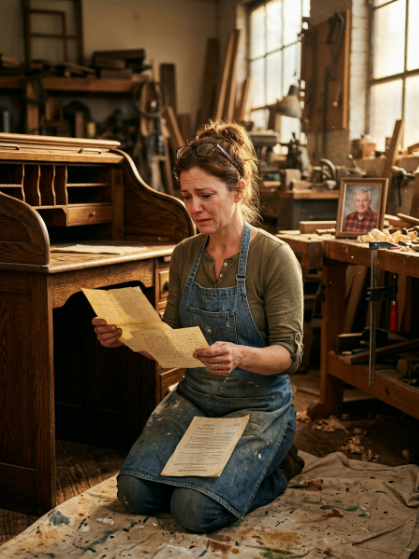
“I decided I would rather be the brother who lost everything,” he wrote, “than the great-uncle who took a child’s whole world just to be proven right.”
So he let the lie stand. He let the relatives whisper “gambler” at every funeral and every Christmas. He grew quiet and small, and he carried it for thirty years, so that a four-year-old could keep her summers on the water.
Beth is forty-three now. Raymond died six years ago.
And she has no idea any of this ever happened.
I sat with that letter for a week before I did anything at all.
Then I took it to a real-estate attorney here in town, a careful woman named Priya who handled the pages like they might go off in her hands. She pulled the county records. She compared the signatures under a loupe. She found the 1991 transfer exactly where Grandpa said it would be.
“The deed is genuine,” she told me. “The transfer behind it is almost certainly fraudulent. If you wanted to, you could challenge the ownership of that house. You’d probably win.”
“And Beth?”
Priya was quiet a moment. “She’d lose her home. She was a child when it happened, so she’s innocent of the fraud. But the law doesn’t grade on innocence. If you push, she’s the one who pays.”
Legally, none of it mattered.
I thought about my grandfather choosing a little girl over his own good name. I thought about what kind of woman I’d be if I undid the one mercy he spent his whole life paying for.
I drove out to the lake house on a Sunday.
Beth answered the door in gardening gloves, surprised and warm, and made me coffee on the same porch where Walter used to sit and watch the light go down. I almost lost my nerve right there.
Then I set the deed and the letter on the table between us.
I told her everything. The forged transfer. The thirty years of silence. The reason behind it.
She read the letter twice. By the second time she was crying so hard she couldn’t hold the page steady.
“He let everyone call him a gambler,” she whispered. “He let my father take all of this. For me?”
“For you,” I said.
She looked out at the water her father had stolen, and for a long time she didn’t say anything at all.
She didn’t fight me. That’s the thing. She didn’t defend Raymond, and she didn’t make excuses, and she didn’t ask me to keep it quiet.
She drove to the county office with me herself the very next week. We filed the truth into the record — not to throw anyone out of anything, but so that Walter Caldwell’s name would no longer sit in that file beneath a lie.
And then Beth and I did the thing I think Grandpa was actually hoping for.
We put both our names on the deed.
The lake house belongs to the Caldwells again. All of us. The way it was always supposed to. Beth still lives there. I have a key, and a room, and a standing invitation every July.
At Thanksgiving, the relatives who used to whisper “gambler” went very quiet when Beth stood up at the table and told them, in her own words, what her father had done and what my grandfather had chosen instead.
Some of them still won’t quite meet my eyes. That’s all right. The truth doesn’t need everyone to clap.
But that’s not the part that stays with me.
The part that stays with me is that Walter Caldwell died last winter still believing he was the man who lost everything. He never heard his name cleared. He never saw Beth weep over his handwriting. He carried the whole weight, all the way to the end, alone — because he loved a child more than he loved being right.
I finished restoring the desk. The tambour rolls smooth now. The bad leg is solid. I gave it to the lake house, and I hung his photograph on the wall above it.
Sometimes in the evening, with the lake going gold, I sit there and slide that little hidden compartment open, just to watch it come out empty.
He hid the truth in the one place only love would ever think to look.
And in the end, love looked.