Frail Elder Carried Through Blackout FULL STORY
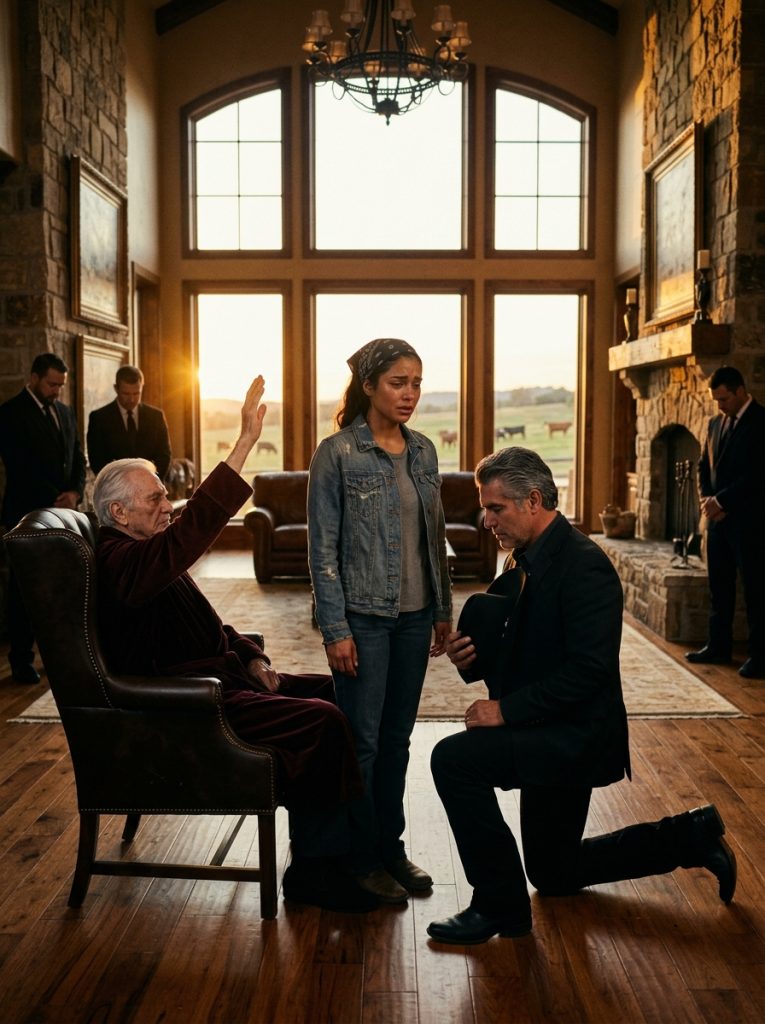
Don Emilio Vargas bent one knee on my doorstep, and I forgot how to breathe.
In Texas, you don’t see a Vargas bend his knee. Ever. The Vargas family has been running cattle empires and political machines since before Texas was a state. I’d seen pictures of Don Emilio shaking hands with presidents. I’d read articles about his charity foundations, his land holdings, his influence that stretched from El Paso to the Gulf.
And now he was bowing to me.
A soup-kitchen volunteer from the south side of Dallas.
“Please,” I managed to say. “Please stand up. I don’t — I don’t understand.”
Don Emilio rose slowly, replacing his Stetson on his head with the same deliberate grace he’d used to remove it. His eyes — dark and sharp and carrying the weight of a dynasty — held mine without blinking.
“My father has been testing the hearts of this city for forty years,” he said. “He dresses in plain clothes. He rides public buses. He collapses in stairwells to see who will stop. In four decades, four people have stopped. You’re the fifth.”
“And the others?”
“One became a state senator. One runs my logistics operations. One received a scholarship that put three generations of her family through college.”
He paused.
“The fourth is buried in the family cemetery with a headstone that reads ‘Beloved Daughter.'”
I felt tears I didn’t know I’d been holding start to fall.
“Camila Reyes,” he continued, “what do you want? Not what do you need — what do you want?”
No one had ever asked me that question.
I thought about the food bank where I’d volunteered for six years. The shelves that were always half-empty by the third week of the month. The mothers who came in pretending they were just “browsing” when really they were hoping nobody would notice them taking extra canned goods. The children who ate their free lunches so fast I knew they hadn’t eaten since the day before.
“I want the food bank to never run out,” I said.
Don Emilio smiled. It was the first time I’d seen him smile, and it transformed his face completely — the steel softened into something that looked almost like pride.
“Done.”
“Just like that?”
“Just like that. But that’s not what I asked. I asked what you want. For yourself.”
I looked past him at the black SUVs filling my street. At the men in suits who were now standing at attention. At my own apartment building — the cracked stucco, the broken intercom, the window that wouldn’t close all the way.
“I want my daughter to go to college,” I said quietly. “Isabella. She’s eight. She’s brilliant. She’s been reading at a sixth-grade level since she was six. And I’ve been saving for four years and I still don’t have enough for one semester.”
Don Emilio’s expression didn’t change, but something in his eyes shifted.
“Isabella Reyes will receive a full scholarship to any university in the United States she wishes to attend,” he said. “Tuition. Room. Board. Books. All of it. From kindergarten through her doctoral degree, if she wants it.”
I broke.
Right there on my doorstep, in front of a mafia don and his entire security detail, I broke down and cried.
Don Emilio waited.
When I finally composed myself, he reached into his jacket and pulled out a small black card. No name. No title. Just a phone number in gold lettering.
“You call this number if anyone ever threatens you, your daughter, or anyone you love,” he said. “And every Vargas from here to the Gulf will answer.”
I took the card with trembling fingers.
“Why?” I asked. “I just carried an old man up some stairs. Anyone would have done it.”
“No,” Don Emilio said quietly. “They wouldn’t. That’s the point.”
He tipped his hat one final time, turned, and walked back to his SUV.
Six months later, the South Dallas Community Food Bank received an anonymous donation of two million dollars. The shelves have been full ever since. Isabella started at a private academy that fall, and when she came home with her first report card — straight A’s — she looked at me and said, “Mama, who was that old man you helped?”
I told her the truth.
“Someone who needed to see that kindness still exists.”
And every night, before I go to sleep, I look at the black card on my nightstand and remember that one small act of compassion can echo across generations in ways you never expect.