For Nineteen Years This Town Called My Father a Thief FULL STORY
I sat on that dusty mill floor until the rain stopped and the recorder clicked off.
Then I rewound it and listened to the rest, because Gil Trask wasn’t finished confessing.
“The proof’s behind the payroll ledgers,” his voice said. “Bottom of the fireproof box in the records room. I kept the second set of books and the withdrawal slip with my own name on it. Couldn’t bring myself to burn it. Couldn’t bring myself to use it either. I’m sorry, Nora. I knew your daddy was a good man. That’s what made it easy to let him take it.”
I found the records room at the end of the hall.
The fireproof box was exactly where a dying man’s voice said it would be, under nineteen years of ledgers nobody had touched.
Inside: a second set of books, and a yellowed bank withdrawal slip for forty thousand dollars. Gil Trask’s signature. Dated three days before the payroll “disappeared.”
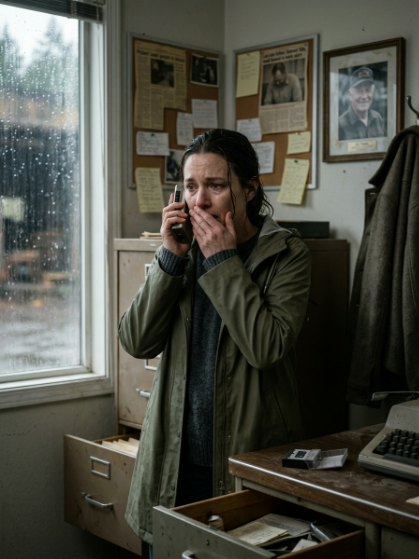
My father had been telling the truth the whole time. And the only man who could prove it had chosen silence right up until the silence followed him into the ground.
I drove to the county sheriff’s office the next morning with the tape, the recorder, the slip, and the second ledger in a grocery bag.
The deputy who took my statement was young enough that the Pickett scandal was just a story his parents told. He listened to the tape twice. Then he made calls.
The bank confirmed the withdrawal slip. A forensic accountant the county brought in confirmed the second ledger. Within a month, the state formally cleared my father’s name. The official record now says what I always knew: Samuel Pickett never stole a dime.
It should have felt like winning.
It felt like standing at a finish line alone.
Because my father died two years ago in a rented room, still flinching when people in town went quiet around him. He never got to hear Gil’s voice say it. He never got to walk back into Ash Fork with his head up.
The town, to its credit, didn’t hide.
The same diner that convicted him hung a small framed copy of the correction by the register. The mill families who’d crossed the street to avoid us wrote letters. One old woman, Edith Mara, drove to my motel just to take my hands and say, “We were wrong about your father, and I helped spread it, and I’ve carried that a long time.”
I didn’t know what to say. So I just let her hold my hands.
The hardest visit was the cemetery two counties over, where we’d buried Dad cheap because it was all we could afford.
I brought the recorder. I felt foolish doing it.
I played Gil’s confession out loud to a granite marker with the wrong story implied in every blank space around his name.
“You were right,” I told him when it finished. “Everybody finally knows. I’m sorry it took so long. I’m sorry you’re not here.”
The wind moved the grass. That was all the answer I got. Sometimes that’s all there is.
I had Dad’s stone replaced. The new one has his name, his dates, and three words I chose myself: A HONEST MAN. The carver pointed out the grammar. I told him to leave it. My father would have laughed at the mistake and kept it forever, and that felt more like him than anything correct ever could.
There’s one more thing.
Gil Trask had a granddaughter, Casey, who never knew any of this. She found me after the story made the regional news, terrified I’d come for the family or the little money they had.
I told her the truth: I didn’t want a cent.
“Your grandfather did a cowardly thing,” I said. “And at the very end, he did a brave one. He could have taken it to the grave clean. He chose to leave a tape with my father’s name on it where someone would find it. He wanted it fixed, even if it cost him every good thing this town ever thought about him.”
Casey cried. I held onto her the way Edith had held onto me.
Two families, wrecked by the same secret, sitting in a mill parking lot in the rain.
I keep the cassette now. Not to play. Just to hold sometimes.
It’s a small, ugly thing — masking tape and shaky ballpoint and a man’s last attempt to be decent nineteen years too late.
But it’s the sound of my father getting his name back.
And on the bad days, when I’m angry the truth waited until everyone who needed it most was gone, I remember the one mercy in all of it.
A coward, alone and dying, still reached for the truth.
Late is not the same as never. I have to believe that. It’s the only way I get to keep loving both of them.