For a Year He Screamed at Me and Left Cruel Notes FULL STORY
The man in the corner booth folded his newspaper, stood, and walked to the counter like he’d been waiting all night for the right moment.
I’d seen him for months. Charcoal overcoat, wire glasses, one black coffee, always the booth by the window. He never complained. He always tipped like the bill was a suggestion. I’d assumed he was a retired teacher, or somebody’s lonely uncle.
He stopped beside Hal and looked at the cigar box on the counter.
“May I?” he asked me.
I nodded.
He opened the lid. Hal flinched like the napkins might bite.
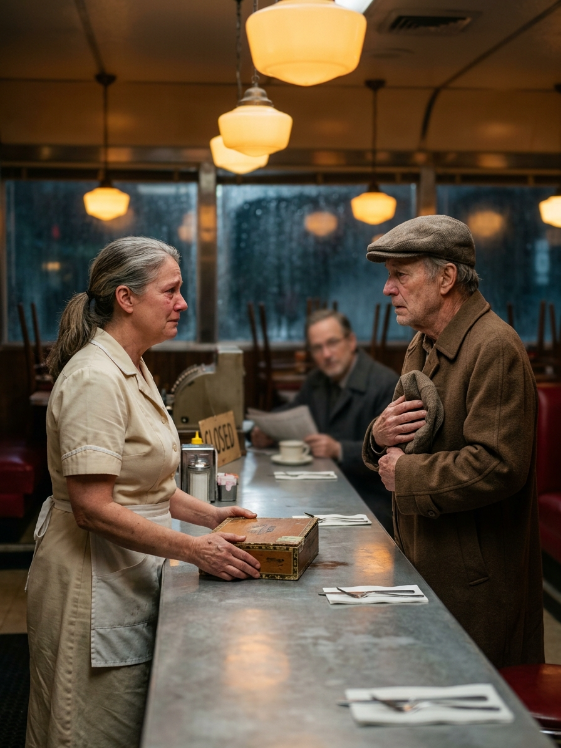
The man lifted the top one out, read the cruel side, then turned it over and read what I’d written on the back. Then the next. Then the next. His face did something quiet and complicated.
“‘Grateful the heater held,'” he read softly. “‘Grateful Mrs. Alvarez tipped in quarters and a hug.'” He looked up at me. “You wrote a gratitude on the back of every unkind thing this man handed you.”
“My son started it,” I said. “Before I lost him. He had a hard couple of years at the end, and he said the only way he got through was deciding what to write on the back of the bad days.” My voice caught. “Keeping Hal’s notes was how I kept practicing it. Wasn’t about Hal, really. I’m sorry, Hal. It was about me not going hard inside.”
Hal was crying openly now, cap crushed in both hands.
“My Eleanor died in April,” he said. “Forty-one years. I didn’t know how to be in a house that quiet. So I came here every night and I was awful to the one person who kept feeding me, because you were the only thing that felt like it was still going. That’s no excuse. There isn’t one. I’m so sorry.”
I came around the counter and I hugged him. Sixty-seven years old and he shook like a boy.
The man in the overcoat waited until Hal could breathe again. Then he held out his hand to me.
“Theo Avery,” he said. “I owe you an explanation for staring at you for three months.”
“I figured you were just a regular.”
“I am now.” A small smile. “But I came the first time because a friend told me the Bluebird had the best night waitress in the valley, and I’m opening a place in Scranton in the spring. A real one. Tablecloths, the works. I’ve been quietly interviewing for a floor manager by watching people work when they don’t know it counts.”
I laughed, the kind of laugh that’s mostly disbelief. “You’ve been auditioning me.”
“For three months,” he said. “And tonight I watched a woman get a year of cruelty handed back to her and respond by showing the man his own grief, gently, with a box she filled with thank-yous.” He set a card on the counter. “I’m not looking for someone who can carry plates. I can teach that. I’m looking for someone who knows what to write on the back of a bad night. The job is yours, if you want it. Salary, benefits, a say in the menu.”
The Bluebird was closing because the owner was retiring and nobody could afford to buy it. I’d been lying awake for weeks wondering what a forty-nine-year-old waitress does next in a town with one diner.
I picked up the card. My hand wasn’t quite steady.
“I want it,” I said.
We didn’t make a fuss. We’re none of us fuss people. Theo shook my hand again, told me to call Monday, and went back to his booth to finish his coffee like the whole thing was ordinary.
Hal lingered while I flipped the last chairs up.
“What happens to the box?” he asked.
“I keep it,” I said. “It’s full. But I’ll start a new one at the new place.”
He nodded. Then, careful, like he was asking for a lot: “Could I be in the new one?”
I understood what he meant. Not the cruel notes. He was asking if he could be a regular somewhere I’d be. If he could try being a person again, near someone who’d seen his worst and hadn’t thrown it back.
“Booth by the window’s yours,” I told him. “But you tip Mrs. Alvarez’s granddaughter right, you hear? She’s starting as a busser.”
He laughed, wet and surprised, the first real laugh I’d ever heard out of him.
Theo’s place opened in April, a year to the week after Eleanor died. I run the floor. I hung one thing on the wall by the register, small, where only the staff really notices it: a single napkin, cruel side to the wall, gratitude side out.
“Grateful the heater held through the storm tonight.”
Hal comes Tuesdays and Fridays. Booth by the window. He orders the special, whatever it is, and he never sends it back. Some nights he brings a paperback. Some nights he just watches the rain and the room and the lights, and I catch him looking like a man who decided, late but not too late, what to write on the back.
I lost my son and I lost my diner.
But I learned the thing he tried to teach me before he went.
You can’t always choose what people hand you across the counter.
You can always choose what you write on the back.