Fired for Bringing My Son to Work FULL STORY
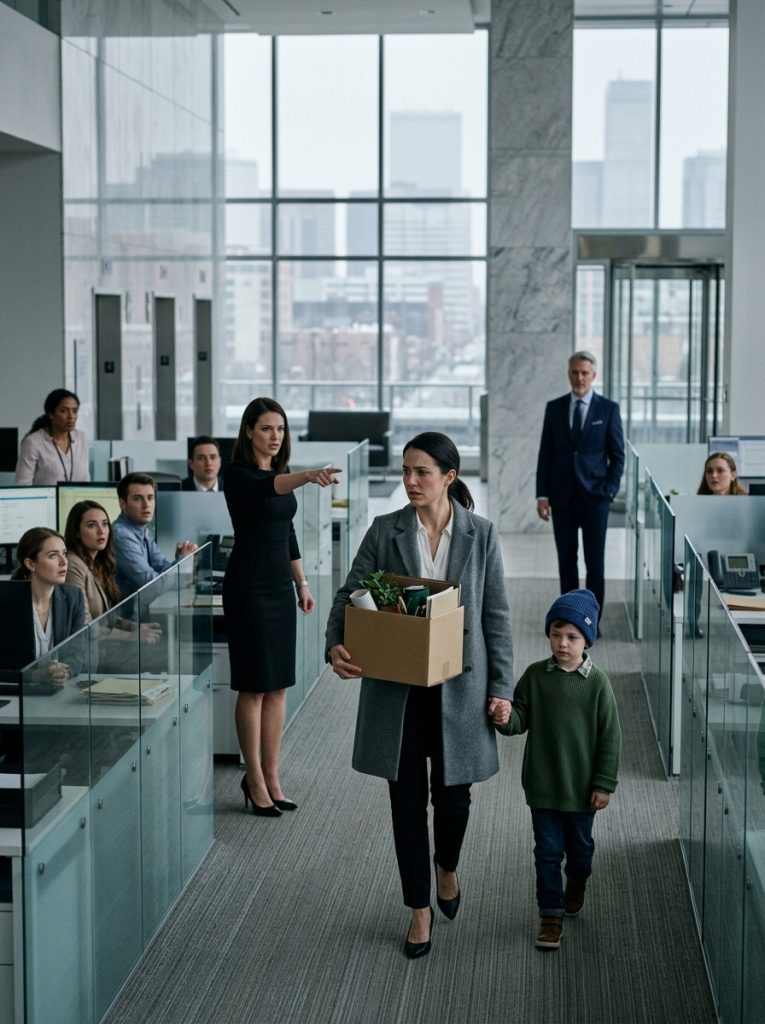
The man in the navy suit didn’t raise his voice.
He just said, “Hold the elevator, please.”
Lauren turned, ready to snap at whoever it was. Then she saw his face and the color drained out of hers.
“Mr. Crane,” she said. “I didn’t — I was just handling a personnel issue.”
Daniel Crane was the CEO. Not a name on a door I’d ever expected to meet. He ran the whole firm from the fortieth floor, and he was standing by the twelfth-floor elevators with his hands in his pockets, looking at the cardboard box in my arms and the little boy holding my hand.
“A personnel issue,” he repeated. “Tell me about it.”
Lauren found her footing fast. “Ms. Holloway brought an unauthorized child into a secure office. It’s a liability. I terminated her, per policy.”
“Per policy.” He nodded slowly. “Which policy number?”
“I — the conduct policy. Section, I’d have to check—”
“I know it well. I wrote half of it.” He crouched down to Sam’s level. “Hey. What’s your name?”
“Sam,” my son whispered.
“Sam, were you being good up here?”
Sam nodded hard. “I stayed quiet. I read four books.”
“Four books.” Crane smiled. “That’s more reading than most of my executives do in a week.”
He stood back up, and the smile was gone.
“Here’s what I overheard on my way to this elevator, Ms. Pierce. A coworker noting that you brought your own child to the client gala in March. That you’ve skipped this exact policy more than once. And that the rules seem to bend for you because of who your uncle is.”
The floor had gone silent again. Different silent this time.
“That’s — that’s gossip,” Lauren said.
“Maybe. I don’t run a company on gossip. I run it on records.” He turned to a young man frozen at a nearby desk. “Pull the visitor logs from the March gala and the last twelve months of break-room badge access. Email them to me and to HR in the next hour.”
The young man started typing like his life depended on it.
Crane looked at me then, and his voice changed. Gentler.
“Ms. Holloway. Your sitter canceled this morning?”
“Her husband had a heart attack,” I said. My throat was tight. “I called everyone I could. I didn’t have a choice. I tucked him in the break room. I know it was against the rules. I just — I couldn’t lose the day and I couldn’t lose the job and I picked the one that—”
“You picked your son,” he said. “And then you tried to do your job anyway. That’s not a liability. That’s the kind of person I spend a fortune trying to hire.”
He turned to the floor — the whole open floor of people pretending to work.
“Listen up, because I’m only saying this once. Effective today we have an emergency caregiver policy. If your childcare collapses, you bring your kid in, you tell your manager, and you keep working. No one — no one — gets walked to an elevator with a box in their arms for being a parent in a bind. If that’s a problem for anyone, my door’s on forty.”
Nobody moved.
“Ms. Holloway is reinstated. Effective this second.” He glanced at the box in my arms. “You can put that down now.”
I put it down. My hands were shaking too hard to do it gracefully.
Then he turned back to Lauren, and the temperature dropped.
“You didn’t enforce a policy today. You enforced it on her and exempted yourself. That’s not management. That’s the thing I built this company to be free of.” He nodded toward the elevator she’d been pointing me at all morning. “Pack your desk. HR will meet you in the lobby. Let’s see how the walk feels from the other direction.”
I have never heard a floor of forty people stay so quiet.
Lauren left that day. The audit Crane ordered turned up more than the gala — expense reports, favors, two other people she’d pushed out who suddenly had a reason to talk. Being the owner’s niece bought her a meeting with her uncle, and from what I heard, it did not go the way she expected. The rules, it turned out, applied to her too.
Me? I went back to my desk.
Sam spent the rest of the day in the break room with his four books, except now half the floor stopped by to meet him, and someone from accounting brought him a juice box, and the woman who’d muttered the truth by the elevators sat with him on her lunch and told him his mom was the bravest person on twelve.
A year later, the emergency caregiver policy has a nickname around the office. People call it “Sam’s Rule.”
There’s a framed crayon drawing on the wall outside the break room now. Sam drew it. It’s a tall man in a blue suit holding an elevator door open, and a smaller woman with a box, and a little boy in a blue hat between them.
Underneath, in his careful six-year-old letters, it says: THE DAY MOM DIDN’T HAVE TO SAY SORRY.
I walk past it every morning.
And every morning I remember that the worst day of my career turned, in one overheard sentence, into the day someone finally held the door.