Father Publicly Humiliates Daughter at Military Gala Unaware She Saved Her Brother’s Life
PART 3 (FULL STORY)
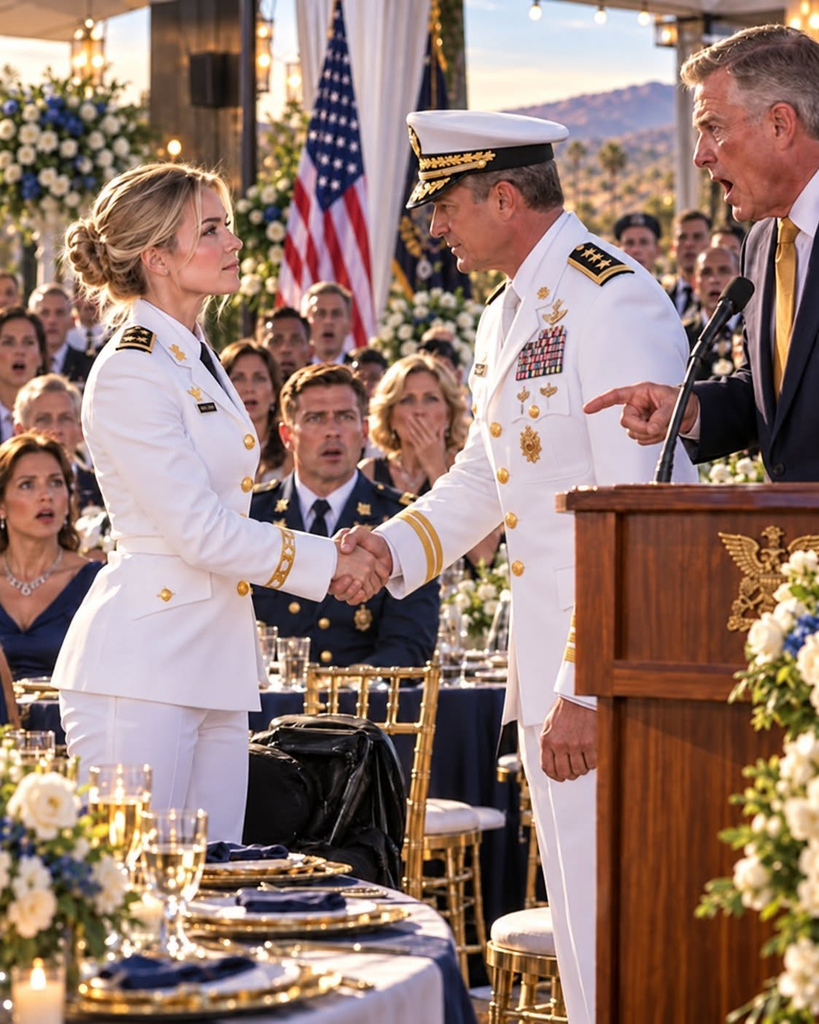
The squeal of feedback faded into absolute silence as Major General Thomas Vance held the microphone with iron composure. Two hundred active-duty soldiers, senior commanders, and military spouses sat entirely motionless beneath the Fort Huachuca pavilion, the festive clatter of barbecue cutlery forgotten in an instant.
“For those of you who do not know me,” General Vance began, his voice echoing with the unmistakable authority of a combat theater commander, “I serve as the Director of Cyber Operations and Tactical Cryptography for United States Cyber Command. And I did not fly from Fort Meade to Arizona to celebrate a barbecue. I flew here to deliver an overdue debt of honor.”
General Vance turned his piercing gaze toward Colonel Marshall Kincaid, who stood paralyzed beside the podium, his face drained of every drop of color.
“Colonel Kincaid has stood before this community and claimed his daughter was dishonorably discharged,” Vance said, his tone dropping into a lethal, measured cadence. “That statement is not merely false; it borders on criminal defamation under military code. Adelaide Kincaid was never discharged. Six years ago, when the Department of Defense established the National Special Access Cryptologic Wing, Captain Kincaid was hand-selected as one of seven operational architects tasked with developing deep-theater electronic warfare countermeasures.”
Whispers erupted across the tables like a brushfire. Senior non-commissioned officers and field-grade officers exchanged stunned looks, their eyes darting to the small bronze pin resting quietly on the lapel of my charcoal blazer.
“Because the operational parameters of her unit required total non-attribution and deep-cover deployment,” General Vance continued, “Adelaide’s official military personnel file was placed under Department of Defense Tier-One masking. To the public, she appeared to step into private commercial consulting. In reality, she was deployed to forward operating bases in four hostile theaters, engineering the automated counter-surveillance firewalls that shielded American strike teams from enemy interception.”
Across the pavilion, my mother had dropped her face into her hands, weeping with a mixture of shock and devastating shame.
Beside her, my younger brother Garrett remained frozen, clutching the red-striped classified folder against his dress greens. His chest rose and fell in ragged gasps as the memories of the worst night of his life rushed back over him.
Three years earlier, Garrett’s infantry company had been pinned down in an isolated valley outside Sangin, Afghanistan. Ambushed by seventy insurgent fighters, their primary satellite antennas destroyed and their local radios jammed by Russian-made electronic warfare pods, Garrett’s platoon had faced total annihilation. At two in the morning, when all hope was lost, an untraceable emergency data packet had penetrated the jamming, establishing a secure micro-link that coordinated close air support from two F-16s and guided three medevac Blackhawks through a mountain blinding dust storm.
Every soldier in Garrett’s unit had tattooed the call-sign ORACLE on their combat gear.
“You spent two years telling everyone in this regimental circle that Addie failed,” Garrett choked out, rising from his chair, his eyes blazing with fury as he stared at our father. “You told me she was weak! You told me she quit because she couldn’t handle the standard of the Kincaid name! And the only reason I am breathing right now—the only reason eighteen men in my company have children today—is because my sister was sitting in an underground bunker twenty miles away, bleeding her fingers across a keyboard to save our lives!”
“Garrett, stand down!” Marshall barked, his voice trembling as he attempted to salvage his shattered authority. “You don’t understand the administrative structure! I was informed—”
“You were informed of nothing, Colonel,” General Vance interrupted, cutting him off with the sharpness of a field guillotine. “Because you were never cleared for the truth. What you did, however, was abuse your retired status to place improper, backchannel calls to the president of the Major selection board in twenty-twenty-two and twenty-twenty-three. You attempted to derail your daughter’s advancement because her classified profile prevented you from bragging about her decorations at your country club.”
A collective gasp swept through the pavilion. Two full colonels sitting in the front row stood up and walked away from Marshall’s table in open disgust.
General Vance reached into his tunic pocket and withdrew a velvet box containing a polished silver oak leaf cluster.
“Two weeks ago, the Secretary of the Army formally reviewed the administrative tampering committed against Captain Kincaid,” Vance announced, looking directly across the room at me. “The selection board has retroactively back-dated her promotion to Major, effective three years ago, with immediate advancement to Lieutenant Colonel approved by congressional confirmation.”
General Vance stepped down from the stage, walked across the pavilion floor, and stopped directly before my picnic bench.
He didn’t wait for me to stand. He snapped to attention and rendered a crisp, flawless salute.
“Lieutenant Colonel Kincaid,” General Vance said, his voice ringing with pure respect. “On behalf of the United States Army, thank you for holding the line in the dark. Your country owes you a debt it can never fully repay.”
I stood slowly, smoothed down the front of my blazer, and returned the salute with steady, unshakeable dignity.
Across the room, the entire pavilion rose to their feet. Two hundred soldiers, veterans, and military families erupted into thunderous, standing applause.
Garrett walked over to my bench, tears streaming down his face. Without saying a word, he threw his arms around my neck, burying his face into my shoulder, sobbing like the little boy I had protected when we were children.
“I’m sorry, Addie,” Garrett wept, his hands gripping my coat. “I’m so sorry I didn’t question him. I’m so sorry I let him make you feel small.”
“I never felt small, Garrett,” I whispered softly into his ear, resting my hand against his cheek. “I was watching over you the entire time.”
On the stage, my father stood entirely alone. The microphone lay abandoned on the lectern. Stripped of his pride, exposed before the regiment he had spent his life using as a theater for his ego, Marshall Kincaid gathered his things in humiliating silence and slipped out through the back of the pavilion into the Arizona darkness.
Six months later, spring arrived in Maryland with cool breezes and blooming cherry blossoms.
Outside the headquarters of Cyber Command at Fort Meade, the morning sun reflected off the polished glass facades of the intelligence complex.
Dressed in my crisp service uniform, the silver oak leaves of a Lieutenant Colonel gleaming on my epaulets, I walked down the stone corridor flanked by two young captains carrying morning tactical briefs. On my chest, beside the bronze medal for distinguished intelligence service, rested the small unit citation from Garrett’s division.
Down near the parade field, Garrett—now assigned to doctrine development—stood waiting by the oak trees with two warm paper cups of black coffee.
He smiled as I approached, handing me a cup, his eyes bright with deep, genuine pride.
“Morning, Colonel,” he teased gently.
“Morning, Major,” I replied with a warm, easy smile.
I took a slow sip of the coffee, letting the morning sunlight warm my face as the sound of bugles echoed across the parade grounds. The years of silence, the cruelty of a bitter father, and the shadows of the past were gone forever. I had served my nation without recognition, guarded my family without applause, and under the wide open sky, truth and honor had finally claimed their rightful victory.