Everyone Swore My Husband Never Once Came to See Our Baby in the NICU FULL STORY
I held that printed still in both hands until the edges went soft, and then I went looking for my husband.
I found Marcus in the hospital parking garage, sitting in our old Civic, not driving anywhere. Just sitting. He had a janitor’s coverall folded on the passenger seat.
I got in. I put the photo on the dashboard between us, the grainy frame of him at 3:02 a.m. with one gloved hand on our son’s isolette.
“Explain this to me,” I said. “Slowly. Because I have spent three weeks hating you, and I need to know if I was wrong.”
So he explained.
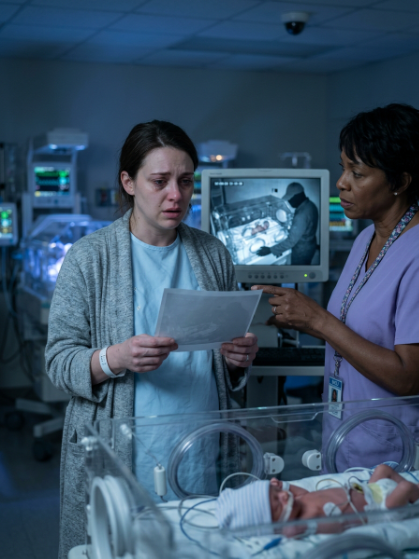
Two days after Eli was born, Marcus lost his job. The plant cut a third of the floor with no warning, and our insurance — the insurance covering a nine-weeks-early baby in intensive care — was tied to that job. He didn’t tell me. I’d just had an emergency C-section and our son was fighting for every breath, and Marcus decided, in the worst way a scared man decides things, that he would carry it alone until he’d fixed it.
But it got worse, and this is the part that broke my heart open.
There’d been a mix-up at the front desk. During a chaotic first night, a clerk had flagged the wrong “Ramsey” on a visitor-restriction note meant for a different family entirely — a custody situation, a barred parent. By the time anyone caught it, Marcus had been turned away at the NICU desk twice, publicly, told he wasn’t authorized to see his own son.
He was a newly unemployed man who’d just been told, in front of a waiting room, that he couldn’t see his dying baby. He was ashamed and he was furious and he didn’t have it in him to stand there and fight a computer while I was upstairs healing.
So he found another way in.
He knew a guy on the overnight custodial crew from his old plant. He borrowed a set of coveralls. And every single night, after the day shift went home and the floor went quiet, Marcus pushed a mop down the NICU corridor until he reached the corner where our son slept, and he stood there with one gloved hand on the incubator port, and he talked to Eli through the plastic.
Every night. For three weeks. While I sat upstairs deciding he was a coward.
“I was going to tell you when I had a job again,” he said, staring through the windshield. “When I could walk in the front door as a man who had it handled instead of a man who lost everything in the same week his son was born. I didn’t want you to look at me the way — ” He stopped. “The way you’ve been looking at me.”
I thought about my mother saying some men just can’t handle this.
She’d been so sure. Everyone had been so sure. And the whole time, the truth was a man in borrowed coveralls refusing to let our son spend a single night without a parent’s hand on him.
The misunderstanding had a hundred fathers. The front desk. The insurance. My mother’s certainty. My own hardened heart. But not Marcus. Marcus had never once not shown up. He’d just shown up where no sign-in sheet could see him.
I took his hand. The same hand from the photo.
“We’re going to fix the desk thing today,” I said. “Together. And then you’re going to walk into that NICU at noon, in your own clothes, with your name on the list, and you’re going to hold your son in the daylight.”
He did.
The barred-visitor flag came off in twenty minutes once we made the hospital actually look at it; it had been a clerical error the whole time, the kind that ruins lives in the quiet. The charge nurse, Patrice — the woman who’d shown me the footage in the first place — walked Marcus in herself and put Eli, all three pounds and change of him, into his father’s arms.
I watched my husband hold our son without a sheet of plastic between them for the first time, and I watched him cry, and I forgave myself slowly for the three weeks I couldn’t get back.
We told people the truth after that. About the job. About the mix-up. About the coveralls. Marcus found work two months later. Eli came home at six pounds, in a going-home outfit three sizes too big, in the back of the same old Civic.
I kept the printed still from the corner camera.
It’s not a flattering picture. Grainy. Gray. A tired man in a borrowed uniform, breaking a rule he had no business needing to break.
It’s the most beautiful photograph I own.
Because it’s the night I thought my son was alone, and he never was. Not once.
His father was always in the room.