Estranged Siblings in Adjacent Hospital Beds FULL STORY
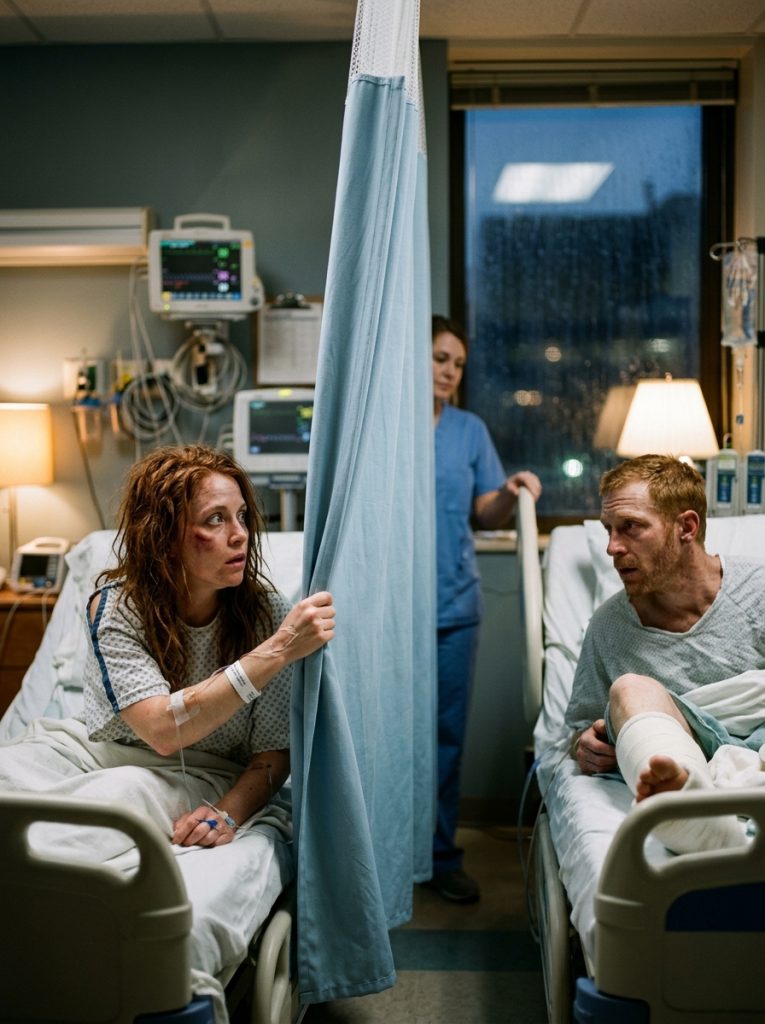
I pulled the curtain back at 2:14 a.m. on a Thursday in May.
I remember the exact time because the digital clock on the wall above Sean’s bed was the first thing I focused on after I focused on his face.
He had stopped mumbling.
His eyes were closed.
The IV in his hand caught the light from the small reading lamp the night nurse had left on for me.
He looked, for the first time in seven years, like my brother.
Not the villain I had built.
Not the coward I had decided he was.
Just a man with red hair turning gray at the temples, breathing slowly, with a broken leg in a cast.
I sat there in my own bed with the curtain bunched in my fist and I cried into my hospital gown for forty minutes without making a single sound.
The night nurse came in at 3 a.m. to check vitals and saw my face and saw the curtain pulled back and did not say a word.
She tightened my IV.
She refilled my water cup.
She closed the door very quietly behind her on the way out.
Sean woke up at 6:42 a.m.
The first thing he saw was my face on the other side of an open curtain.
He stared at me for ten seconds without speaking, the way a person stares at something they have wanted to see for so long that they aren’t sure if they’re awake.
Then he said, “Grace.”
I said, “Sean, you talk in your sleep.”
His face went still.
He understood, in that one sentence, what I had heard.
He looked down at his own hands.
He whispered, “How much.”
I told him.
I told him I had heard the word Westwood.
I told him I had heard “two kids.”
I told him I had heard “she didn’t know.”
He closed his eyes.
He took a deep breath that ended in a small sob.
Then he started to talk.
In 2019, three weeks before my engagement party, Sean had run into Elliot at a bar in Brookline.
He had not been planning to.
He had stopped in for one drink with a coworker.
Elliot was at a corner booth with a woman who was not me, and two children — a boy maybe four years old and a girl maybe two — and the way Elliot was holding the little girl in his lap was the way a father holds a daughter.
Sean did not approach.
He left the bar without finishing his drink.
He spent four days deciding what to do.
He paid a private investigator three hundred dollars to confirm what he already knew.
The investigator delivered a five-page report.
Elliot Marsh, my fiancé, the man who had told me he had a “client account” in Westwood that required regular Tuesday and Thursday overnights, had a wife and two children in a four-bedroom Cape on a quiet street in Westwood.
He had been married to her for eleven years.
She had no idea about me.
I had no idea about her.
Sean carried that report around in his briefcase for two weeks.
He told me he could not eat.
He told me he could not sleep.
He told me every option he had considered.
Telling me directly, and watching me convince myself he was lying out of jealousy, the way I always assumed the worst of him.
Telling our parents and watching our mother spend a month trying to “save the engagement.”
Confronting Elliot privately and giving Elliot the chance to control the timeline.
In the end, he chose the only option that he believed left no room for Elliot to manipulate me.
He chose to tell Elliot, in front of me, in a hallway near a kitchen, that Sean had been to Westwood, that Sean had photographs, and that if Elliot did not call off the engagement and tell me the truth himself by morning, Sean would do it for him in front of everyone.
Elliot called it off on the sidewalk.
He did not tell me the truth.
He did not have the courage.
He blocked my number that week so I could not call him for the answer.
Sean had assumed, in the months after, that Elliot would eventually tell me.
Or that I would figure it out.
Or that one of his Westwood neighbors would slip up.
When none of that happened, when I instead built a seven-year story around Sean as the villain who ruined my engagement out of spite, Sean made a decision he told me, in that hospital room on a Thursday morning in May, was the worst decision of his adult life.
He decided to let me hate him.
Because the alternative was pulling out the photographs of Elliot’s wife and children, mailing them to me, and proving the truth at the cost of two children in Westwood whose father would still come home Tuesday and Thursday nights as long as I did not know.
Sean made the math in his head.
He decided that protecting two kids he had never met from a divorce in the middle of a kindergarten year was worth more than fixing his relationship with his sister.
He decided he could survive my hatred.
He decided maybe one day Elliot would slip and the truth would come out without Sean ever being the one who tore down the second family.
He decided wrong.
He told me all of this in fragments, in the hospital bed across from me, in a low voice with a nurse occasionally peeking in to check his cast.
By the time he finished, I was holding his hand across the gap between our beds.
The IV cord was tangled around my forearm.
I did not care.
He looked at me through tears and said, “Grace. I’m sorry I couldn’t find a better way.”
I said, “Sean. I’m sorry I never asked you why.”
Our mother came in at 9 a.m. with two coffees in a cardboard tray and a folded photograph in her purse.
She had been carrying the photograph since 2019.
Sean had given it to her as a kind of guarantee — proof that if anything ever happened to him, our mother would know what he had been carrying alone.
The photograph was the cover of the PI’s report.
Elliot.
His wife, Theresa Marsh.
A boy named Caleb, age four.
A girl named Lily, age two.
Standing in the front yard of the four-bedroom Cape on Westwood Lane in 2019, smiling at the camera.
My mother had carried that photo in the inside pocket of her purse for seven years.
She had not told me.
She had not told my father.
Sean had sworn her to secrecy.
She handed it to me in the hospital bed at 9:14 a.m.
She said, “Gracie. I have wanted to give this to you for two thousand five hundred and eighty-four days. Sean wouldn’t let me.”
I looked at my brother across the curtain.
His eyes were wet.
I said, very quietly, “It’s okay. He gets to give it to me himself now.”
I held that photograph for the rest of the morning.
I looked at the little girl in the yard.
She was nine years old now.
The boy was eleven.
I thought about the marriage they had grown up inside.
I wondered what their mother knew now, and when she had learned it, and how.
I told my own mother and brother that I was not the only person in this story who deserved an explanation.
We made a plan.
It took two months and a lawyer and a careful, written letter delivered through an intermediary.
In late July, on a Saturday morning in a coffee shop in Newton, halfway between Boston and Westwood, I met Theresa Marsh.
She had divorced Elliot in 2022, three years after her own breaking point.
She had not known about me in 2019.
She had figured out other women on her own in 2021.
She had learned my name from a paralegal during the divorce.
She had wanted to meet me for years.
She told me, in that coffee shop, that she had been at my engagement party in Brookline.
She had stood across the street, on the sidewalk, holding her phone in her shaking hand.
She had been about to walk in.
She had seen Sean go in first.
She had seen Elliot leave forty minutes later.
She had gone home that night and told the babysitter she had a migraine.
She had carried that night, alone, for years.
Theresa and I are not friends, exactly.
We are something quieter and harder to name.
We meet for coffee twice a year.
We send each other cards on each other’s children’s birthdays — well, on her children’s birthdays, since I do not have any.
She tells me Caleb is in seventh grade now and runs cross-country.
She tells me Lily is in fifth grade and wants to be a marine biologist.
I sent Lily a small package of plastic dinosaurs in March.
She sent me a thank-you card with a sticker on it.
Sean and I had Christmas together this year for the first time since 2018.
Our mother set the table for five — our parents, Sean, me, and an empty chair we left set on purpose, for the seven years we did not get to have.
After dinner, Sean handed me an envelope.
Inside was the original PI report.
He told me he had been carrying it for seven years.
He told me it was time for me to be the one who decided what to do with it.
I read the cover page.
I looked at my brother across our parents’ dining room table.
I walked over to the fireplace.
I burned it.
Sean cried.
I cried.
Our mother cried.
We did not speak for a few minutes.
Then Sean said, “Gracie. Thanks for finally pulling that curtain.”
I said, “Sean. Next time, just tell me.”
He nodded.
He said, “I will.”
I believed him.