Empty “Family” Row at the Talent Show FULL STORY
The man on the phone was named David Stern. He published music in New York, and he did not call people at 6 a.m. for nothing.
He told me to sit down. I was already sitting.
The melody Walter played at our little talent show — the one I’d posted for fun — was the spine of a song called “Evening, Come Gentle.” If you’ve sat in a church or a waiting room or a funeral home in the last thirty years, you’ve heard it. It’s everywhere. It’s been recorded four hundred times.
And for thirty years it had been credited to “Traditional. Arranged by R. Bishop.”
R. Bishop.
Russell Bishop. Walter’s oldest son.
“There is no traditional source,” David said quietly. “We’ve looked. That melody appears nowhere before 1994. I think your resident wrote it. And I think someone put a different name on it.”
I walked down to room 14 with my heart in my mouth.
Walter was pressing his Sunday shirt, even though it was a Tuesday.
I asked him, gentle as I could, about the song. About Russell.
He smiled the way old men smile when they’ve decided not to be angry about a thing anymore.
“I wrote it for their mother,” he said. “The year she died. Russell was just a boy. He used to fall asleep to it.”
“Did you give it to him?”
“He told me a publisher might be interested. Said he’d handle the paperwork.” Walter folded the shirt. “I was tuning pianos sixty hours a week. I signed what he put in front of me. I trusted my son.”
He didn’t know what it had become. He didn’t know about the four hundred recordings. He didn’t own a computer. His children had made sure of the rest.
I want to tell you I handled it calmly. I didn’t. I cried in the supply closet for ten minutes.
Then I called David Stern back and said, do it. Tell the truth.
It moved faster than anything I’ve ever seen. A music-rights reporter ran the story: the famous “anonymous” hymn was written by an eighty-one-year-old man in an Akron nursing home whose family had collected the royalties for three decades.
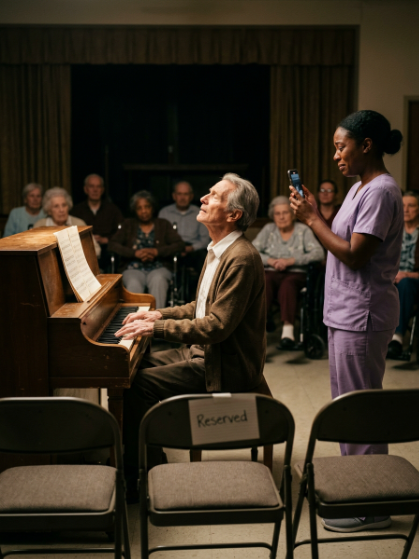
The clip of Walter at our battered upright — eyes closed, the empty “Family” row in front of him — went everywhere.
And that’s when the children came.
Russell first. In a suit. With a lawyer and a soft voice, talking about “a misunderstanding” and “honoring Dad properly now.”
His sister came with a casserole, of all things, like a casserole could fill two years of an empty visitor log.
The youngest, Mark, didn’t come at all. He sent a statement to a reporter about “respecting the family’s privacy.”
They sat in the common room — finally, in those chairs — and they smiled for a photo with the local news.
Walter let them. He held their hands. He is a better person than I will ever be.
But when the cameras left, he asked me to wheel him back to room 14. And he asked me one question.
“Did they come because they’re sorry,” he said, “or because I’m worth something now?”
I didn’t answer. He already knew.
Here is how it ended, and I’ll tell it straight.
A forensic accountant David hired traced thirty years of royalties. The number had six figures and then some. The lawyers fought about it for a while, the way lawyers do.
In the end Russell signed the songwriting credit back to his father rather than face a courtroom and a headline. The back royalties came too, most of them.
Walter took that money — money that could have bought him anything — and he set up a fund. Music lessons for kids in the county who can’t afford an instrument. He named it after his wife.
He kept just enough to buy one thing for himself.
A piano. Not a grand. He said he was past grand pianos. A good upright, for the common room, so the other residents would have something better than that beat-up thing to listen to in the evenings.
The day it arrived, the whole floor gathered. Wheelchairs, walkers, the kitchen staff, me.
Walter sat down and flexed those trembling hands and played “Evening, Come Gentle” for a room full of people who had nowhere else to be and nobody else who came.
His children weren’t there. By then he’d stopped pressing the shirt.
He didn’t need the front row anymore. He had us.
When he finished, he looked at the circle of old faces around him, some of them crying, and he said the truest thing I ever heard him say.
“Funny,” he said. “I spent my whole life thinking I gave my music up for my family.”
He patted my hand.
“Turns out I just hadn’t met them yet.”
He played every evening after that, right up until the end, and the room was always full.
Not one of those chairs ever said “Family” again.
It didn’t have to.