Driver Saves Confused Elderly Man on Wrong-Way Ramp FULL STORY
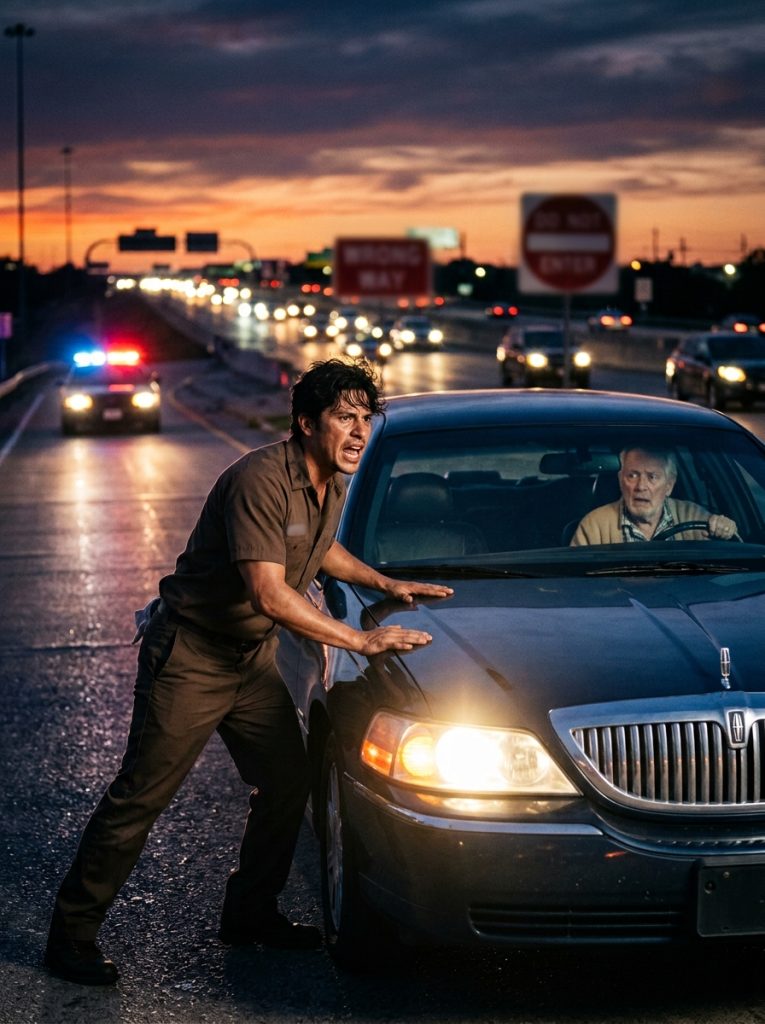
Judge Raymond Price stepped into the headlights of the Lincoln, looked at the first officer, and said the seven words that I will replay in my head for the rest of my life.
“Take the cuffs off this young man.”
The first officer hesitated.
He had been trained to hesitate.
He glanced at his partner.
His partner had already lowered her hand from her radio and was watching the judge in the kind of way you watch a person whose face you have seen on television.
“Sir, with respect, this is an active investigation. The vehicle was abandoned on a federal—”
“I’m aware of what the vehicle was doing,” Judge Price said.
He was very calm.
“I’m also aware of what your dashcam recorded for the last seven minutes. The cameras on the cruisers are always running, officer. You can roll the tape on your way home. Or I can pull it Monday morning. Your choice.”
The officer’s jaw tightened.
He took the cuffs off me.
I rubbed my wrists.
I did not say thank you.
I have been told by my older brother, twelve times in twelve years, that you do not say thank you to a police officer for stopping doing something he should not have started.
Judge Price walked me a few steps away from the cruiser, into the soft amber wash of the streetlights at the bottom of the on-ramp.
He looked at me directly.
“What’s your name, son?”
“Marco. Marco Reyes.”
“Marco, my father has Lewy body dementia. He was diagnosed last year. He is not supposed to drive. He is not supposed to be alone in the house. My sister and I have a caregiver who comes Monday through Friday. She doesn’t come Friday nights.”
He paused.
“He left while my mother was in the bathroom. We’ve been looking for him for ninety minutes.”
I told him I was glad his father was safe.
I told him I had not done much.
He told me, with a small wry smile, that running across two lanes of merging traffic to plant my body in front of a wrong-way Lincoln on the entrance ramp of the Southwest Freeway at rush hour was not what he would call “not much.”
Then he asked me what was on the speakerphone.
I told him.
I told him my dispatcher had terminated me about eleven minutes ago, in front of two officers, while I had been in handcuffs.
I told him I had a wife and a son and a mother-in-law and four shifts a week of overtime that were about to disappear on a Friday night.
Judge Price did not promise me anything.
He asked for the company name and the dispatcher’s name.
He wrote them down on a small black notepad he pulled from the inside pocket of his coat.
He thanked me again.
He shook my hand.
He gave me his card.
He told me to call him Monday morning at 9 a.m.
That was Friday.
By 9 p.m. that night, I was at home in my apartment in Sharpstown with my wife Carla and my son Luca on my lap, eating the leftover chicken Carla had warmed up because she could not stand to watch me eat dispatcher-terminated, and my phone rang.
The number was the regional vice president of my parcel company.
A man named Stephen Halloran.
I had never spoken to him in my life.
He apologized for the call coming in so late.
He said the company had been alerted to “a regrettable miscommunication” with my dispatcher.
He said the termination was being rescinded immediately.
He said my employee record would be updated to reflect a “commendation for civilian assistance to law enforcement.”
He said the company would be issuing a check the following Monday for forty hours of “missed wages, with apologies.”
He said, very carefully, that the company was “looking forward to a long relationship with one of our outstanding drivers.”
He did not mention Judge Raymond Price.
He did not need to.
I went back to work the next Monday.
My dispatcher, a man named Dale, did not look at me.
He read my route assignments off a clipboard in a flat voice.
He said, “Reyes. Northwest sector. Truck 47.”
I said, “Yes, sir.”
I drove my route.
I delivered my packages.
I did not say a word about Friday.
Three weeks later, Dale was reassigned to a different facility on the other side of Houston.
Six weeks later, the company offered me a route supervisor position.
I had not applied for it.
I took it anyway.
The pay raise was twenty-eight percent.
Carla cried at the kitchen table when I read her the offer letter.
That should have been the end of the story.
It was not.
Three months after the night on the on-ramp, on a Wednesday morning in October, my older brother Hector called me from a halfway house in Pasadena, Texas.
He was crying.
Hector is six years older than me.
Hector has been in and out of the Texas Department of Criminal Justice since I was eleven.
In 2017, Hector was convicted of a robbery he did not commit.
I will say it the way my mother says it, because she is the one who paid the lawyer.
He was convicted of a robbery he did not commit.
The case was ugly.
Two witnesses identified him from a six-pack photo array under conditions a competent eyewitness expert would have torn apart in a deposition.
A public defender had represented him.
The trial took two and a half days.
The jury came back in less than four hours.
He served seven years.
He had been out on parole for fourteen months when he called me that morning.
He was crying because his parole officer had just called him in for an unscheduled meeting.
A judge somewhere in Harris County had filed a motion to reopen his case for “post-conviction review of eyewitness identification methodology, in line with recent precedent.”
Hector did not understand what that meant.
He had been told once, in 2018, that his case was “closed and not appealable.”
I drove to the halfway house that afternoon.
I sat across from my brother in a small visiting room with vending machines.
I asked him the name of the judge.
He pulled the letter out of his back pocket.
The Honorable Raymond Price, Civil Court, Harris County.
I sat there for thirty seconds.
I did not say anything.
Hector said, “Marco. You good?”
I told him I was good.
I told him to do exactly what his lawyer told him to do.
I drove home.
I did not call Judge Price.
I did not need to.
His Good Samaritan ruling came down the following spring.
It was a five-page opinion in a separate civil case involving a Houstonian who had been sued by a delivery company for property damage incurred while preventing a pedestrian fatality.
In the second-to-last paragraph, Judge Price wrote, in a voice every Houston attorney recognized as his own, that the court had personally observed instances in which delivery and rideshare drivers had acted with selfless disregard for their own livelihoods to protect strangers.
He did not mention me by name.
He did not need to.
The phrase he used was, “I have, in this judge’s own life, owed everything to a young man in a brown uniform on an on-ramp.”
That paragraph went semi-viral in a small subset of Texas legal circles.
It also got read into the record at my brother Hector’s post-conviction review hearing six months later, by a different judge in a different court, who used it as part of his rationale for granting Hector’s appeal.
Hector was exonerated of his 2017 conviction in March of the following year.
The state of Texas issued a formal apology and paid him under the wrongful-conviction compensation statute.
He used some of the money to take our mother on a four-day cruise.
He used some of it to buy his daughter, my niece, a used Honda Civic.
He used the rest to pay back our mother for the lawyer.
Last year, Judge Raymond Price retired from the bench.
He sent me a Christmas card.
It said, in his own handwriting, “Mr. Reyes — you are the best decision my family ever didn’t have to make. — RP.”
I kept it on the refrigerator for six months.
Then I put it in the small fireproof box in our bedroom closet, with my son’s birth certificate, my marriage license, and the original card Judge Price gave me on the Southwest Freeway on-ramp at 6:53 p.m. on a Friday night in October.
Some nights I drive home from work down the same on-ramp.
I do not slow down.
I do not point it out to Luca.
I do not need to.
I just look at the spot where I planted my hands on the hood of a black Lincoln, and I keep driving.