Denied a Library Card FULL STORY
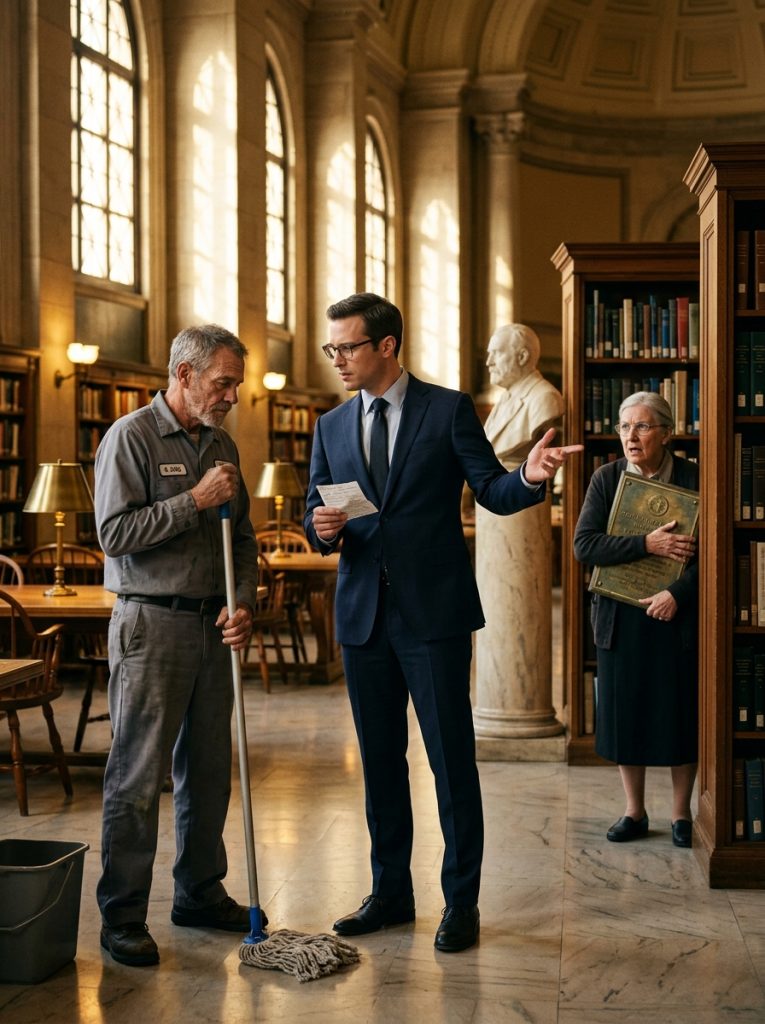
Kenneth Ward’s hand stopped midair.
The library card application drifted from his fingers and landed on the marble floor.
He looked at Mrs. Delgado like she’d just told him the building was on fire.
“That’s impossible,” he said.
Mrs. Delgado — Elena Delgado, who had started working at this library when Nixon was president and had outlasted eleven different directors — walked around the circulation desk and set the brass plaque gently on the counter.
RAYMOND COLE, it read. EAST WING BENEFACTOR — 1996.
“Mr. Cole donated two million dollars to this library thirty years ago,” she said, her voice loud enough to carry to every corner of the reading room. “He funded the east wing expansion, the children’s section, and the literacy program that serves three hundred families in this neighborhood. I was there when they nailed this plaque to the wall. I shook his hand.”
The reading room was so quiet I could hear the heating vents.
Kenneth Ward’s mouth opened, closed, opened again. The smugness that had been etched into his face five minutes earlier had been replaced by something that looked a lot like panic.
“I… I didn’t know,” he stammered.
“No,” Mrs. Delgado said. “You didn’t. Because you never asked. You never learned a single name in this building. You walked in here six months ago with your expensive suits and your contempt for anyone who didn’t match your idea of what a patron should look like, and you never once thought to ask who built the wing you stand in.”
She turned to me.
“Raymond,” she said softly. “I am so sorry.”
I picked up the library card application from the floor. The paper was crumpled where Kenneth’s fingers had creased it.
“It’s all right, Elena,” I said. “He’s not the first person to see a janitor instead of a man.”
But the damage was done — not to me, but to Kenneth Ward.
Because one of the people in the reading room that afternoon was a member of the library’s board of trustees. An older woman named Mrs. Nakamura who’d been sitting in the corner armchair reading the newspaper. She’d heard everything. And she was already on her phone.
The board called an emergency meeting that evening.
Kenneth Ward was suspended pending an investigation. What the investigation found was worse than a single incident of rudeness. Kenneth had been denying library cards to homeless patrons for six months — in direct violation of the library system’s inclusion policy. He’d cut the budget for the literacy program by forty percent. He’d fired the part-time librarian who ran the children’s reading hour and replaced her with an automated checkout kiosk.
One week later, the board voted unanimously to terminate his contract.
Mrs. Delgado was named interim director.
Her first act was to issue me a library card.
But that wasn’t the end of it.
The story made the local news — “Former Benefactor Humiliated at Library He Built.” A reporter from the Boston Globe called. Then a lawyer. Then a former bank executive who’d been investigating predatory foreclosure practices in western Massachusetts. He’d read the article and recognized my name.
“Mr. Cole,” he said, “the bank that seized your farm was using falsified foreclosure documents. You’re one of dozens — maybe hundreds — of victims. I’d like to help you get your land back. No charge.”
It took eleven months.
Eleven months of depositions, paperwork, and waiting. But in the end, the court ruled that the foreclosure on my farm was illegal. The bank was ordered to return the property and pay restitution — enough to restore the farmhouse, replant the fields, and set aside something for the future.
I didn’t move back. The farm is a working operation now, managed by a young couple I hired. They send me pictures every harvest season. Corn. Soybeans. A pumpkin patch that the local elementary school visits every October.
I stayed in Boston.
I still work at the library — not as a janitor anymore, but as a volunteer in the children’s reading program. Every Tuesday and Thursday, I sit in the east wing and read picture books to a circle of toddlers while their parents watch from the chairs I helped pay for.
Mrs. Delgado retired last year. At her farewell party, she gave me a gift — a framed copy of the old brass plaque, polished to a shine, with a new line engraved at the bottom:
“A man is not measured by what he owns, but by what he gives.”
I hung it in the reading room.
Right above the shelf where the picture books live.