Cleaning Out the Attic FULL STORY
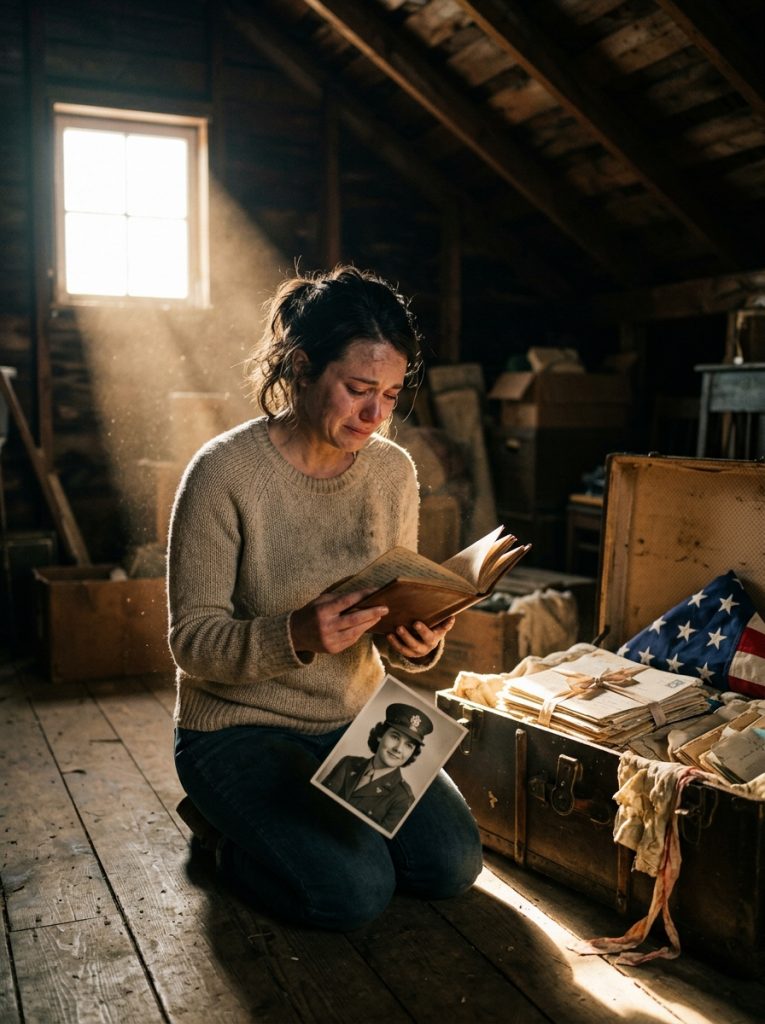
The first entry that mentions my grandfather isn’t a love story. Not yet.
It’s a triage note.
March 1945. A field hospital somewhere behind the line in France. My grandmother — twenty-two years old, a farm girl from Vermont who had lied about almost nothing except how scared she was — wrote it in a hand so steady it frightened me.
“Convoy hit at dusk. Eleven in. We have room for six. I am the one who decides.”
I sat on that attic floor until my legs went numb, reading my Nana decide who lived.
She wasn’t a cook who happened to marry a hero. She was an Army nurse, one of a handful holding a canvas hospital together through the worst nights of the war, and the diary laid it out in a voice that never once asked for credit.
The night the entries are really about, the night my whole family had the story backwards, was in December of that winter.
The hospital took a direct hit. Half the tent came down. The generator died. The two doctors were buried in the collapse, and for nineteen minutes — she timed it, she always timed everything — my grandmother was the most senior medical person standing in a tent full of dying men, in the dark, in the snow, with the line close enough to hear.
She didn’t run.
She tied off what she could by flashlight held in her teeth. She organized the walking wounded into stretcher crews. She kept a soldier with a chest wound breathing by doing the work of a machine they didn’t have, with her own two hands, for most of an hour.
That soldier’s name was Thomas Reed.
My grandfather.
The man whose medals hung in the shadow box downstairs. The man who told the war stories. He survived that night because a terrified, unshakable twenty-two-year-old woman decided he would.
They didn’t fall in love there. That came after, slow, in letters. But she saved him first. Before she ever loved him, she saved him.
He knew. That’s the part that undid me. Tucked into the back of the diary was a letter in his handwriting, dated their fortieth anniversary. “You have let me be the hero of this family for forty years,” he wrote, “because you said the medals embarrassed you and the attention made you tired. I have kept your secret because you asked. But I have never for one day forgotten who carried whom out of that tent. — T.”
He’d offered her the wall. She’d handed it to him and stepped back into the kitchen on purpose.
I understand it now, a little. She came home from deciding who lived and who died and she wanted, more than anything, a small ordinary life where the biggest decision was whether to put cherries in the pie. She earned that quiet. She chose it.
But she also kept the diary. And taped the key where I would find it. Which tells me some part of her wanted the truth to outlive the silence — just not until she was past being thanked for it.
So I’m thanking her anyway.
It took me four months. I contacted a military historian at the state university and a project that records the stories of women who served. I had the diary’s dates verified against the unit records. It checked out, every line. There’s a citation in those records, it turns out — a commendation recommended for an Army nurse who “maintained casualty care under direct threat after the collapse of the surgical tent.” The name had been logged wrong, half-erased by a clerk’s bad handwriting and seventy years.
We fixed the name.
This spring, in a small ceremony at the veterans’ hall, they read it out correctly for the first time. Eleanor Reed. My grandmother. There were forty people there and most of them were crying and the youngest nurses in the room stood the whole time.
I brought the black-and-white photograph from the attic — the girl in the white cap with the red cross — and they framed it.
It hangs downstairs now, in the old farmhouse, right beside Grandpa’s shadow box. Same wall. Same light. The way it always should have been.
I dust them both on Sundays.
And every time, I look at that twenty-two-year-old girl who decided, in the dark, that the man she hadn’t yet learned to love was going to take another breath — and I tell her the thing nobody got to tell her in time.
We see you now, Nana. We finally see you.