An Excluded Heir Used His Mother’s Legal Agreement To Reclaim The Entire Estate
PART 3 (FULL STORY)
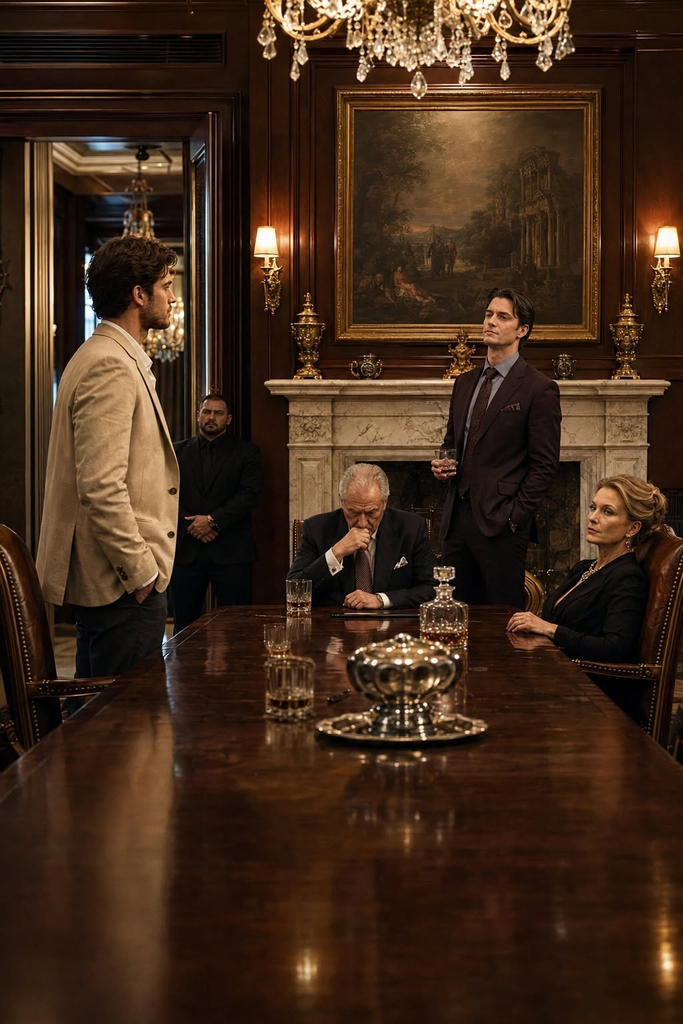
Beatatrice did not scream. She sat frozen in the high-backed velvet chair, her painted lips parting slightly as the reality of the court order settled into the room. For twenty years, she had ruled this house with cold, calculated politeness, snapping her fingers to command staff and arranging galas to curate an illusion of untouchable prestige. Now, the glossy facade was cracking in front of four armed state troopers and the senior probate counsel who had represented my mother before I could even write my own name.
“This is an outrage,” Beatatrice whispered, her voice tightening like a dry wire. She looked at Richard Sterling, the attorney standing at the foot of the table. “I have been Robert’s lawful wife for nineteen years. I managed this household. I represented this family. You cannot walk into my home with police officers and wave papers at me.”
“It was never your home, Mrs. Vance,” Richard Sterling replied with calm, devastating precision. He opened a thick leather briefcase and placed three bound documents next to the crystal scotch decanter. “When Eleanor Vance drafted her testamentary trust in 2004, she included an absolute remarrying exclusion. Under Section Nine of the Savannah covenant, Robert Vance forfeited all administrative authority over Eleanor’s commercial holdings, intellectual property, and real estate the moment your marriage certificate was filed.”
Sterling adjusted his glasses, looking at Beatatrice over the silver frames. “Furthermore, because you were never an authorized beneficiary, every dollar transferred to your personal accounts, every charity gala underwritten by Eleanor’s trusts, and every vehicle purchased for your son Julian constitutes unauthorized conversion of estate assets. We have initiated a full forensic clawback for forty-seven million dollars.”
Julian struggled against the trooper’s grip, his face flushed with panicked fury. “You can’t do this! Arthur agreed to sign! We had an agreement!”
“An agreement extracted under physical duress with a hired guard blocking the door?” Evelyn stepped forward, her voice ringing with the quiet authority of someone who had documented every second of the confrontation. She held up her phone, displaying a live audio-video feed transmitted directly from a pinhole camera in my mother’s antique wall sconce. “Everything said in this room for the last fifteen minutes has been recorded and submitted into evidence with the district attorney’s office.”
Julian went dead silent, his eyes darting frantically toward the door.
Evelyn turned to the lead investigator. “The toxicology results from the state crime laboratory confirmed that the champagne sample taken from the party contained three milligrams of flunitrazepam combined with a liquid antihistamine. The prescription was traced this morning to a private clinic in Atlanta where Mrs. Vance holds an executive board seat.”
The lead investigator stepped forward, holding a pair of steel handcuffs. “Beatatrice Vance, you are under arrest for attempted aggravated assault with a lethal substance, extortion, and grand larceny. Julian Vance, you are being detained as an accessory to extortion and conspiracy.”
As the troopers clicked the handcuffs around Beatatrice’s wrists, she turned her head toward my father, her manicured fingers clawing at the mahogany table. “Robert! Say something! Tell them who I am! Tell them they can’t take me out of this house!”
My father sat completely still.
He had not stood up when Julian threatened me. He had not spoken when the bouncer blocked the exit. And now, as his wife was pulled toward the doorway, he could only stare at his own trembling hands, his face gray with the sudden realization that the comfortable, coward’s peace he had spent twenty years buying had finally collapsed into nothing.
“Robert!” Beatatrice shrieked, her composure breaking completely as the troopers escorted her into the grand hallway.
Her heels dragged across the marble foyer, the desperate echo fading down the corridor until the heavy front doors closed with a dull, final thud. Julian was led out behind her, his head hanging low, unable to meet the eyes of the domestic staff who had gathered silently in the archways.
When the front gates clicked shut and the sirens faded into the Savannah evening, the great dining room was left in total stillness.
Evelyn and Richard Sterling stepped into the library to coordinate the preliminary asset injunctions with the bank, leaving my father and me alone on opposite sides of the long mahogany table.
For nearly two minutes, neither of us spoke.
My father slowly lifted his head. His eyes were red, rimmed with tears of self-pity and exhaustion. “Arthur… you have to understand. When your mother died, the world was too big. The companies, the board meetings, the debt… I couldn’t handle it alone. Beatatrice knew how to smile at the right people. She took the pressure off my shoulders.”
“She erased her,” I said, my voice steady, without anger, but hollowed out by twenty years of quiet grief. “She took down her portraits. She packed her silver into cardboard boxes in the cellar. She gave Julian everything, and when I asked for help with college tuition, you looked me in the eye and told me money was tight.”
“I was trying to keep our family together,” he whispered, his voice cracking.
“No,” I replied, looking at him with clear, unyielding certainty. “You were trying to keep yourself comfortable. You sacrificed your wife’s memory and your own son because it was easier than standing on your own two feet.”
I reached down, unbuttoned the beige suit jacket Beatatrice had mailed me to make me blend in, and slipped it off my shoulders. I dropped the fabric onto the empty chair where Julian had stood.
“The probate court will allow you to keep your personal pension and a modest apartment in town,” I said quietly. “You will not go hungry, and you will not be homeless. But you will never make a decision for Eleanor Vance’s company again. You have twenty-four hours to pack your clothes.”
My father looked at the table, his shoulders slumping under the weight of his choices. He nodded once, stood up slowly, and walked out of the room without looking back.
Three weeks later, the Savannah courthouse approved the complete restoration of my mother’s estate.
The legal proceedings moved swiftly. Faced with forensic financial records and laboratory evidence, Beatatrice accepted a plea agreement resulting in a multi-year federal sentence, while Julian was barred from holding corporate directorships and ordered to repay seven million dollars in unauthorized disbursements.
I did not sell the estate.
Instead, I hired a restoration team to bring back what had been buried for two decades. The beige wallpaper was stripped away. The original warm walnut paneling was restored. And from the basement storage rooms, we brought up the heavy oak crates that had sat in darkness for twenty years.
On a bright Tuesday morning, the sunlight poured through the floor-to-ceiling windows of the grand foyer.
Evelyn walked into the hall carrying an official security clearance binder. She had agreed to take over as Chief of Corporate Security and Risk Management for Vance Holdings, establishing a permanent, independent oversight division that answered only to the board of trustees.
“The regional directors have signed the new operating covenants,” Evelyn said, handing me the summary. “Every tenant lease is intact, and the scholarship foundation in your mother’s name is officially registered with the state.”
“Thank you, Evelyn,” I said, taking the file. “For everything.”
She smiled faintly, her sharp eyes softening. “Your mother built an incredible foundation, Arthur. She just needed someone who remembered why she built it.”
After Evelyn left for the corporate offices downtown, I walked into the central library.
Above the marble fireplace where Julian had once stood with his smug smile, my mother’s portrait hung once more. In the painting, Eleanor Vance sat with her head held high, wearing a dark navy blazer, her eyes bright with the intelligence and resilience that no one in this house had ever truly been able to destroy.
On the mahogany desk beneath the painting sat her antique silver fountain pen, polished and filled with fresh ink.
I sat down in her chair, picked up the pen, and signed the first charter of the Eleanor Vance Foundation. For the first time in twenty years, I was no longer a ghost in someone else’s house. I was my mother’s son, and I was finally home.