An Anonymous Account Tormented My Daughter for a Year FULL STORY
Maya read the name over my shoulder, and then she said it out loud, and the saying of it made it real for both of us.
Renata Pell.
The youth-group volunteer. The “cool aunt” half the kids in our church orbited. The woman who’d driven my daughter home from a dozen events, who’d texted me Maya’s so wonderful, you’re doing a great job, mom, who’d sat in my kitchen drinking my coffee.
The login that had posted the photo mocking my daughter traced back to Renata’s account, from Renata’s home address, the pin landing squarely on the little blue house with the wind chimes where Maya had felt safe.
I want to be careful here, because when you find a thing like that, the first instinct is to drive over and put a brick through a window.
I didn’t.
I had a fifteen-year-old watching me to learn what you do when the worst thing is true.
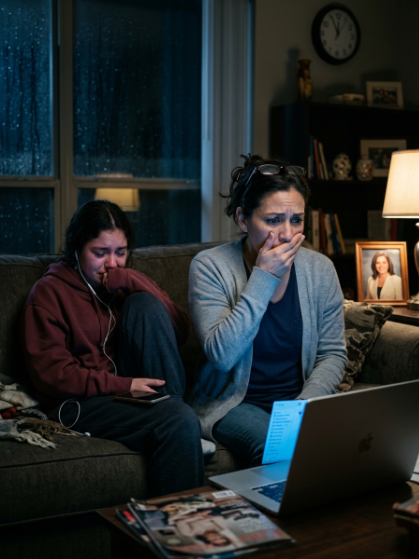
So here’s what we did.
First, I believed my daughter. Out loud. I told Maya, “This was never about you. Nothing she said was true. The problem was always inside the person typing it.” I made her hear it twice.
Then I stopped touching the evidence. Everything Maya had saved — the screenshots, the image, the metadata — I copied to a drive and didn’t alter a pixel of it, because I’d read enough to know that a careful record is worth more than a loud accusation.
In the morning I called the school, and then I called a lawyer who handles this, and then — the hard one — I called the youth pastor, because other kids spent time alone with this woman and I was not going to sit on that to spare anyone’s comfort.
The metadata held up. It wasn’t just one photo. Once people knew where to look, the pattern was everywhere — times that matched her schedule, a second “anonymous” account built on the same device, details only an adult trusted with these kids could have known.
Why she did it, I’ll never fully understand. The closest anyone came was the counselor’s word for it: she fed on being the adult these girls confided in, and when Maya started pulling away that year — getting her own friends, her own confidence, needing Renata a little less — something curdled. She built an anonymous account to cut my daughter back down to a size that still needed her.
She tormented a child for a year to stay important to her.
The consequences were real and they were lawful. She was removed from every youth role, permanently. The documentation went where it needed to go, including to people with badges, because what she’d done to a minor had names in the Texas statutes. I let the process be the process. I didn’t need a brick. The truth, kept carefully, did more damage than any window I could’ve broken.
The part the internet would want is the takedown.
But that’s not the part that healed my kid.
What healed Maya was smaller and slower.
It was the youth pastor standing up in front of the group and saying, without using Maya’s name, that someone in a position of trust had hurt one of their own, and that it was being handled, and that anyone who’d received cruelty from a hidden account should know it was never the truth about them.
It was three girls texting Maya that night: it wasn’t just you. she did it to me too. i’m so sorry i thought it was real.
It was Maya, a month later, putting in one earbud instead of two at the dinner table. Then no earbuds. Then, one night, humming in the kitchen again — that off-key, careless hum I hadn’t heard in a year — while she did her homework.
I stood in the hallway and cried where she couldn’t see me.
We did go back to youth group, eventually. I sat in the parking lot the first time, ready to pull her out at one text. She came out beaming. The new volunteer is a retired math teacher named Gloria who is approximately as cool as a cardigan and exactly as safe as one, and Maya adores her.
I keep the drive with all the evidence in a fireproof box. Backed up. I hope I never need it again.
The account is gone. The woman is gone from our lives, by court paper and by choice.
And my daughter sings in the kitchen.
It turns out the most dangerous voice in a child’s life isn’t always the stranger you warn them about.
Sometimes it’s the one you trusted to drive them home.
I’ll never stop checking the data again.