After Dad’s Funeral I Found a Box FULL STORY
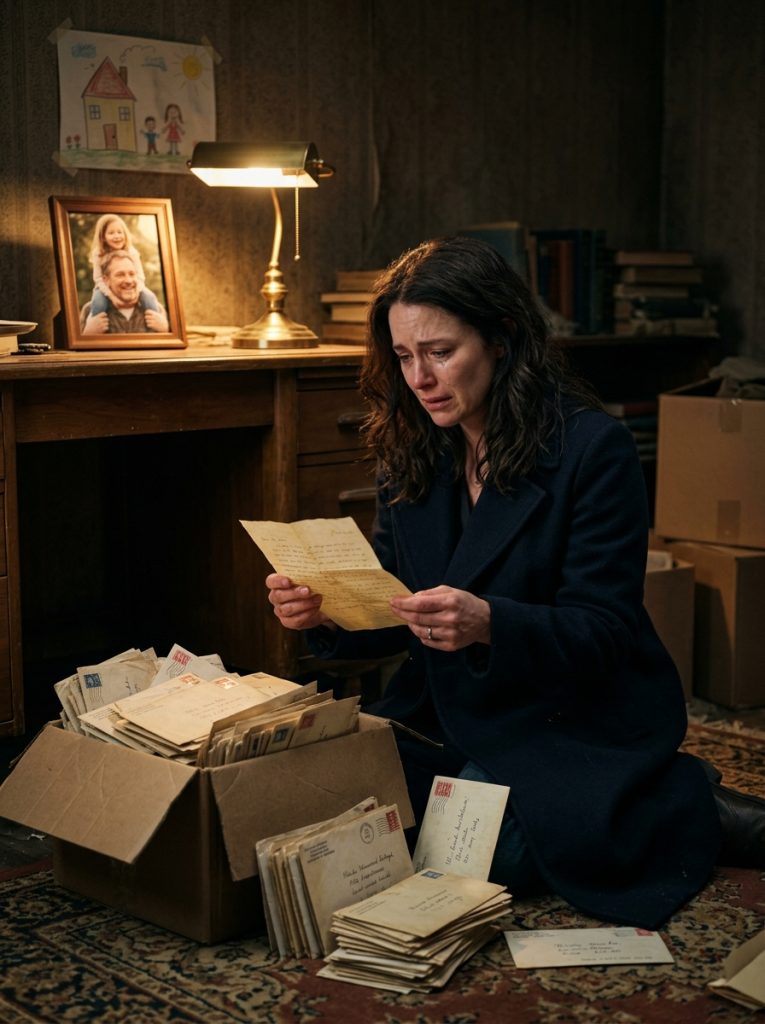
The first letter was dated three weeks after he left.
“Dear Laura,” it began, in that careful, blocky hand. “You are six and you do not understand why Daddy went away, and I am not allowed to be the one to tell you. So I am writing it here, where maybe someday you’ll read it and know I tried.”
I read it on the floor of his study in my coat, and then I read the next one, and the one after that, until the lamp was the only light left in the house and my knees had gone stiff under me.
The story I’d been raised on had one line in it: your father walked out and never looked back.
The truth had more lines, and they were harder.
My father drank. Badly, for a few years, when I was small. He never raised a hand to anyone — every letter swears it and so did the neighbors I later tracked down — but he scared my mother, and she gave him a choice: get sober or get gone. He couldn’t manage it fast enough. She changed the locks. I don’t entirely blame her. She was protecting her little girl with the tools she had.
What the story left out was what happened next.
He got sober. Two years too late to save the marriage, but he did it, and he kept doing it for the next thirty years. By the time he was steady enough to come back, my mother had remarried, and she told him — and told me — that I was settled now, that a sober stranger turning up would only “rip the child in half.” She said if he fought for visitation she’d make the drinking years sound like something they weren’t, in front of a judge, and he believed her, because shame makes you believe the worst version of yourself.
So he made a terrible, quiet choice. He decided that loving me meant not detonating my childhood to prove he loved me.
And he wrote it all down instead.
A letter every birthday. Every Christmas. The day I lost my first tooth — he heard about it from a cousin and wrote two pages. The day I graduated high school: “I was there, in the back, by the gym doors. You wore yellow. You found your seat without looking nervous and I had to leave before the end because a man crying alone draws attention. I have never been prouder of anything in my life.”
He was there. I scanned that crowd for a father my whole childhood and told myself I’d stopped caring, and he was standing by the gym doors the entire time.
He never sent any of it. The shame again, I think — the fear that a letter arriving out of nowhere would do more harm than silence. Or maybe he was just waiting to be brave enough, the way I keep things in drafts I never send. By the time my mother passed and the path was clear, too many years had stacked up, and he didn’t know how to walk back across them. So he kept writing into the dark.
I spent the next month becoming an expert on my own father. I found his AA sponsor, a gentle man named Earl who teared up on the phone. “Ray talked about you at almost every meeting for twenty years,” Earl said. “Kept your drawing in his wallet till it fell apart, then he laminated it. You were his whole reason. You should know that.”
I’d believed I was the daughter a man threw away.
I was, it turns out, the daughter a man rebuilt his entire life around and never let himself touch.
I can’t get those years back. That’s the part that doesn’t resolve, the part I’ve stopped pretending will. He died believing I hated him, because as far as he ever knew, I did. There’s no clever ending that fixes that. The misunderstanding cost us both the only thing neither of us could afford to lose, and it was nobody’s single fault and everybody’s a little, and that’s just true.
But I did one thing.
I took all the letters home. I read them in order, one a night, the way he wrote them — refusing to rush the only conversation we’d ever get to have.
And on what would have been my forty-first birthday, I took the very first letter, the one he wrote three weeks after he left, and I bought a stamp, and I addressed a fresh envelope to myself.
Then I walked to the blue mailbox on the corner and I mailed it.
Because every letter that man ever wrote me deserved, just once, to actually arrive.
I stood there a moment after the lid clanged shut. Cold evening. My breath fogging.
“I got it, Dad,” I said, to nobody, to him. “It came. I finally got it.”