A Teacher Read the Cruel Note Out Loud FULL STORY
I read the note exactly as it was written. I won’t reprint the words here; they don’t deserve to live twice. They mocked the way Caleb’s hands shake. They suggested he was slow because his body wouldn’t stay still. They were signed with a little laughing face.
The auditorium went quiet. The kind of quiet that has heat in it.
Parents looked at their children. Some children looked at the floor. In the third row, Jordan Beck slid down in his seat as if he could fold himself out of existence.
I want to be fair to Jordan. He was fifteen, and fifteen is a country with bad weather. But fairness to the cruel can never come at the cost of the kind. Not in my room.
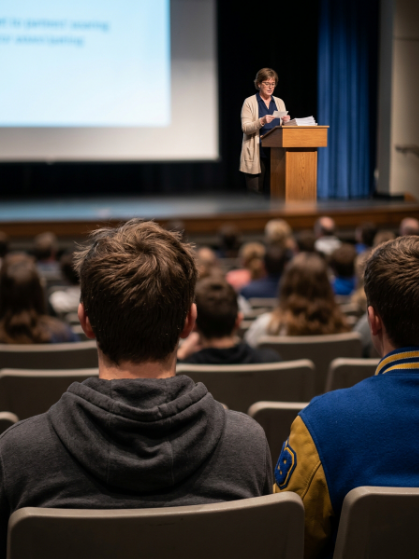
I let the silence sit there a moment. Then I folded the note back up.
“That note was passed in my classroom this afternoon,” I said. “About a student. A boy who carries more courage in his shaking hands than the author of this note carries in his whole body.”
I picked up the second piece of paper.
“This,” I said, “is what that same boy wrote. It won first place in the state young-writers competition this week. Out of four thousand entries. I’d like to read it to you, if his hands will forgive me for not asking him first.”
And I read Caleb Moss’s essay.
It was called “Steady.”
It was about his father. A man who worked two jobs and still made it to every appointment. About how, when Caleb was small and frightened of his own trembling hands, his dad would fold them inside his two big steady ones and say, “Steady. I’ve got you. The shake doesn’t get to decide who you are.”
It was about the morning last spring when his father didn’t wake up. About how Caleb’s hands shook so badly at the funeral that he couldn’t hold the program. And how he heard his father’s voice anyway, in the quiet. Steady. I’ve got you.
The essay ended on a line I have read a hundred times since.
“My hands shake because they are mine. They are the same hands my father held. I would not trade the shaking, because I would not trade the holding.”
By the time I finished, half the room was crying. I was one of them. So, I noticed, were a few of the kids who used to laugh.
Caleb sat in the front row with his eyes wide, as if he could not believe the words he’d written in private were strong enough to fill a room.
They were. They filled it to the rafters.
The principal came up afterward and shook Caleb’s trembling hand for a long, long time. The superintendent emailed the next morning. They wanted Caleb to read “Steady” aloud at the district ceremony in the spring.
Caleb’s mother was in the audience too, near the back, in her work uniform. She told me later that she had not really heard her son’s voice — not the whole of it — since his father died. She said that for three minutes, in a borrowed school auditorium, she got her boy back, and a little of her husband too. I have taught a long time for a sentence like that one.
Jordan Beck’s mother found me in the parking lot. She had been in the audience. She had heard her son’s note in her own ears, in a flat teacher’s voice that stripped away everything that made it feel clever.
She didn’t make excuses. She asked what Jordan could do.
I told her the truth. “He can apologize. Not a performance. A real one. And then he can spend the rest of the year proving he meant it.”
Here is what surprised me.
He did.
It started clumsy, the way real things do. Jordan began saving Caleb a seat. Picking up his pencil when it rolled off the desk and handing it back without a word. By winter they weren’t friends, exactly. But they were something. Two boys learning that cruelty is the easy thing, and the easy thing is almost never worth doing.
I have broken my one rule exactly once in twenty-six years of teaching.
I do not embarrass children.
But I have learned there is a difference between embarrassing a child and refusing to let a child be erased. That night I was not humiliating Jordan. I was making a whole room look — really look — at a boy it had quietly decided not to see.
Caleb keeps a framed copy of “Steady” on his desk now. He told me he wants to be a writer someday.
His hands still shake.
He writes anyway.
Steady. Somebody’s got him.