A Stranger’s Voice in the Produce Aisle Made My Hands Shake FULL STORY
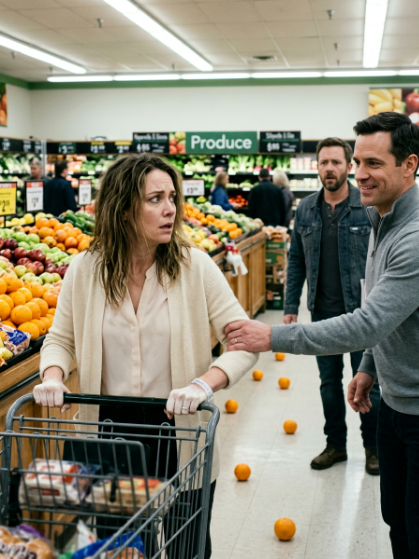
Adam’s hand tightened on my elbow, and I let him start to turn me toward the exit, because that’s what I’d been trained to do for fourteen months. Be agreeable. Don’t make a scene. Trust the man who knows your life better than you do.
But my feet wouldn’t move right.
The man in the denim jacket said one more thing to my back, quietly, like he was afraid of breaking something.
“You used to hum when you were scared,” he said. “Mom taught you. You’re humming right now.”
I stopped.
I hadn’t noticed. But I was — a low, tuneless hum under my breath. The one I do in the MRI machine. The one I do at the dentist. The one Adam always told me was “a nervous habit we should really work on.”
A stranger doesn’t know the sound your fear makes.
A brother does.
I turned around. Adam’s hand went from guiding to gripping.
“Nora, we’re leaving,” he said — and for the first time in fourteen months I heard it. Not concern. Command. The exact tone you’d use on a dog wandering toward a road.
“Who are you?” I asked the man in the denim jacket. My voice came out shaking.
“David,” he said. “David Mercer. I’m your brother. Your name is Eleanor. Ellie. You’re four years younger than me, and you used to follow me around with a plastic stethoscope, and that’s why you became a—”
“That’s enough,” Adam snapped.
“—a nurse,” David finished, his voice cracking on the word, “before the fall.”
A nurse.
Adam had told me I’d never finished school. That I’d been “between jobs” for years. That the medical words that sometimes surfaced in my head — sats, BP, push fluids — were things I’d picked up from TV.
I looked down at the faded band on my wrist. The hospital one. The one Adam said I should keep on “for the memories.”
I’d never been able to read the small print before. I read it now.
It wasn’t a patient band. It had a name and a title. NORA MERCER, RN.
Mercer. Not Bennett.
The floor of my whole careful little life tilted.
David pulled the worn paper from his pocket and unfolded it with shaking hands. A flyer. MISSING. My face on it — thinner, but mine — a phone number, and the words HAVE YOU SEEN MY SISTER.
“Two years,” he said. “He told the family you’d cut us all off. That you called us toxic and never wanted to see us again. He moved you twice. Changed your number. Every birthday, I drove to wherever I thought you might be and stapled one of these to a pole.”
“She fell,” Adam announced to the gathering crowd, smiling that reasonable smile. “She has memory problems. This man is harassing my wife—”
“She fell,” David repeated. He wasn’t looking at me now. He was looking straight at Adam, and his voice had gone very low and very dangerous. “Funny. That’s the same word you used when you called our mother to say Ellie didn’t want to speak to her. Right before you blocked the number.”
I don’t remember deciding to move.
I just remember letting go of the cart, stepping out of Adam’s hand, walking the three feet to my brother, and saying the truest thing I’d said in fourteen months:
“Hum it with me. The song. If you really know it.”
And he did.
A soft, broken, off-key little melody, right there in the produce aisle with the oranges still rolling across the floor.
The second his voice carried the tune my mother apparently taught us both, something in my chest broke open and I started to cry — because my body remembered him even though my mind couldn’t. The fear had never been mine. It had been installed. Adam had spent fourteen months pairing the people who loved me with the feeling of danger, so I’d run from the only hands that could pull me out.
It took months to prove the rest. But it proved.
My old phone — the one Adam said was “lost in the fall” — turned up in a box in the garage, and a technician recovered it. On it were forty-three texts from David. None I had ever seen. All read on my account, and deleted.
There was a journal, too. Mine. From before. The last entry, three days before my fall, read: I think he’s been lying to me about my own sister. I’m going to call her tomorrow.
I never made that call. I fell down the stairs that night.
The police have the journal now. That’s a different story, and it isn’t finished yet.
But this part is.
I live near David now, in the town I grew up in — the one Adam moved me three states away from. My mother’s memory isn’t perfect anymore either, but she knew me the second I walked in. She didn’t need my mind to remember. She held my face and hummed.
I’m working to get my nursing license reinstated. My hands remember more than I expected. Muscle memory, they call it. The body keeps the things that matter.
Sometimes the old fear still rises for no reason — a certain tone, a hand on my elbow.
But now I know what it is. It isn’t a warning. It’s a scar.
And scars can’t tell you who to run from.
Only the people who love you can do that. I just had to relearn how to hear them.