A Misread Bruise Took My Son FULL STORY
Dr. Priya Anand did not perform for the room. She just told the truth, and the truth did the rest.
“I’m a pediatric hematologist,” she said. “That means I study children’s blood. I read Leo Pruitt’s lab work from the night he came into the emergency department. May I show the court what everyone skipped past?”
The judge nodded.
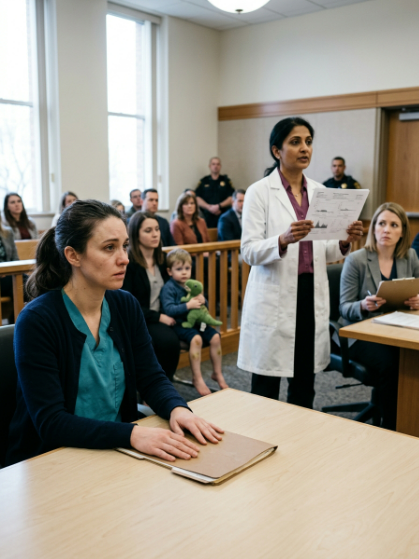
She laid it out plainly. The night the ER flagged us, they had also drawn a basic blood panel. Standard. Then they got pulled into the bruises and never went back to look at the numbers.
A four-year-old’s platelet count, she explained, should sit somewhere around two hundred and fifty thousand.
Leo’s was nine thousand.
“At nine thousand,” she told the judge, “a child bruises if you lift him too fast. He bruises in his sleep. He bruises from the elastic of his own waistband. This is not a child somebody hurt. This is a child whose blood cannot clot.”
The name for it was immune thrombocytopenia. ITP. The body’s own defenses attacking its platelets, often after a simple virus.
Leo had a cold three weeks before the bruises started. I remembered it. I remembered wiping his nose at four in the morning before my shift.
“The bruising that was labeled non-accidental,” Dr. Anand said, “is, in fact, textbook for this condition. I would expect a first-year resident to recognize it.”
I started to cry. Quietly. I’d sworn to myself I wouldn’t.
Across the aisle, Karen Voss finally set down her pen.
She asked one question. “Why wasn’t this caught sooner?”
Dr. Anand looked at her, not unkindly. “Because once the word abuse is written in a chart, people stop looking for anything else. Including, I’m sorry to say, the people who wrote it.”
The judge called a recess.
When we came back, it took nine minutes to undo eleven days.
The petition was dismissed. The emergency removal was vacated. The judge ordered Leo returned to me that same afternoon. Then he looked at me and said something I will keep for the rest of my life.
“Ms. Pruitt, this court is sorry.”
No one had said that word to me yet. Not once in eleven days.
They brought Leo to a little family room with plastic chairs and a donated box of toys.
He came through the door with the green dinosaur tucked under his arm, the one I’d sent so he wouldn’t be alone in the dark.
He stopped when he saw me. Like he wasn’t sure I was allowed to be real.
Then he ran.
I caught him so hard the chair tipped over behind me. I didn’t care. I held my son and breathed in the top of his head and felt eleven days slide off me like a soaked coat.
“I told them you’d come,” he whispered into my neck. “I told them my mama always comes.”
It would be a lie to say everything snapped back to normal.
Leo had nightmares for a while about “the other house.” I had nightmares about a clipboard. There are still nights I get up twice just to watch him breathe.
But the diagnosis turned out to be the manageable kind. Dr. Anand became his doctor. His platelets climbed back up with treatment. He is a loud, clumsy, perfectly ordinary four-year-old again, and I have never been so grateful for an ordinary bruise on an ordinary shin.
Karen Voss asked to meet with me a month later. I almost didn’t go.
She didn’t make excuses. She told me the county was changing its protocol. From now on, unexplained bruising in a young child would require a blood and hematology consult before a removal, not weeks after one.
She said they were quietly calling it an internal policy update.
I asked if it had a name. She hesitated, then admitted the working file called it the Pruitt review.
I don’t know if that is a comfort. A protocol with my son’s name on it, born from the worst eleven days of our lives.
But I think about the next mother. The one who will carry a bruised, feverish child through those ER doors some night, terrified, and get a blood test instead of a clipboard.
She will never know my name. She will never know how close it came.
That’s all right.
Dr. Anand said something to me the day she handed Leo back, and I think about it constantly.
“The bruises were telling the truth the whole time,” she said. “Someone just had to be willing to read them.”