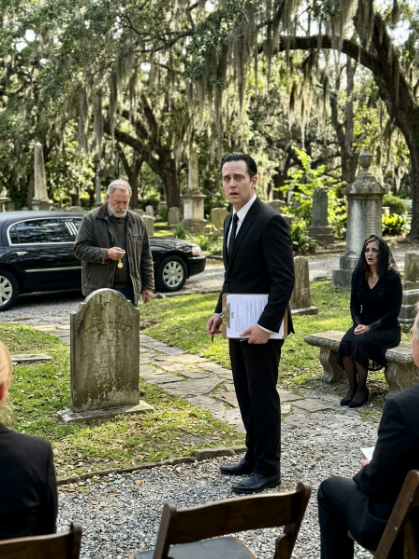
The signed notary certificate on the attorney’s clipboard was the only proof that my father was alive at nine o’clock this morning, even as my brother stood beside his open grave, reading a will that claimed he had died last week.
My name is Clara Hall. At forty years old, wearing a black lace veil that did little to hide the tears on my face, I sat on a cold stone bench under the mossy oak trees of a cemetery lawn in Savannah, Georgia. The warm afternoon sun filtered through the branches, casting dappled shadows on the freshly dug earth. It was my father’s funeral service, but instead of grieving, I was forced to watch my older brother Douglas turn the solemn occasion into a hostile corporate takeover.
Douglas Hall, forty-five, stood near the gravestone with a smug grin on his face. His slick dark hair was combed perfectly, and he wore a black suit that looked completely out of place against the quiet, rustic beauty of the cemetery. He held a will clipboard in his hands, tapping the papers with a silver pen.
“Under the terms of this final will,” Douglas announced, his voice carrying over the small group of mourners, “father has left the Savannah estate and all corporate shares of Hall Logistics to me. Clara, you have thirty days to vacate the house. The executors have already approved the transition.”
I clutched my hands together in my lap, my chest tight. Our father, Arthur Hall, had been a quiet, loving man who had spent his life protecting us. I knew he would never have disinherited me, let alone left Douglas in charge of the company he had spent forty years building. But Douglas had controlled father’s medical care at the private clinic during his final days, blocking me from visiting. When the clinic called to say father had passed, Douglas had rushed to organize a closed-casket funeral, refusing to let me see the body.
“Douglas, please,” I said, my voice shaking behind my black veil. “Father’s body is barely in the ground. Can we not do this here?”
“Business doesn’t stop for sentiment, Clara,” Douglas replied coldly, waving the clipboard. “The law is the law. The signature is right here. It’s time for you to accept that you’ve been cut out.”
Before the priest could begin the final commendation, the quiet of the cemetery was broken by the sound of tires crunching on the gravel path.
A long, polished black limousine pulled up near the lawn, parking under the shade of a massive oak tree. The driver’s side door opened, and a young man in a notary uniform stepped out. He walked quickly toward our family lawyer, Mr. Gentry, who was standing near the stone path. The young man handed a single sheet of paper to Mr. Gentry, whispering something in his ear.
Mr. Gentry’s eyes went wide as he stared at the paper. He walked over to the grave, his hands trembling as he held up the document.
“Douglas, wait,” Mr. Gentry said, his voice loud enough to silence the crowd. “We cannot proceed with the burial or the reading of this will. I have just been handed a certified, signed notary certificate.”
Douglas scoffed, his face tightening. “What are you talking about? What certificate? This is my father’s funeral.”
“It’s a notary certificate, signed and stamped in the city of Savannah at exactly nine a.m. this morning,” Mr. Gentry said, his voice shaking. “It confirms that Arthur Hall was present in their office, showed his legal identification, and signed an affidavit voiding all previous power of attorney.”
“That’s a lie!” Douglas shouted, his slick dark hair disheveled as he pointed accusingly at the lawyer. “My father is in that casket! He died in the clinic last Tuesday! This is a cheap stunt!”
But as the words left his mouth, the passenger door of the black limousine swung open.
A man stepped out onto the gravel path.
He was sixty-eight years old, with a thick grey beard and a weathered face, wearing a worn green canvas jacket over a flannel shirt. He walked slowly but steadily toward us, his boots clicking on the stone path. In his right hand, he held a silver pocket watch, its glass face cracked, catching the afternoon sun.
It was my father, Arthur Hall.
Douglas stood frozen near the gravestone, his hand clutching the will clipboard, his face turning a sickly, pale color as his jaw dropped in absolute horror. He looked from the casket to the man walking toward him, his knees trembling.
I stood up from the stone bench, my hands flying to my mouth as I stared in complete disbelief. The father I had wept for, the man I believed was gone forever, was standing right in front of me, looking at my brother with a cold, resolute gaze.
Arthur Hall walked up to the edge of the open grave, his heavy boots stopping just inches from Douglas’s polished loafers. He looked down at the polished mahogany casket, then slowly turned his gaze to my brother, his expression filled with a mixture of sadness and stern disappointment.
“You couldn’t even wait for the dirt to hit the lid before you tried to throw your sister out of her own home, could you, Douglas?” my father said, his voice deep and raspy, carrying the familiar weight of authority.
“Father…” Douglas whispered, his voice cracking as he took a step back, his knees bucking. The clipboard slipped from his fingers, clattering onto the stone path. “How… how are you alive? The clinic… the doctors said you passed away from cardiac arrest. I have the official death certificate right here in my hand.”
“You have a forged death certificate, Douglas,” father said, pulling his silver pocket watch from his pocket and looking at it. “A certificate you paid a corrupt doctor at that private clinic fifty thousand dollars to write. You wanted me dead on paper so you could execute this fraudulent will and take control of Hall Logistics before the board audited the shipping accounts.”
“That’s not true!” Douglas cried, his eyes darting toward the cemetery gates. “I was just trying to manage the estate! I was trying to protect the company!”
“You were trying to steal it,” father said quietly. “And you didn’t care if you left your sister with nothing. But what you didn’t know is that I’ve been watching you. I’ve been hiding in a safe house in Savannah for the last week, working with Mr. Gentry and the federal investigators.”
I stepped forward, my hands shaking as I pulled back my black lace veil. The tears were running freely down my cheeks now, but they were no longer tears of grief. “Father… why did you hide? Why didn’t you tell me? I thought you were gone. I was so alone.”
Father looked at me, his eyes softening as he walked over and took my hands in his. His palms were rough and warm, the solid reality of him making my heart soar. “I am so sorry, Clara. I had to keep you in the dark to keep you safe. My former business partners, the ones Douglas was secretly colluding with, threatened to harm you if I didn’t sign over the shipping rights. I had to make them believe I was dead so they would drop their guard and let their shell companies transfer the funds. It was the only way to gather the evidence the authorities needed.”
He turned back to Douglas, his expression hardening once more. “The federal marshals arrested those partners in Atlanta at eight o’clock this morning. And the local sheriff is waiting at the cemetery gates for you, Douglas.”
As if on cue, two sheriff’s deputies stepped out from behind the mossy oak trees, walking quickly toward us.
Douglas looked around frantically, realizing there was no escape. The smug, arrogant brother who had stood beside the grave trying to dictate my future was now reduced to a trembling, pathetic figure. The deputies stepped up, picking up the discarded clipboard from the path and placing handcuffs around Douglas’s wrists.
“Douglas Hall,” one of the deputies said, reading from a card. “You are under arrest for corporate fraud, conspiracy, and the forgery of a public death certificate.”
They led him away down the stone path, his head bowed, his slick dark hair falling over his face. The small crowd of mourners watched in stunned silence as the limousine and the police cars drove away, leaving the cemetery quiet once more.
I looked at the mahogany casket, then at my father, who stood beside me, holding his cracked silver pocket watch. It was a bittersweet victory. My brother was gone, likely to spend years in a federal prison, and our family was permanently fractured. But my father was alive, and the home he had built for us was safe.
Father wrapped his arm around my shoulders, drawing me close against his worn canvas jacket. “Let’s go home, Clara,” he whispered. “We have a lot of lost time to make up for.”