As she bent closer, a faint voice drifted up from inside.
PART 4
The engraved name belonged to Lily Dawson.
Detective Harris recognized it immediately after checking an old database.
Lily had disappeared almost twenty years earlier.
She had never been found.
Within hours, investigators reopened the cold case.
The bracelet itself had belonged to Lily, but there was no evidence that Julian had harmed her.
Further investigation revealed a different truth.
Julian’s late father had once volunteered with a search organization involved in the original case.
Among his personal belongings, which Julian inherited after his death, had been several boxes of forgotten items collected during volunteer searches.
The bracelet had been stored there for decades and hidden beneath the floorboards with other valuables.
It had no connection to Chloe’s abuse.
Instead, it reminded detectives how carefully Julian hid everything he considered important.
The real crime centered entirely on Chloe.
Forensic accountants followed the money.
Insurance investigators uncovered forged medical reports and fraudulent benefit claims totaling hundreds of thousands of dollars.
Doctors admitted they had been deceived by years of fabricated symptoms and altered records.
One physician sat outside the courtroom after giving testimony and quietly cried.
He had believed he was helping a desperately ill child.
Instead, he had unknowingly become part of the deception.
The trial lasted several weeks.
Jurors heard recordings of Chloe’s interviews.
They saw photographs of the hidden medication.
They listened as experts explained how repeated sedation had weakened her body and nearly cost her life.
Neither Julian nor Victoria could explain away the evidence.
Each tried to place the blame on the other.
The jury believed neither.
Both were convicted of multiple felonies, including attempted murder, aggravated child abuse, insurance fraud, unlawful imprisonment, and conspiracy.
The judge described the crimes as a betrayal of the most basic duty a parent could ever have.
Neither parent looked toward Chloe when the sentences were read.
Eleanor did.
She squeezed her granddaughter’s hand throughout the hearing.
Months later, family court granted Eleanor permanent custody.
The first night Chloe moved into her grandmother’s house, she wandered nervously from room to room.
“Can I really sleep wherever I want?” she asked.
“You can,” Eleanor smiled.
“And nobody will ever make you drink anything you don’t trust again.”
The nightmares did not disappear overnight.
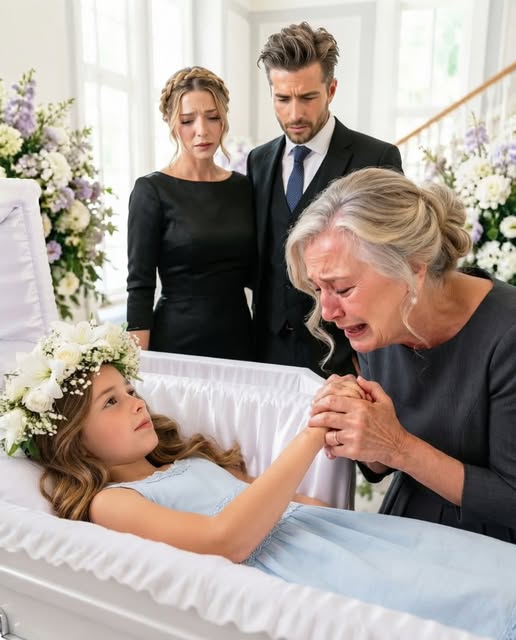
Sometimes Chloe woke screaming after dreaming she was trapped inside the white coffin again.
Eleanor never complained.
She simply switched on the bedside lamp, wrapped Chloe in the same black wool shawl that had carried her out of Julian’s house, and stayed beside her until she fell asleep.
A year later, Chloe returned to school healthy, laughing, and surrounded by friends.
During a class project, every child was asked to draw the person who made them feel safest.
Most drew parents.
Chloe drew her grandmother.
When Eleanor picked her up that afternoon, Chloe handed her the picture without saying a word.
Above the drawing were five carefully printed words.
“My Grandma Saved My Life.”
Eleanor framed it the same evening.
It hung beside the front door where she would see it every time she came home.
Sometimes she would pause before it and remember that terrible night.
The candles.
The white lilies.
The tiny coffin.
And the faint little voice that had refused to be buried.
Without that whisper, the truth would have disappeared forever.
With it, one little girl was given the chance to grow up.
“`