I was walking down the long white hallway of the training facility when I heard footsteps behind me.
“Officer,” a woman’s voice called out.
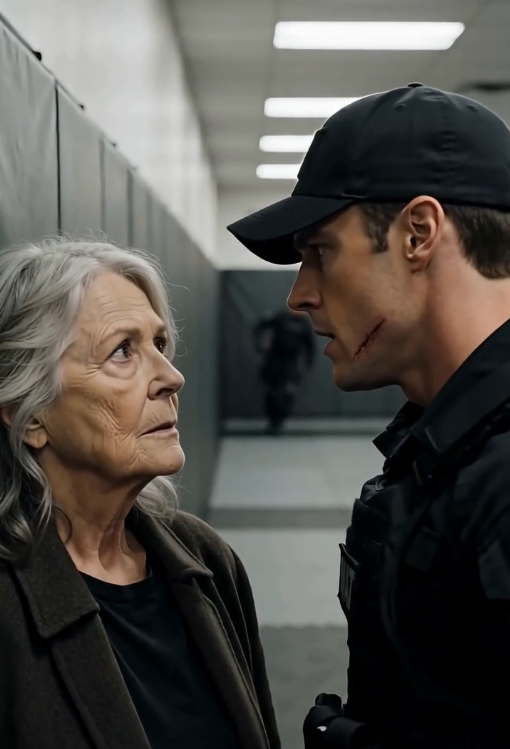
I turned around. An elderly woman stood a few feet away, one hand resting against the wall like she needed it to stay steady. She wore a brown wool coat that looked too heavy for the warm building, and her silver hair was coming loose from where it had been pinned.
“Ma’am, this area isn’t for visitors,” I said automatically.
She didn’t apologize or step back. She just looked at my face — specifically at the left side of my jaw.
“I recognize that scar,” she said.
My hand moved to my cheek before I could stop it. The scar was thin and pale, running from just below my ear down toward my jawline. Most people never noticed it unless the light hit it a certain way.
“I’m sorry?” I said.
She took one small step closer. Her eyes were the color of storm clouds, and they didn’t leave my face.
“The one from the night I pulled you through glass,” she said.
The hallway suddenly felt very quiet.
I was seven years old the night of the fire on Maple Street. My mother had carried my little sister out first. By the time she came back for me, the stairs were already gone. I remember the smoke, the heat, and the sound of glass breaking. Then hands — strong, older hands — reaching through the broken window, pulling me out even as the glass cut into both of us.
I never knew her name. I never saw her clearly. The next thing I remembered was waking up in the hospital with my mother crying and the doctors telling me I was lucky.
Thirty-two years later, that same woman was standing in front of me in a police training facility.
“You were so small,” she said, her voice cracking. “You kept saying you couldn’t leave without your bear. I had to promise I’d go back for it.”
I felt my throat close.
“I still have that bear,” I said. The words came out rough. “It’s on the top shelf of my closet. I never threw it away.”
She smiled then — a small, trembling smile that made her whole face look younger for a second.
“I’ve thought about you every year on the anniversary,” she said. “I used to drive past the house after they rebuilt it, wondering if the little boy ever came back to see it.”
I looked down at my vest, at the word SWAT printed in white letters across my chest.
“I became a firefighter first,” I told her. “For seven years. Then I joined SWAT. I guess… I wanted to be the one who goes in when everyone else is running out.”
She reached up slowly. Her fingers were cool and steady as they touched the scar on my face.
“I’m glad you lived,” she said simply.
Behind us, the sound of training continued — boots on the floor, voices calling out commands — but none of it felt real anymore.
I covered her hand with mine for a moment.
“What’s your name?” I asked.
“Eleanor,” she said. “Eleanor Whitfield.”
“Ryan Keller,” I told her. “Thank you, Eleanor. For the scar. And for everything else.”
She laughed softly through her tears.
“I didn’t give you the scar, young man. The fire did that. I just made sure you lived long enough to wear it.”
We stood there for a long time in that white hallway.
Two people connected by one night of broken glass and smoke, finally meeting in the light.