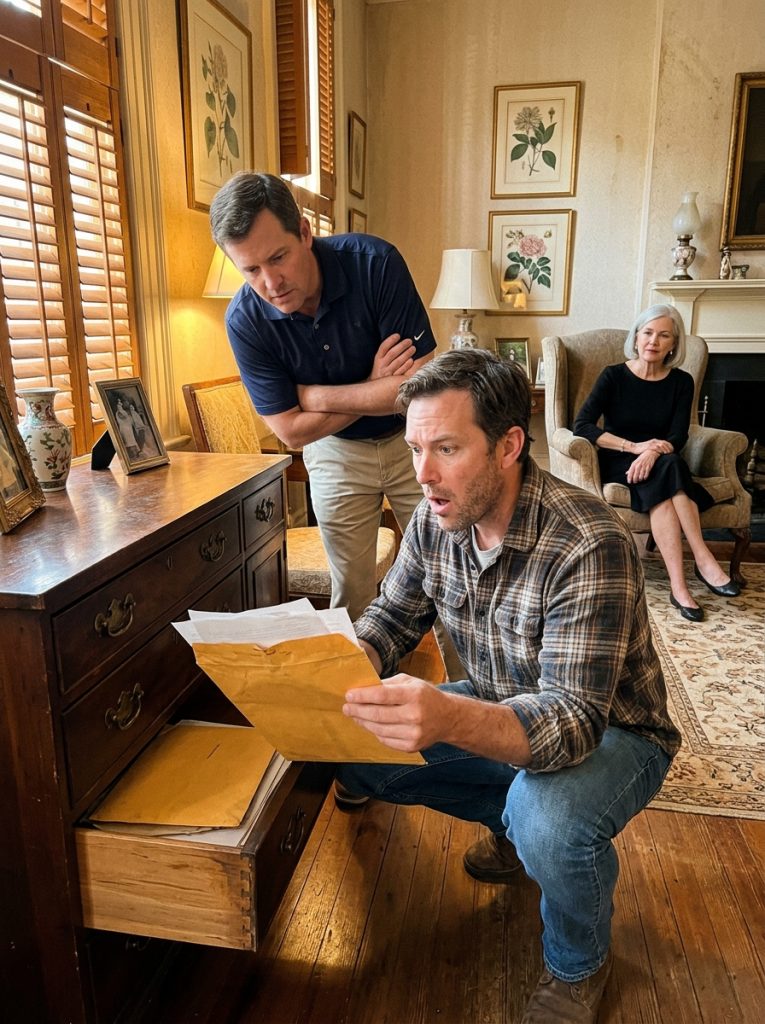
Boyd read the first line of the letter out loud.
“My dearest Margaret —”
Then his voice broke.
He was still crouching in front of the credenza, the manila envelope in one hand and the letter in the other, and his voice just stopped. He looked up at me — at his mother, sitting in the wingback chair by the window — and I saw something move across his face that I had not seen since he was a boy.
Clifford took the letter from Boyd’s hand. He cleared his throat. He read:
“My dearest Margaret. If you are reading this, it means the boys are in the house arguing about furniture, and you have finally told them to look in the right place. I trust your timing. I always have.”
Clifford’s voice was steady but his hands were not.
“What follows is not a surprise to you. It is a surprise to them. And that is by design. I watched our sons grow into men who measure worth by what can be sold. I do not blame them for this — I was not a man who talked about feelings, and perhaps they learned from my silence that value only lives in objects.”
“But you, Margaret — you learned the other thing. The thing I could never say well enough. That value lives in presence. In the Saturday mornings you polished this credenza without knowing what was inside it. In the eleven months you sat beside my bed and read to me when I could not hold the book. In the forty-three years you stood beside a quiet man and never once asked him to be louder.”
Boyd was crying. He was still on the floor, one hand on the credenza drawer, and he was crying without sound — just tears moving down his face while his brother read their father’s words.
Clifford continued:
“The certificates enclosed — 1,400 shares, transferred to your name in 2019 — are worth approximately $1.1 million at current value. The bearer bonds are worth an additional $87,000. These assets are yours. Not the estate’s. Not the boys’. Yours. I made the transfer specifically because I feared that without protection, the estate process would allow these to be liquidated before you could benefit from them.”
“I am not punishing our sons. I am protecting my wife. There is a difference.”
Clifford stopped reading. He looked at me.
I said, “Keep going.”
“Margaret. I want you to know three things. First: you were the best decision I ever made. Not the house. Not the job. Not the pension. You. Every morning I woke up and you were there, I knew I had made the right choice at twenty-five. Second: the boys will be angry at first, and then they will understand. Give them time. Third: when you decide what to do with this money — and I trust you to decide well — please keep the credenza. It was my mother’s, and it held her love letters during the war, and now it holds mine.”
“All my love, always. Thomas.”
The room was silent when Clifford finished reading.
Boyd stood up slowly. He wiped his face with the back of his hand. He looked at the credenza — this piece of furniture he had been ready to sell for four hundred dollars an hour ago — and something shifted in his expression.
Clifford set the letter on the wingback arm next to me. He took off his reading glasses and pressed his fingertips to his eyes.
I waited.
Then Clifford said, “Mom. I’m sorry.”
I said, “For what, specifically.”
It was not a cruel question. It was a real one. I needed him to name it.
He said, “For — for treating this like inventory. For walking through this house with a pricing app and talking about auction dates while you were sitting right here. For not — ” he stopped. “For not sitting with Dad the way you did. For not being here.”
Boyd said, “Me too.”
I said, “Thank you.”
That’s all I said. Because sometimes thank you is enough, and sometimes the conversation that needs to happen next needs to happen over days and weeks, not in a single afternoon in a living room with shutter-light on the floor.
The family attorney — Samuel Reeves, who had handled Thomas’s estate — was called the following Monday. He confirmed everything: the shares were legitimately transferred, the bearer bonds were valid, the total value was accurate. He also confirmed that the transfer was structured specifically to bypass probate — these assets were never part of the estate. They were mine from the moment Thomas signed the transfer in 2019.
Clifford and Boyd did not contest it. I believe the letter made that impossible — not legally, but emotionally. You cannot read your dead father’s words about your mother’s devotion and then take her money.
I made three decisions with the funds.
First: I established the Thomas Ellison Memorial Reading Room at the Charleston County Public Library. Thomas was a reader. He loved libraries the way quiet men love quiet places. The reading room was funded with $150,000 and opened in May. It has a wingback chair in the corner that looks very much like the one in my living room.
Second: I set aside education trusts for each of my grandchildren — Clifford’s two daughters and Boyd’s son. Small amounts. Enough for books. Enough for choices.
Third: I kept the rest. Because I earned it. Because forty-three years of Saturdays polishing a credenza, and eleven months of sitting beside a hospital bed, and a lifetime of standing beside a quiet man who never once asked me to be louder — that is worth something.
And Thomas knew it.
The credenza stays in the house. It sits against the wall in the living room where it has always been. The hidden drawer is empty now — the certificates are in a safe deposit box, the letter is framed on my bedroom wall.
But every Saturday, I still polish it. Same cloth. Same motion. Same warmth in the wood.
Not because I need to.
Because some rituals are not about what’s inside.
They’re about who you became while you were keeping the promise.
I want to say one last thing. About the letter.
It’s framed on my bedroom wall now. The cream-colored stationery, Thomas’s careful handwriting, the slight tremor in the letters from the last months when his hands were beginning to fail.
I read it every morning when I wake up. Not the whole thing — just the first line and the last line.
“My dearest Margaret —”
And:
“All my love, always. Thomas.”
Forty-three years between those two lines. Forty-three years of Saturdays and reading aloud and quiet evenings and the particular kind of love that doesn’t announce itself but simply persists — steady, reliable, present.
Clifford calls more often now. Once a week. Sometimes he asks about the house, sometimes about the grandchildren, sometimes he just asks how I’m doing. He is learning, slowly, that presence doesn’t require a reason.
Boyd comes for Sunday dinner. He brings his son. The boy is seven — the same age Boyd was when Thomas first showed him the credenza. I haven’t shown the boy the hidden drawer yet. But I will. When he’s ready.
Some secrets are meant to be passed down. Not the financial kind — those are in a safe deposit box where they belong. But the other kind. The kind that teaches a child that love can be quiet and still be enormous. That devotion can be invisible and still hold up a family.
Thomas knew that.
He lived it every day of his life.
And he put it in a drawer, and he trusted me to open it at the right time.
I did.
And I’ll keep polishing that credenza every Saturday for as long as I’m able.
Not for what’s inside.
For who put it there.
And for the promise I made to keep it safe.