Gerald’s face.
That’s what people always ask me about. What did Gerald’s face look like when Raymond stepped out of that car?
I’ll tell you.
It went through three stages in about four seconds. The first was confusion — the genuine, uncomprehending blankness of a human brain encountering something it has categorized as impossible. Gerald Meeks believed, with every fiber of his constructed reality, that Raymond Cole was dead. He had attended the memorial. He had given a eulogy. He had filed insurance claims against a dead man’s policy.
The second stage was recognition. His mouth opened. Not words — just the reflex of a jaw dropping when the body understands something before the mind can process it.
The third stage was fear.
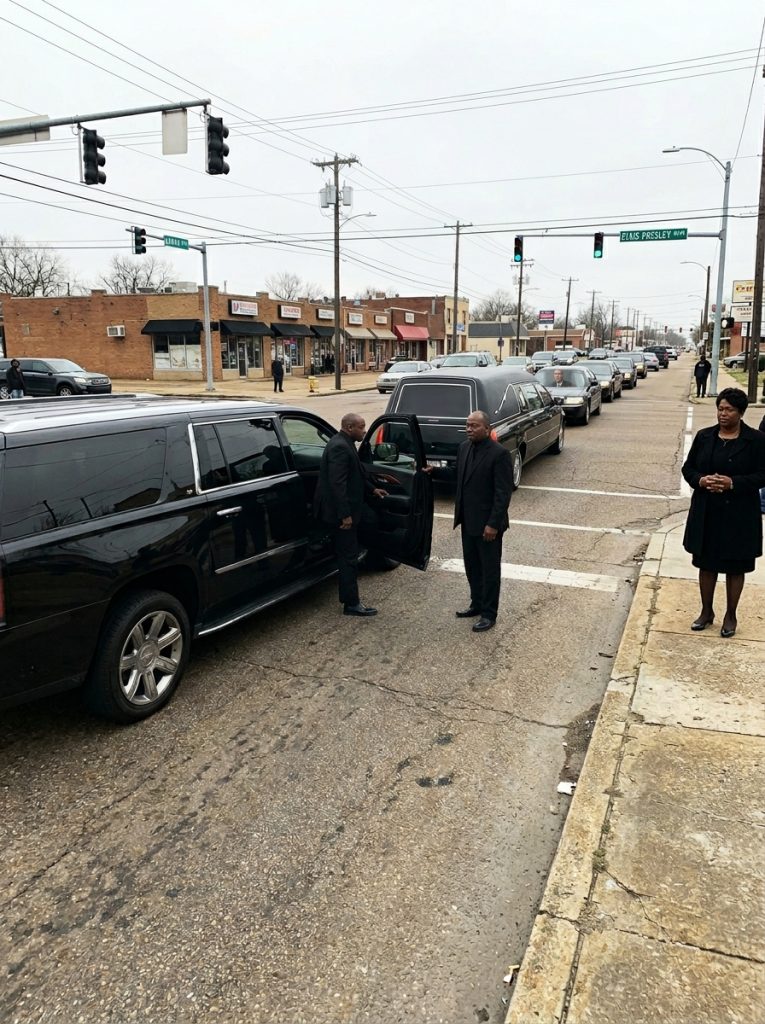
Gerald Meeks understood, in that moment, standing in the back of a limousine at an intersection in South Memphis, that he was looking at a trap that had already closed.
Raymond did not move immediately. He stood at the SUV door — one hand on the frame, black suit, no tie, expression deliberate — and he looked at the limo for five full seconds without speaking.
Then he walked.
He walked toward the limo slowly. Not threatening. Not hurried. The walk of a man who has planned something for five months and is watching it unfold exactly as designed.
The limo driver — an FBI agent — unlocked the rear doors remotely.
Raymond opened Gerald’s door.
Gerald was seated in the back, hands on his knees, face the color of ash. He said, “Ray — this is — what is — “
Raymond said, “Stand up, Gerald.”
Behind the limo, three cars back in the procession, doors opened simultaneously. Four agents — two men, two women, dark suits, credentials visible — stepped out and walked forward. They moved with the coordinated precision of people who have rehearsed this.
Gerald looked past Raymond at the approaching agents. He looked back at Raymond.
“You did this,” he said. His voice was barely audible.
“You did this,” Raymond said. “I just let you.”
One of the agents — Agent Martinez, I learned her name later — stepped forward and said, “Gerald Meeks? FBI. You’re under arrest for wire fraud, insurance fraud, money laundering, and filing fraudulent death benefit claims.”
Gerald did not resist. He did not run. He stood very still while Martinez read him his rights, and he looked at Raymond the entire time. Not with anger. With something worse — with the look of a man realizing that the person he had been stealing from for years had known, had watched, had waited, and had chosen the exact moment to end it.
They handcuffed him at the intersection. In front of fifty funeral cars. In front of a hearse carrying an empty casket. In front of mourners who were now scrambling out of their vehicles trying to understand what was happening.
Some of those mourners — I learned this later from the FBI case summary — were co-conspirators. The funeral home Gerald owned was staffed by people who knew the books were false. Three of them were in the procession that morning. They scattered. Two were apprehended within the week. One turned state’s witness.
I watched all of this from the sidewalk.
When the agents led Gerald to a waiting vehicle, Raymond finally turned and walked toward me.
He crossed Lamar Avenue in ten steps. He was not smiling. His face was tight — the particular tightness of a man who has been carrying something for five months and is finally allowed to set it down.
He stopped in front of me. He took both my hands.
He said, “It’s done.”
I said, “I know.”
He said, “I’m sorry.”
I said, “Don’t.”
I meant: don’t apologize for something we chose together. Don’t apologize for the six weeks I wore black and accepted casseroles and cried at a memorial service. I chose to be in this. I chose to trust the plan. I chose to stand on this sidewalk in a black dress and hold my breath while my husband came back from the dead in front of a hundred people.
We stood there for a long time. The intersection was clearing. The hearse pulled away — empty, irrelevant now. The procession cars were dissolving into traffic. A television crew had appeared from somewhere — Channel 5, I think — and was filming from across the street.
Raymond put his arm around my shoulders and we walked to a waiting car. An FBI vehicle. They drove us to the field office on Poplar Avenue — the same office where, five months earlier, Raymond had sat across from Agent Martinez and said: I think my partner is stealing from our clients, and I want to help you catch him.
The case was resolved in seven months. Gerald pled guilty to twelve counts. He received eight years federal. The funeral home was shuttered. The laundered funds — approximately $1.4 million over four years — were traced, frozen, and partially recovered for distribution to the 22 affected clients.
Raymond gave a real eulogy that evening. Not at a church. In our living room. Our daughter was there — she’d been told nothing until that morning, when we sat her down and explained everything. She was furious and relieved in equal measure. She punched Raymond’s shoulder and then she hugged him and didn’t let go for a long time.
The eulogy was for the 22 clients. For the years of trust Gerald had exploited. For the partnership that had once been real, before greed rewrote it.
Raymond stood in our living room and he said the names of every client whose claim Gerald had falsified. Twenty-two names. He said each one clearly and he paused after each.
That was the funeral. Not the procession. Not the hearse. Not the intersection.
Twenty-two names in a living room, spoken by a man who had been willing to die on paper to make sure justice was spoken out loud.
I still have the black dress. It’s in the back of the closet.
I don’t wear it.
But I don’t throw it away either.
It reminds me of what it costs to do the right thing — and what it looks like when someone loves you enough to let you stand on a sidewalk in the hardest six seconds of your life and trust that what comes next will be worth it.
It was.
I think about that intersection sometimes.
Not every day. But on Tuesdays. Because it was a Tuesday morning when Raymond stepped out of that SUV and the world rearranged itself in six seconds.
We rebuilt the business. Raymond renamed it — Cole Insurance Group, singular. No ampersand. No Meeks. He hired three new associates and brought back the clients who had been defrauded, one by one, with phone calls that began with: “I owe you an apology and an explanation.”
Most of them stayed. A few didn’t. Raymond understood that. Trust, once broken by proximity, doesn’t always survive — even when the person apologizing was the victim too.
Our daughter forgave him in stages. The first stage was anger — two weeks of barely speaking. The second was questions — months of them, careful and probing, the questions of a young woman trying to understand why her parents would choose to put themselves through something so extreme. The third stage was pride. That one came slowly, over a year, and it showed up in small ways — the way she mentioned “my dad” to her friends, the way she asked him to tell the story at family dinner one night.
He told it simply. The way he does everything.
Gerald Meeks is serving his sentence at a federal facility in Alabama. He does not write. We do not expect him to.
The funeral home on the south side was torn down last spring. They’re building a community center in its place. Raymond donated the building supplies. Quietly. Without his name on anything.
Some people rebuild the same way they tear down — loudly, publicly, with a name on every brick.
Raymond rebuilds the way he always built.
From one client. And a phone. And the belief that if you tell the truth, eventually the truth holds.
He was right.
It held.