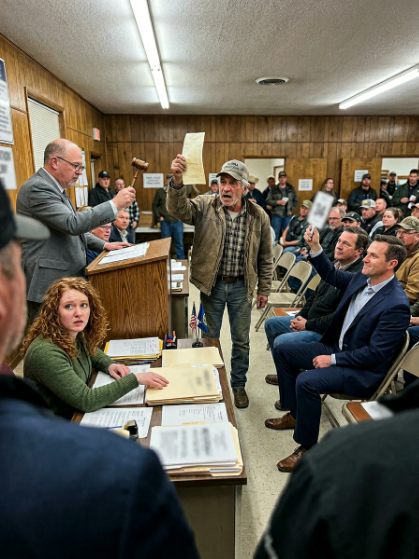
Bethany touched the wrong folder like it was hot.
Then she pulled her hand back.
For one second, I thought that would be the end of it.
The room had already decided what kind of man I was. An old orchard owner who missed a deadline. A man with a faded receipt and a shaky voice. A man standing in the way of people with clean shoes and parcel maps.
Miles Grant lowered the gavel just enough to look annoyed.
“Mr. Alvarez, this is not the proper channel for a dispute.”
“Then let her read the number,” I said.
Kellan Price laughed under his breath.
“This is sentimental theater.”
Bethany flinched at the word theater.
That was when I understood she was not afraid of me.
She was afraid of the truth making a sound.
I held the receipt higher.
The paper had gone soft at the fold lines. My thumb covered a coffee stain near the corner. The county stamp was still visible, though faint, and the receipt number sat at the bottom like the last honest thing in the room.
“Receipt 47-19-8836,” I said again.
Bethany closed her eyes.
Not long.
Just long enough to choose.
Then she opened the wrong folder.
A few people leaned forward. Kellan stopped smiling. Miles set the gavel flat on the podium, and that small sound carried through the room.
Bethany turned one page.
Then another.
Her hand was shaking worse than mine now.
“Please read it,” I said.
She looked up at me.
I do not know what she saw.
Maybe my age.
Maybe my fear.
Maybe the orchard behind me, though she had never walked it.
Her voice came out thin.
“Receipt 47-19-8836.”
No one laughed that time.
The number hung there over the folding chairs and parcel lists.
Miles stepped away from the podium.
“In which file?”
Bethany swallowed.
“Parcel 118-C.”
“That is not Mr. Alvarez’s parcel,” Miles said.
“No,” she whispered.
Kellan stood so fast his chair scraped the floor.
“This auction was publicly noticed. We are here in good faith. You cannot void a sale because someone found paper in the wrong drawer.”
“It is not a drawer,” Bethany said.
Her voice was still quiet, but something had changed in it.
“It is the county record. And I filed it wrong.”
There are moments when a room inhales as one body.
That was one of them.
I looked down at my receipt because looking at Bethany felt too intimate. Confession is not clean. It costs the person saying it before it helps anyone else.
Miles asked for the folder.
Bethany handed it over with both hands.
Kellan moved toward the table.
“This is irregular.”
Miles did not look at him.
“Sit down, Mr. Price.”
For the first time all morning, Kellan obeyed.
The county supervisor was called from upstairs. Her name was Linda Cho, and she arrived with reading glasses hanging from a chain and the expression of someone who had been told her day had just become public. She took my receipt, then the misfiled county copy, then the parcel notice.
She did not rush.
That almost killed me.
Every second felt like the orchard was being measured in someone else’s hands.
Linda compared the numbers. She checked the date. She checked the amount. She checked the parcel code that had been typed wrong in one place and carried wrong into another until my paid taxes looked unpaid.
Then she looked at Bethany.
Advertisement
“You processed this?”
Bethany nodded.
“Yes.”
“And you recognized it before the gavel fell?”
Bethany’s eyes filled, but she did not cry.
“Yes.”
Linda turned to Miles.
“Suspend the sale of the Alvarez parcels.”
Kellan’s face changed.
The delight drained first.
Then came calculation.
“Suspend?” he said. “We have bid deposits. We have financing lined up.”
Linda looked at him over her glasses.
“You have nothing on those parcels if the taxes were paid.”
He pointed at me.
“He disrupted a lawful auction.”
“He produced a lawful receipt.”
I had to grip the back of a folding chair.
Not because I was weak.
Because relief can hit like bad news if you have held your breath too long.
Miles announced the suspension. The gavel stayed on the podium. It never fell.
People began whispering. Some bidders packed up quickly, already hunting for the next piece of someone else’s trouble. Kellan lingered with his partners near the aisle, pretending to read his parcel sheet while watching Linda copy documents.
When he passed me, he stopped close enough that I could smell his cologne.
“You got lucky,” he said.
I looked at his polished shoes.
Then at my boots, dusty from walking the orchard that morning because I needed to remember what I was fighting for.
“No,” I said. “I got a receipt.”
He hated that more than an insult.
By afternoon, the county posted a correction notice. By the next week, the sale was formally voided for all three Alvarez parcels. The tax account was marked paid as of the original date, not the date they admitted the mistake. Linda called me herself to say no penalties would remain.
I thanked her.
Then I asked about Bethany.
There was a pause.
“She has been disciplined,” Linda said.
My chest tightened.
“Fired?”
“No. Written discipline. Retraining. File audit rotation for six months.”
I looked out my kitchen window at the orchard rows.
The trees were bare then, still waiting for spring. Bare trees look dead to people who do not know them. To me, they looked like patience.
“She told the truth in public,” I said.
Linda was quiet.
“I know. That is why she still has a desk.”
Two days later, Bethany came to the orchard.
She parked near the packing shed in a little blue car and stood outside like she needed permission to walk on the gravel. She wore the same green sweater. Her hair was down this time. In her hand was a new certified copy of the corrected county record.
I met her by the gate.
She apologized before I could say hello.
Not the fast kind.
Not the kind people use to escape discomfort.
She said she was sorry for the mistake, sorry for hesitating, sorry the county’s error had made me prove what they should have protected.
I listened.
Then I showed her where my father planted the first twelve trees.
She looked surprised.
Maybe she expected me to stay angry.
I was angry.
But anger is not the only thing a person can be.
We walked past the irrigation ditch and the old ladder hooks on the shed wall. I told her my mother used to write payment dates on a calendar by the stove. I told her my father kept every tax receipt in cigar boxes after nearly losing land once in the seventies.
“I thought that was old-man habit,” I said.
Bethany held the corrected record against her coat.
“It saved you.”
“No,” I said. “You did the part the receipt could not.”
She cried then.
Quietly.
I pretended to study a branch until she was done.
The next season, I took the first crate of good apples to the county office. Not many. Just enough for the front desk, the file room, and one small bag with Bethany’s name written on it.
Kellan’s warehouse project moved two exits down, where the land had already been sold by someone who wanted out. I saw his name in the paper once and turned the page.
My orchard stayed an orchard.
That was the win.
Not that a rich man looked foolish for half a morning.
Not that the county had to correct itself in public.
The win was walking between rows at dusk and hearing sprinklers start under trees that almost became a parcel number.
I keep the faded receipt in a frame now, next to my father’s pruning shears.
The paper is ugly.
The proof is beautiful.