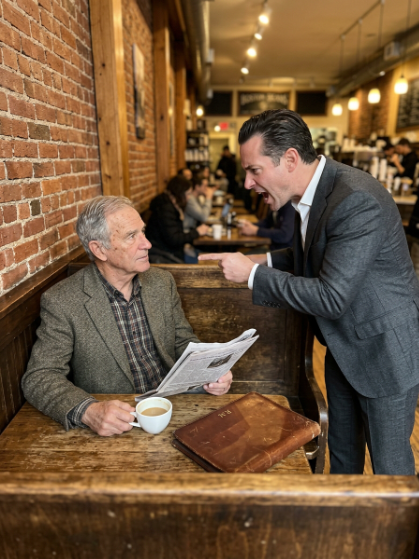
Greg Vance sneered, snatching page four of the document from the table with a quick, dismissive flick of his wrist.
His slick dark hair caught the light of the modern coffee shop, and the expensive watch on his wrist clinked against his designer suit as he held the paper up to his face.
‘What is this?’ Greg laughed, a loud, mocking sound that echoed off the brick walls and wooden tables. ‘A letter from some private trust? You think a fancy LLC name is going to scare me, old man? I run this district. I answer directly to the regional president, and I tell you who stays and who goes. This document doesn’t mean a thing to me.’
I sat calmly, my weathered hands resting on the table beside my newspaper, taking a slow sip of my black coffee from the white ceramic cup.
‘I suggest you read the second paragraph, Greg,’ I said softly, my voice carrying a steady, quiet confidence that seemed to make his laughter die down. ‘Particularly the signature line at the bottom.’
Greg’s smirk flickered, his eyes dropping to the second paragraph of the document.
As he read, the color began to drain from his face, his features tightening in sudden, icy confusion.
His eyes darted from the paper to my worn tweed jacket, then to the worn brown leather portfolio with the brass monogram ‘R.M.’ resting on the table.
‘Miller Holdings LLC…’ Greg whispered, his voice cracking as he looked at the signature line. ‘Raymond Miller. You… you’re Raymond Miller?’
‘I co-founded this company forty years ago, Greg,’ I said quietly. ‘And my private trust still holds sixty percent of the voting shares. I may have retired from active management, but I never stopped keeping track of how my employees are treated.’
I remembered when my partner Arthur and I first opened our cart in East Boston in 1986.
We roasted the beans in a tiny garage, swept our own floors, and served our customers with a smile, promising our very first baristas that as long as we were successful, they would have a share in the profits.
We believed that a business was only as good as the respect it showed its workers.
But over the last decade, after Arthur passed away and the new board took control, they shifted focus from quality and fair wages to stock buybacks, outsourcing, and cutting healthcare benefits to secure their own executive bonuses.
They hired managers like Greg Vance—men who believed that leadership meant intimidation, cutting hours to the bone, and treating the staff like disposable assets.
For the last twelve days, I had sat in corner booth three, watching Greg Vance run this shop like a personal fiefdom.
I had watched him force a young barista to work a ten-hour shift while she was visibly sick, threatening to fire her on the spot if she left.
I had seen him dock the tips of the entire staff because the cash register was short by three dollars.
I had logged every single safety exit he blocked with extra boxes of inventory just to save a few dollars on off-site storage.
And today, his arrogance had finally run out of runway.
At that moment, the bell above the coffee shop door chimed, and the heavy glass door swung open.
Mr. Sterling, the regional president of the New England division, walked in, his face flushed and sweating as he scanned the room.
He wore a sharp charcoal suit and was flanked by two corporate assistants.
As soon as he saw me sitting in corner booth three, he ignored Greg entirely and walked straight over, bowing his head respectfully.
‘Mr. Miller,’ Mr. Sterling said, his voice filled with nervous deference. ‘I came as soon as your secretary called. I had no idea you were conducting a personal site inspection at this location today. I apologize if we kept you waiting.’
Greg stood frozen, his mouth slightly open, his hands trembling as he held the document.
The young barista, who had been wiping the counter with wide eyes, stopped completely, her jaw dropping as she realized who the quiet regular in the worn tweed jacket actually was.
The other customers in the shop fell silent, watching the sudden, dramatic shift in power.
‘Mr. Sterling,’ I said, nodding toward the empty chair opposite me. ‘I’ve spent the last twelve days sitting in this booth, reading my newspaper and drinking my coffee. And during that time, I’ve observed some very troubling practices.’
I tapped the worn brown leather portfolio on the table.
‘Inside this folder are detailed logs of every violation committed by Greg Vance. I have documented twelve instances of forced overtime without pay, three cases of illegal tip docking, and a clear record of safety exit doors being blocked to stack extra inventory. Not to mention the verbal abuse he has directed at the staff.’
Mr. Sterling’s face turned pale. He looked at Greg, his eyes filled with fury.
‘Greg,’ Mr. Sterling hissed, his voice cold. ‘Is this true?’
‘Mr. Sterling, please!’ Greg stammered, his slick hair disheveled as he took a step back, his hands gesturing frantically. ‘It’s a misunderstanding. I was just trying to increase the profit margins. I was only trying to meet the regional targets. The old man… I mean, Mr. Miller, was just sitting here for hours, and I thought…’
‘You thought I was just a defenseless regular who didn’t fit the ‘prestige’ of your corporate image,’ I interrupted, my voice remaining soft but absolute. ‘But this company was built on the hard work of the people behind that counter. We promised them they would always have a share in our success. We did not build this brand to enrich arrogant managers at the expense of our workers’ dignity.’
I looked at Mr. Sterling.
‘Greg Vance is terminated from his position as district manager, effective immediately. He has fifteen minutes to clear his desk at the regional office, and he will receive no severance.’
Mr. Sterling nodded quickly. ‘Of course, Mr. Miller. It will be handled immediately. Greg, leave your badge on the desk and get out.’
Greg Vance stared at us, his eyes wide with utter defeat.
He looked down at his expensive watch, then at the document in his hand, and slowly placed it back on the table.
He turned and walked out of the coffee shop, his head bowed, his designer suit looking empty and foolish as the glass door clicked shut behind him.
A soft cheer rose from the back of the counter.
I looked at the young barista, whose face was now glowing with relief and joy.
‘Thank you, Mr. Miller,’ she whispered, her hands no longer shaking.
‘You don’t need to thank me,’ I said, giving her a gentle, reassuring smile. ‘You did nothing wrong. And starting next week, the trust is restoring the full healthcare benefits for all hourly employees. We are also raising the starting wage by four dollars an hour and reinstating the profit-sharing program my partner Arthur and I created decades ago.’
The barista’s eyes filled with tears, and the other staff members began to applaud, a warm, joyful sound that filled the modern shop, reflecting off the brick walls and the wooden tables.
I sat back in my corner booth, feeling a deep, quiet satisfaction.
I took another sip of my black coffee, which had gone slightly cold, but tasted sweeter than it had in years.
I picked up my folded newspaper, adjusted my tweed jacket, and returned to my reading.
Power is best exercised quietly, and today, the coffee shop was finally a home again.