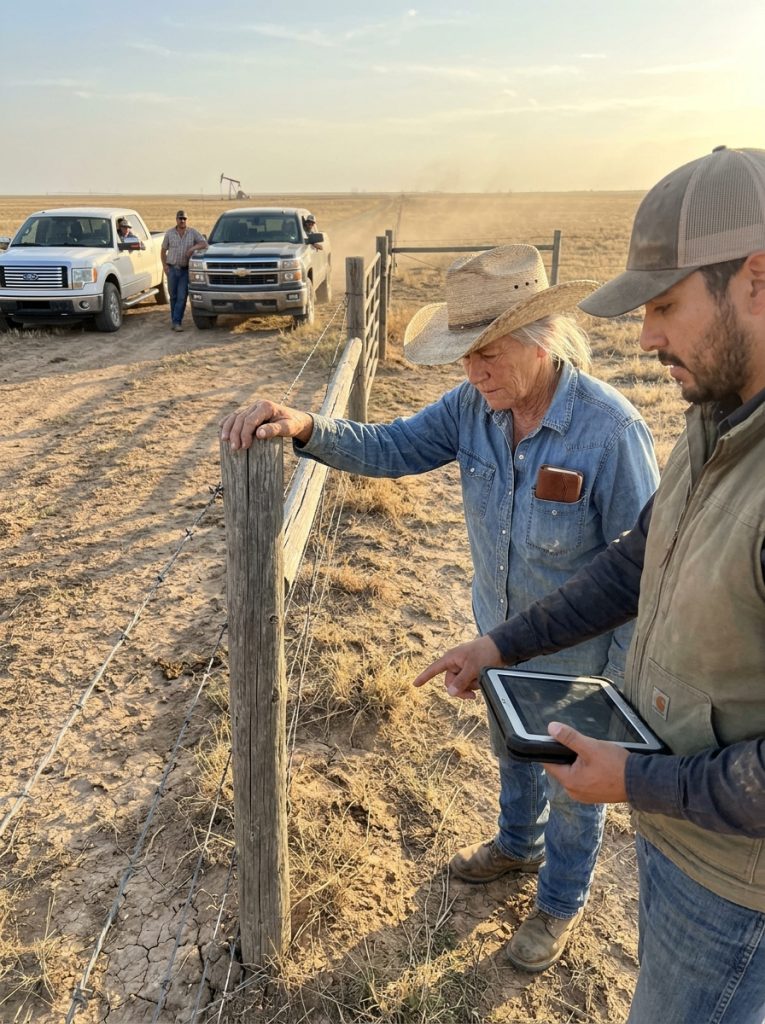
I did not sit down. Sixty-four years on this land, you learn to take news standing up.
“Tell me,” I said.
Caleb explained it slow, the way you’d explain to someone who didn’t go to school for it, which I appreciated. The Hargroves’ big lease next door had been producing for years off a formation everyone knew about. But Roy’s notebook, and the rock Caleb was scraping at my fence, pointed to something underneath that — a deeper formation that the old surveys had missed because nobody bothered to look hard under “the widow’s dust patch.”
“The geology doesn’t care about fences,” Caleb said. “If I’m right, the best of it isn’t under their lease at all. It’s under yours. Your husband spent forty years noticing what a rushed survey crew never would.”
I thought about Roy walking the fence line every evening with his notebook. I’d thought he was just an old man saying goodbye to his dirt. He’d been leaving me a map.
Now, I’m going to tell you the part where I could have gotten greedy, because that’s the part I’m proudest of, and it’s the part Roy would have cared about.
The first thing I did was not call an oil company. The first thing I did was protect myself. Caleb helped me find a real petroleum geologist and a sharp, plainspoken lawyer in Midland named Frances Boon who’d spent thirty years watching big operators take advantage of small landowners. Frances looked at the data, looked at me, and said, “Mrs. Pruitt, do not sign anything anyone hands you, and do not let those neighbors or that developer know what you know. Not yet.”
So I didn’t.
The developer called again about the eleven thousand dollars. I told him I’d decided to keep the land for sentimental reasons. He sighed, like I was being difficult. “Suit yourself, Mrs. Pruitt.” He had no idea what he’d nearly walked off with.
The Hargrove boys kept smirking at the gate. I kept waving. Let them grin.
It took the better part of a year. Frances ran a proper title search and confirmed what Roy had always made sure of — that when we bought the land, we’d bought the mineral rights with it, free and clear. A lot of folks out here don’t have that. We did. Roy insisted on it back when we were too broke to afford the extra, and I’d been mad about it at the time. Turns out the maddest I ever got at my husband was the smartest thing he ever did.
When the test results came back, they confirmed the formation. It ran under my north forty, just like Roy’s last shaky map said. The land everyone called worthless was sitting on top of something worth more than this county had seen in a generation.
Here’s where the story could turn into a different kind of story. The widow gets rich, buys a big hat, drives past the Hargroves with the windows down. I thought about it. Lord, I thought about it.
But that’s not what Roy would have wanted, and it’s not who he married.
When I finally signed a lease — a real one, negotiated by Frances, on my terms, for a fair royalty instead of a developer’s pocket change — I did three things.
First, I set up a trust in Roy’s name, so the land could never again be talked out from under a person who didn’t understand what they had. Frances built it so tight that no smooth-talking developer could ever pull the dust-patch trick on this property again.
Second, I went to see the Hargrove boys. Not to gloat. Their lease and mine sit on the same ground, and the smart play, Caleb told me, was to work together on the development rather than fight over the fence line in court for ten years. So I drove up to their place, and I’ll tell you, the grins came off real fast when they understood the widow they’d been mocking now held the better hand. I offered them a partnership anyway. Fair terms. “Roy would’ve wanted neighbors to act like neighbors,” I said. They were ashamed enough to take it, and decent enough, once shamed, to act right.
And third — the part that matters most to me — I went to the county and I funded things. The little school out our way that’s always one budget cut from closing. The volunteer fire station with the truck older than Caleb. A scholarship, in Roy’s name, for kids from ranch families who want to study the land the way he did, without a degree he never got the chance at.
Word got around the way it does in a small county. Sue Ellen Pruitt, who almost sold for eleven thousand dollars, was sitting on a fortune. Suddenly everyone remembered being my friend. The developer from Houston called four times in one week, his voice gone from condescending to honeyed, “circling back” to “revisit our conversation.” I let Frances handle him. She enjoyed it more than I did.
The Hargrove boys came around in person. They stood on my porch with their hats literally in their hands, and the older one, Wade, said, “Sue Ellen, we owe you an apology. We been mockin’ you at that gate for two years.” I gave them coffee. I’m not built to hold a grudge, and Roy always said a neighbor’s still a neighbor even when he’s being a fool. We worked out the partnership at my kitchen table, on the same oilcloth where I’d nearly signed my land away.
I did make one thing clear to all of them, gentle but firm. “I know how I got treated when you all thought I had nothing,” I said. “I’m going to remember it. Not to punish anybody. Just so I never treat another soul that way myself.” Wade Hargrove couldn’t look at me when I said it. Good. Some things ought to sit on a man a while.
The checks, when they started, didn’t feel real. I’d worked my whole life for hundreds, and here came numbers with too many zeros to fit in my head. I kept driving the same old truck. I kept my straw hat. Money doesn’t change what kind of person you are; it just turns up the volume on whoever you already were. I’d decided a long time ago, on this porch with Roy, what kind of person I was going to be.
The county doesn’t call it the widow’s dust patch anymore. They call it the Pruitt field. I don’t love the attention, but I love hearing his name out loud.
Caleb’s still around. The royalties bought him out of his student loans, and then I hired him on proper to manage the geology, because the boy earned it kneeling in my dirt when everyone else was laughing at the gate. He keeps Roy’s notebook in a glass case in the little field office now. Says it’s the best survey work he’s ever seen, done by a man with no instrument but patience.
Roy’s scholarship gave out its first award last spring — a ranch girl from two counties over who wants to study soil science the way he never got the chance to. I shook her hand and nearly came apart on the spot. Somewhere, I know, Roy was grinning.
I sit on my porch in the evenings, same as always. The pumpjacks turn slow against the orange sky. I’ve got more money than Roy and I ever dreamed of being broke and hopeful about, and I’ll tell you honestly, it’s nice, but it’s not the thing.
The thing is the notebook. Forty years of an old man writing down what nobody else would bother to see, on land everybody else called worthless, leaving his wife a fortune in handwriting she almost signed away for eleven thousand dollars.
He always said our land was enough.
Turns out he was right twice.