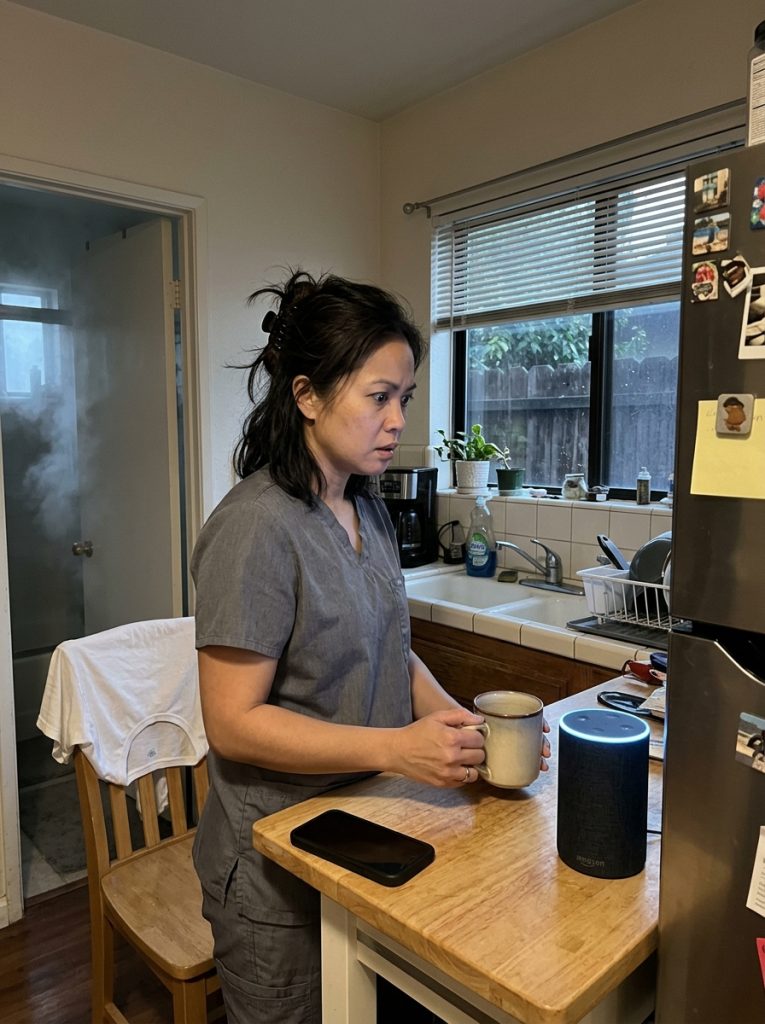
I didn’t confront him that morning. I made him an egg.
I know how that sounds. But I needed time, and time only stays on your side if the other person doesn’t know the clock has started.
So I scrambled an egg, kissed him goodbye, and watched his car pull out of the driveway. Then I sat down at the kitchen table with my grandmother’s folder and the little speaker still glowing on the windowsill, and I read every page.
The cabin on Jenkinson Lake was never Marcus’s. It was never even fully mine. My grandmother, Pearl, had put it in a family trust before she died, and the trust named exactly one trustee with the authority to book it, lease it, or sell it.
Me.
Marcus had used my login. He’d watched me type that password a hundred times across nine years of marriage. He thought the cabin was a shared toy. He never once read the document that said otherwise, because Marcus has never read a document in his life that he could get someone else to read for him.
I called the property manager, a kind man named Russ who’d known my grandmother.
“Russ,” I said. “There’s a reservation for anniversary week. Under the name Sloane.”
“Sure is,” he said. “Your husband set it up. Said it was a surprise for you.”
A surprise.
“It is,” I said. “Cancel it. Effective now. And Russ — going forward, no booking on that property happens without my voice on the phone. Not his. Mine.”
There was a pause. “You okay, Dana?”
“I will be,” I said, and I almost believed it.
Then I did the second thing.
I exported the speaker’s voice history — every timestamped request, his voice, his words — into a single clean file. I’m a scheduler. Organizing a timeline is the one thing I can do in my sleep. I matched each midnight booking and each whispered note to a night he’d told me he was working.
Twenty-two nights over fourteen months.
Twenty-two.
I didn’t cry until I saw the number. Then I cried for about ninety seconds, washed my face, and stopped. Crying was for later. The morning belonged to the work.
Last, I lifted the pineapple magnet off the fridge.
The sticky note underneath was in his handwriting. It said a name and a time: Sloane — 7:30, the Riverside place. It was dated that night.
He had a dinner. Tonight. While I was supposed to be at my mother’s.
I put the magnet back exactly where it had been.
That evening I did go to my mother’s — but first I made one stop.
The Riverside place is a steakhouse with big front windows, the kind where the people inside feel important and forget that the people outside can see everything.
I didn’t go in. I’m not built for scenes. I stood on the sidewalk in the blue evening light and I watched my husband pull out a chair for a woman in a red dress, and I watched him laugh the easy laugh, the 1 a.m. laugh, the one I’d heard come out of a glowing cylinder that morning.
Then I took one photo. Not for revenge. For the lawyer I’d already emailed at lunch.
And I went to my mother’s house, and I told her everything, and she held my hand across her kitchen table the way I’d held a thousand strangers’ hands in hospital hallways, and for once I let someone keep their face still for me.
Marcus came home at eleven. He smelled like someone else’s perfume and a restaurant we couldn’t afford on extra shifts. He found me at the kitchen table with my laptop open and the folder squared neatly in front of me.
“You’re up late,” he said.
“I am,” I said. “Sit down, Marcus.”
He sat, because the voice I used wasn’t angry. Angry he could have fought. This was the scheduler’s voice. The one that means the appointment is already on the books.
I turned the laptop toward him.
He saw the timeline first. Twenty-two rows. His own words in the leftmost column.
“Dana—”
“The speaker logs everything,” I said. “You knew that. You just thought I’d never look, because in nine years I never have. That’s the part that actually hurts, if you want to know. You didn’t outsmart me. You bet on my trust and you collected on it twenty-two times.”
His mouth opened and closed. “It’s not — Sloane is just—”
“From logistics. Exhausting. I remember.” I clicked to the next tab. “Here’s the cabin reservation you made for anniversary week. It’s cancelled. I cancelled it this morning, about four minutes after I heard you book it.”
“You can’t just—”
“I can, actually.” I slid my grandmother’s trust document across the table, the highlighted line facing up. “Read that. Out loud. I know it’s hard for you, but try.”
He didn’t read it. He just stared at my grandmother’s name and the word trustee and, underneath it, mine.
“It was never ours,” I said quietly. “It was hers, and then it was mine, and you booked another woman a week inside the one place on this earth my grandmother trusted me with. You used my login to do it. You said it was a surprise for me.”
For the first time in fourteen months, Marcus had nothing easy to say.
I didn’t burn anything down. That isn’t me. But the next morning I sent the timeline and the cancellation notice to exactly one place — the family group chat where his mother and his two brothers had spent nine years telling me how lucky I was that Marcus had “settled down.”
I didn’t add commentary. I didn’t need to. His own voice did the talking, twenty-two timestamps deep.
His mother called me within the hour. Not to defend him. To apologize. “I taught him better than this,” she said, and she cried, and I let her, because her face had stopped staying still too.
What surprised me most was how fast the story I’d believed for two years came apart once the timeline was in the open. Marcus tried, at first, the way charming people try. He told his brothers it was “complicated.” He told his mother I’d “invaded his privacy.” He actually said that — that I’d violated his privacy by listening to a device in our own kitchen that he had used, at one in the morning, to plan our anniversary with another woman.
Nobody bought it. That’s the thing about twenty-two timestamps. There’s no charming your way around a spreadsheet. His own voice had made the case, calm and happy in the dark, over and over, and no amount of “complicated” could soften it.
Sloane called me, eventually. Crying. She hadn’t known I scheduled surgeries for a living, or that the cabin had a dead woman’s initials carved into the porch rail, or that “the whole week, same as last time” meant there had been other weeks. He’d told her he was already separated. He’d told her a lot of things. I believed her, mostly. We were both just appointments to him — scheduled, confirmed, and confident.
The divorce is in motion now. The cabin stayed in the trust, untouched, where Pearl wanted it. I drove up alone last weekend and sat on the porch with my hand on the rail where her initials are carved, and I drank coffee that I made for exactly one person.
Marcus texts sometimes. Long ones. He’s discovered paragraphs now that there’s something he wants. I read the first line of each and then I do the thing I should have done years earlier.
I keep my face still, and I don’t reply.
The speaker still sits on the windowsill. Every morning I ask it to play the news.
These days, that’s all it has to tell me.