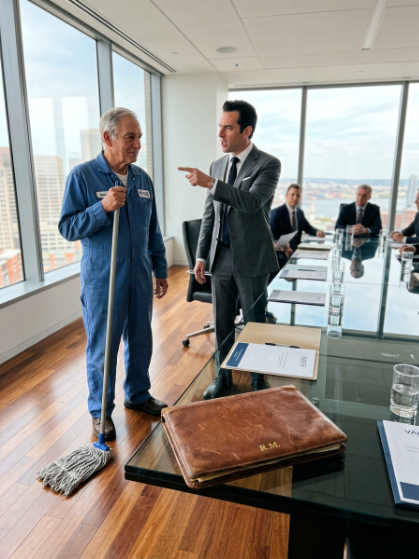
Greg Vance’s smirk didn’t fade immediately. He reached down and snatched the page from the worn leather portfolio, his movements quick and aggressive, as if he were trying to rip the document just by grabbing it.
‘You’ve got some nerve, old man,’ Greg sneered, holding the paper up to his face. ‘I don’t know what kind of fantasy you’ve cooked up in that janitor closet, but this company belongs to the Vance family. My grandfather built this empire, and I am the one who—’
He stopped.
His eyes locked onto the bottom of the page, where the official gold-embossed seal of the Vance Family Trust was stamped.
The color began to leave Greg’s face, starting from his temples and rushing down to his neck, leaving him a pasty, sickly white.
The sheet of paper began to tremble in his hand, the quiet rustle of the page the only sound in the high-tech boardroom of Vance Industries.
‘What is it, Greg?’ one of the senior board members asked, leaning forward. ‘Is there a problem with the cleaning contract?’
Greg didn’t answer. He couldn’t. His mouth was slightly open, his eyes darting back and forth across the lines of text as if hoping the words would change.
Arthur Vance, the oldest board member in the room and the brother of the late founder, stood up. He walked slowly toward Greg, squinting through his bifocals at the document in Greg’s hand.
Arthur looked at the paper, then looked up at me.
His jaw dropped.
‘Raymond?’ Arthur gasped, his voice trembling. ‘Raymond Miller? Is… is that really you?’
I smiled, my hands still resting on the handle of my wooden mop.
‘Hello, Arthur,’ I said softly. ‘It’s been a long time since we sat at the same table.’
The boardroom exploded into whispers. The younger executives looked confused, looking between me in my blue janitor jumpsuit and Arthur, who looked as if he had just seen a ghost.
‘Arthur, what’s going on?’ Greg stammered, finally finding his voice, though it was thin and pitched high. ‘Who is this man? Why are you talking to the janitor like he’s someone important?’
‘He is someone important, Greg,’ Arthur Vance said, his voice grave. ‘Forty years ago, before you were even born, Raymond Miller and my father, your grandfather Arthur, founded this company in a small garage in East Boston. Raymond was the genius who designed the original manufacturing lines. He was the one who kept the company running when we had no money.’
Arthur turned to the other board members, his face filled with awe.
‘When we went public, Raymond didn’t want the spotlight. He hated the corporate meetings and the press. So he put his controlling shares into a private trust and retired. We all thought he went to Florida. We thought he wanted to spend his days fishing.’
‘I did go to Florida, Arthur,’ I said, leaning my mop against the floor-to-ceiling glass window that overlooked the Boston harbor. ‘But after a few years, I got bored. And more than that, I got worried. I watched from afar as Arthur’s heirs began to take over. I saw the company shift from a manufacturing business that cared about its people to a financial machine that only cared about stock buybacks and executive bonuses.’
I walked slowly toward the table, my work boots quiet on the polished hardwood.
‘Twelve years ago, I decided to see for myself what this company had become. I didn’t want to sit in a boardroom and hear polished reports. I wanted to see it from the bottom. So, I applied for a janitorial position under my middle name. Nobody checked. To the HR department, I was just another old man looking for a pension.’
Greg’s face turned a furious red. He stood up, slamming his hands onto the glass table.
‘This is ridiculous!’ he shouted. ‘Even if you are Raymond Miller, that was forty years ago! You can’t just walk in here after twelve years of sweeping floors and tell us how to run Vance Industries! The trust is managed by an independent board!’
‘Read the next page, Greg,’ I said, tapping the leather portfolio.
Greg reluctantly turned the page, his fingers shaking.
‘The trust agreement states that as long as I am alive, I hold the sole voting power of the Vance Family Trust,’ I explained calmly. ‘Which owns sixty percent of the voting shares of this corporation. The independent board only manages the distributions. The final authority belongs to me.’
I looked around the room, making eye contact with each of the board members.
‘For twelve years, I have cleaned this boardroom. I have emptied your trash cans and wiped the grease from your coffee cups. I have listened to you plan layoffs while discussing your summer homes. And today, I listened to Greg Vance laugh about firing three hundred factory workers—the very people who work in the hot Boston summers to build the products that pay for your luxury cars.’
I took a deep breath, my voice growing firm.
‘The restructuring plan is vetoed. There will be no layoffs at the Boston plant. In fact, we are going to use the ten-million-dollar bonus pool that was earmarked for the executive team this year to fund a wage increase for the manufacturing staff.’
‘You can’t do that!’ Greg screamed, his voice cracking. ‘That’s my bonus! I earned that!’
‘You earned nothing but my disappointment, Greg,’ I said, looking at him with a mixture of pity and anger. ‘As the majority shareholder, I am calling for an immediate vote of the board to remove you from your position as Executive Vice President for gross mismanagement and unethical behavior.’
Arthur Vance was the first to raise his hand.
‘I vote yes,’ Arthur said, looking at his nephew with embarrassment.
Slowly, one by one, the other board members raised their hands. They knew where the power lay, and they knew they couldn’t fight the founder.
Greg Vance sank back into his leather chair, his face hollow, his slick hair looking suddenly greasy and disheveled.
‘You have thirty minutes to clear your office, Greg,’ I said. ‘Security will escort you from the building.’
The boardroom was silent as Greg slowly stood up, leaving his spreadsheets on the table, and walked out of the room, his head bowed.
I turned to Arthur Vance and the remaining board members.
‘Marcus,’ I said, addressing the corporate secretary. ‘Draft the paperwork for the wage increase and the cancellation of the layoffs. I want it on my desk—or rather, the janitor’s desk in the basement—by the end of the day.’
‘Raymond, are you going to take your seat at the head of the table?’ Arthur asked, gesturing to the executive chair Greg had just vacated.
I looked at the comfortable leather chair, then at my wooden mop leaning against the glass wall.
‘No, Arthur,’ I smiled. ‘I don’t fit in those chairs anymore. My back hurts if I sit too long, and besides, the third floor has a spill that needs cleaning.’
I picked up my mop, gathered my worn leather portfolio, and walked toward the boardroom doors.
As I opened them, the receptionist looked up, her eyes wide with shock. She had heard the shouting, and she had just seen the Executive Vice President leave in tears.
I gave her a warm wink.
‘Have a good day, Sarah,’ I said.
I walked down the long carpeted hallway, the mop bucket rolling smoothly beside me.
I took the elevator down to the basement, returning to the small, quiet janitor’s closet that had been my home for twelve years.
I hung up my jumpsuit, placed the leather portfolio back in my locker, and sat down on my wooden stool, listening to the hum of the building’s boilers.
The company was safe, the workers’ jobs were secure, and for the first time in a long time, the air in the boardroom felt clean.
I smiled, closed my eyes, and took a well-earned rest, knowing that the factory floors would still be shining tomorrow morning.