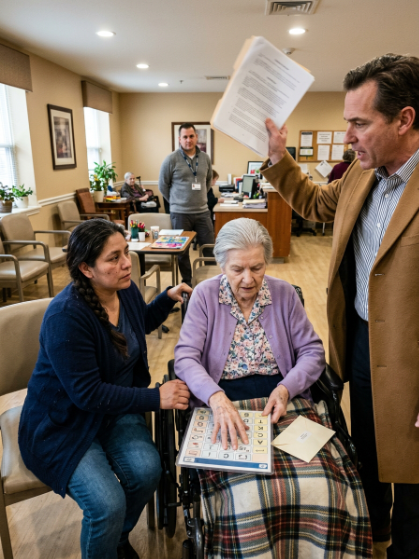
The tap came again.
Slow.
Exact.
Not confused.
Evelyn Hart’s finger rested on the communication board, then dragged to the next square. Her hand shook from the stroke, but there was nothing uncertain about where she wanted it to land.
G.
L.
A.
Bradley laughed under his breath.
“See?” he said to Denise Walker, the administrator. “This is what I mean. We are wasting time while she plays spelling games.”
I kept my hands folded in front of my worn cardigan.
That was the rule Evelyn and I had made together.
I could steady the board. I could adjust the lamp. I could wait. But the words had to be hers.
Denise leaned closer. “Mrs. Hart, are you spelling glasses?”
Evelyn tapped yes.
I crossed to the windowsill and picked up her reading glasses. I placed them in her hand, not on her face, because Evelyn hated being handled like furniture.
Once the glasses were on, she looked at Bradley.
Before the stroke, Evelyn had been a judge in St. Louis for twenty-nine years. I had known her only after, when sentences came one letter at a time and people mistook slowness for surrender.
They were wrong.
Bradley had been wrong every time he walked into that room and spoke over her chair.
Evelyn moved her finger again.
E.
N.
V.
“Envelope?” Denise asked.
Evelyn tapped yes so hard the plastic clicked.
Bradley reached toward the blanket.
I stepped half an inch forward.
Not enough to touch him. Enough for him to notice.
“Facility policy says the administrator opens resident legal correspondence when the resident requests it,” I said.
Bradley looked at me like I had forgotten my place.
“You are an aide,” he said. “This is family business.”
Evelyn tapped the board again.
N.
O.
Denise picked up the sealed cream envelope from beside Evelyn’s blanket. Across the front, in Evelyn’s uneven handwriting, were three words.
Open with admin.
Bradley’s face changed so quickly someone else might have missed it.
“Mother,” he said, suddenly softer, “you do not understand what that is.”
Evelyn’s eyes did not leave him.
Denise opened the envelope.
The first page was a revocation. The second was a new directive. The third was a letter in Evelyn’s blocky hand, witnessed by a mobile notary and the facility social worker three Fridays earlier.
Denise read silently for a moment.
Then she looked at Bradley.
“Mr. Hart, this revokes the financial power of attorney you have been presenting to us. It also requests an immediate elder-law review of transactions made under the prior document.”
Bradley went red from his collar to his hairline.
“That is ridiculous.”
Evelyn tapped again.
R.
E.
A.
D.
“You want me to read the relevant part aloud?” Denise asked.
Yes.
Denise read the portion Evelyn had underlined with a ruler and a blue pen.
“I, Evelyn Margaret Hart, revoke any prior authority granted to Bradley James Hart, effective immediately. I further request that no transfer, discharge, relocation, property sale, or change in care plan be accepted without review by independent counsel appointed for my protection.”
Bradley snapped, “She cannot do this from a nursing home bed.”
Evelyn moved her finger before Denise could answer.
A.
D.
Advertisement
V.
Denise bent closer. “Advocate?”
Yes.
Denise turned the page. Her expression softened, and my stomach dropped.
“There is also a temporary medical advocacy designation,” she said. “Pending counsel review, Mrs. Hart names Rosa Martinez as the person she trusts to be present for care conferences and to help staff understand her stated wishes through the board.”
For a moment, nobody moved.
My name sat in the room like something breakable.
“No,” Bradley said.
Just that.
No.
As if the word could close the envelope again.
I looked at Evelyn and shook my head, not because I refused, but because I was scared.
I was an overnight aide. I was not family. I was not a lawyer. I was not supposed to be the person an old judge trusted more than her son.
Evelyn tapped once.
Y.
Then she stopped to breathe.
Everyone waited.
O.
U.
Then the next row.
W.
A.
I.
T.
You wait.
My throat closed.
Because that was what she had asked of me from the first night she pushed the call button and found me instead of daylight staff.
She did not ask me to guess. She did not ask me to finish her words. She asked me to wait long enough for her to still have them.
Denise placed the papers on the desk and picked up the phone.
“I am calling our legal liaison and Adult Protective Services for guidance,” she said. “Until this is reviewed, there will be no discharge paperwork, no facility transfer, and no property-related forms accepted from you.”
Bradley pointed at me.
“She did this.”
Evelyn tapped so sharply that even Bradley flinched.
N.
O.
Then she kept spelling.
I.
D.
I.
D.
Denise read it aloud.
“No. I did.”
That was when Bradley stopped pretending this was confusion.
He grabbed his leather folder from the bed. One paper slid out and landed faceup on the floor.
It was a listing agreement for Evelyn’s condo.
Not a draft.
Signed by Bradley.
Dated for the next morning.
Denise saw it. So did Evelyn. So did I.
“That is for planning,” Bradley said.
But the damage was already standing in the room with us.
Denise’s voice went flat. “Mr. Hart, you need to wait in the conference room.”
“I am not leaving my mother with her.”
Evelyn tapped the board.
S.
T.
A.
Y.
Bradley smiled like he had won.
“She wants me to stay.”
Evelyn moved again.
R.
O.
S.
A.
Stay Rosa.
Bradley left with the face of a man angry not because the process was unfair, but because for once it had not bent toward him.
The review took three weeks.
Lawyers came. A social worker came. Denise came with forms and a witness whenever a decision needed more than routine care. Bradley called twice a day for four days, then stopped calling when someone asked why utility payments from Evelyn’s account had gone to a property he owned in Kansas City.
The condo sale froze.
The transfer to the cheaper facility disappeared.
Evelyn stayed in her room with the morning light she loved, the violets on the sill, and the board on her lap where everyone could see it.
The biggest change was not legal.
It was how staff entered.
They stopped asking me what Evelyn wanted while standing over her chair. They asked Evelyn. Then they waited.
At the next care conference, Denise put a second chair beside Evelyn’s wheelchair and nodded for me to sit.
I almost refused.
Evelyn tapped the chair arm once.
So I sat.
The elder-law attorney asked why she chose me.
The room waited.
Evelyn spelled slowly.
N.
I.
G.
H.
T.
S.
Then she rested.
We waited again.
K.
N.
O.
W.
Nights know.
No one spoke for a while.
I thought of all those dark hours when Evelyn spelled window because she wanted rain, pain because a medication burned her shoulder, son and then nothing for ten minutes because some words were too heavy even for a judge.
I had not done anything grand.
I had waited.
I had believed her board.
I had refused to let speed become proof of intelligence.
That night, I worked my regular shift.
At 3:15 a.m., Evelyn was awake with her glasses on and the board beside her hand.
I asked if she needed anything.
She tapped yes.
T.
E.
A.
I brought chamomile in the blue mug with the chipped handle.
She took three careful sips, then tapped again.
W.
A.
I.
T.
So I waited.
Four minutes later, she spelled the rest.
T.
H.
A.
N.
K.
Y.
O.
U.
I did not tell her it was unnecessary. I did not wave it away. I had learned better than to erase a sentence just because it made me emotional.
I placed my hand over my heart and nodded.
A person is not gone because speech is slow. A person is not powerless because family is loud. And trust is not proved by a title on paper.
Sometimes it is earned at 3 a.m., one patient minute at a time.