They Called Me Too Old to Fight FULL STORY
Clause nine.
Dunmore put on his reading glasses and skimmed the page Aaron had marked. I watched his face the way I watch a soufflé that might fall.
It fell.
“This is forty years old,” he said. “This doesn’t —”
“It’s recorded,” Aaron said. Quiet. Patient. The same voice he used as a boy explaining his homework to kids who teased him. “My father had this lease recorded with the county in 1984. It runs with the land. It survives a sale. Which means it survived your purchase of the building.”
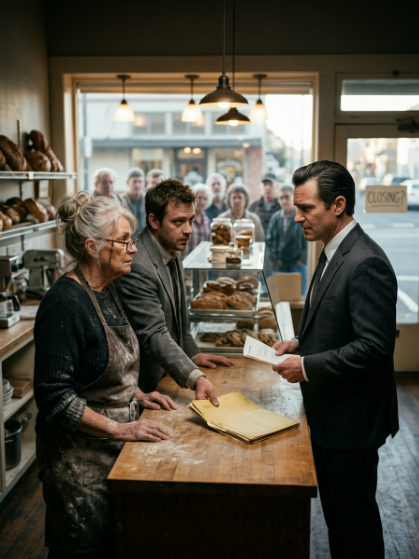
I didn’t fully understand it in that moment. Aaron walked me through it later, slowly, the way you explain things to your mother.
When Sam and I signed our lease in 1984, the old owner — a kind man named Mr. Petrakis — had liked us. He wrote in a renewal option. As long as the bakery kept operating and paid its rent, we held the right to renew at a fixed, modest increase, for as long as we wanted it. In perpetuity, the lawyers say. Forever, in plain English.
Sam, rest his soul, paid forty dollars to record it at the courthouse. I thought it was a waste of forty dollars. I told him so. He just smiled and said, “Pearlie, someday somebody’s going to be real glad I did this.”
He didn’t live to be the one who was glad. But he set it up so that I could be.
Dunmore took it to court anyway. Men like him always do. They don’t believe a thing is real until a judge agrees that a poor woman gets to keep it.
The hearing was short.
His lawyer argued the clause was “unconscionable” and “antiquated.” Aaron stood up in his rumpled gray suit and set the recorded lease on the table, county stamp and all. He pointed out that Dunmore’s own purchase paperwork required him to honor existing tenancies.
The judge read clause nine twice. Then she looked over her glasses at Dunmore and asked whether he had read the building’s title before he bought it.
He had not.
You could watch the exact moment it landed on him. That he had spent more money on lawyers fighting one paragraph than the paragraph had ever cost me. That all his leverage had really been a smirk and a bet that I was too old and too tired to do anything but fold.
The eviction was thrown out. The renewal option stood. My rent dropped back to the fixed increase Sam negotiated when Reagan was president.
The town found out fast, the way small towns do.
The next morning there was a line out the door of Whitman’s Bakery that wrapped clear around the corner. Not for a sale. There was no sale. They just came. To buy bread and stand in my shop and be glad it was still mine.
One of my regulars, an eighty-one-year-old named Earl who has ordered black coffee and two day-old rolls every morning since before Sam passed, stood at the counter with his hat held in both hands. He told me, very seriously, that if I had needed money to fight, half the town had been ready to bring it. I hadn’t needed money. I’d needed my son and a forty-dollar piece of paper. But I cried anyway, right there in front of the bread case. The first time in the whole ordeal I let anyone see.
I took the “Closing?” sign out of the window. I didn’t throw it away. I framed it and hung it over the register, question mark and all, to remind me that the question got an answer.
Aaron stayed a week. He finally fixed the wobbly case door he’d been promising to fix since college. We talked more in that one week than we had in years.
On his last morning, he stood at the counter with a coffee, looking around at the flour and the steam and the old photographs of his father.
“Dad really did love this place,” he said.
“He loved you more,” I told him. “That’s why he taught you to read the fine print.”
He didn’t answer. He just came around the counter and hugged his mother, which my quiet son does not do easily.
Dunmore sold the rest of the block to someone else. The luxury units went up next door. They put a coffee bar in the lobby that charges seven dollars for something Sam would have called brown water.
People walk right past it. They come to me.
Because a chain can buy a corner. It cannot buy forty years of four-in-the-morning, or the smell of cardamom at dawn, or a man who spent forty dollars in 1984 so his wife would never have to be afraid of a smile in a charcoal suit.
They called me a stubborn old woman who didn’t know when to quit.
They were half right.
I always knew exactly when to quit.
The answer was never.