Lawyer Mocks Street Vendor FULL STORY
Judge Elena Morales said, “Mr. Corrigan,” in a voice that made Blake’s performed apology collapse before it left his mouth.
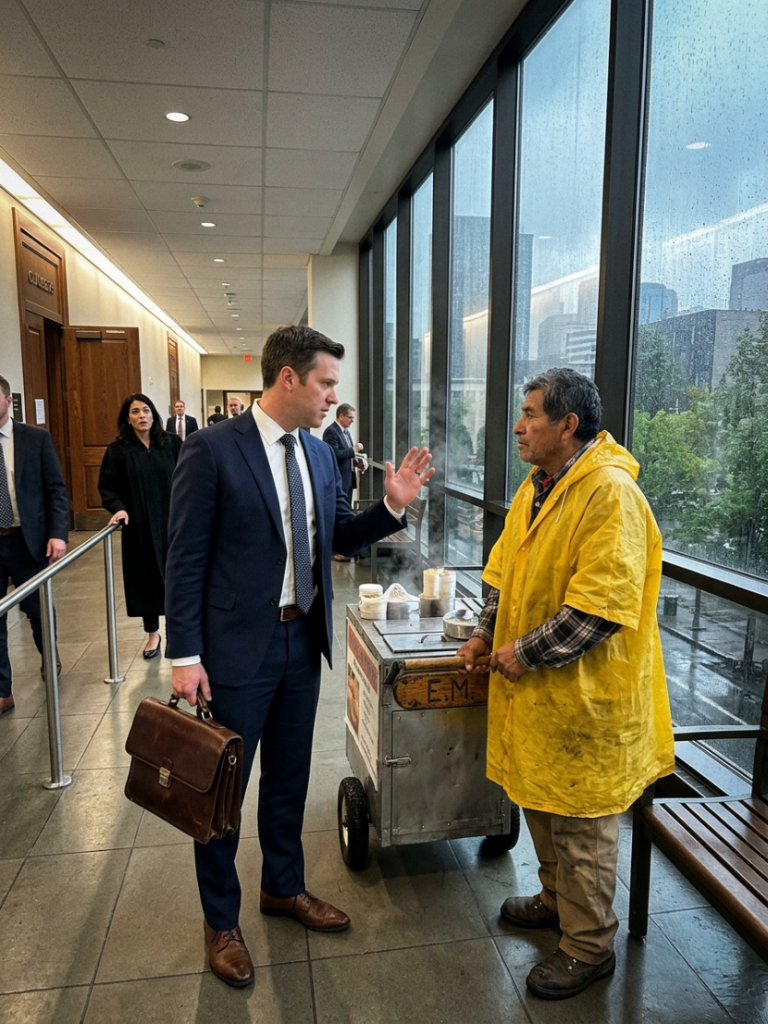
Tuesday at eight in the King County Courthouse hallway, rain-gray light pressed against the windows while clerks moved with coffee and clipboards toward another morning of procedure. Blake Corrigan, thirty-nine, sharp navy suit, leather briefcase at his ankle, had already rehearsed the apology he would never mean — measured tone, controlled impatience, corporate half-regret performed to end a scene without costing billable minutes. He flicked his hand toward Ernesto Solis’s tamale cart as if the gesture could sanitize inconvenience.
“Move this before the judge walks through,” Blake said, loud enough for the intake desk to hear. “This is a courthouse, not a food court.”
Ernesto Solis, sixty-three, yellow rain poncho over work clothes, steady eyes, both hands on his cart handle where worn carved initials caught the window glare: E.M., deep in the wood, old knife work, not vandalism. He did not argue. He did not flinch. He adjusted his grip and waited like a man who had waited through worse mornings than this.
Morales paused at the chamber door, robes still, expression shifting from routine to something sharper. Clerks behind her slowed without knowing why.
Blake noticed the pause and pivoted instantly — the way litigators pivoted when they smelled an audience. “Your Honor, I apologize for the disruption. This vendor is obstructing—”
“Mr. Corrigan,” Morales said again, colder. “Step aside.”
Blake stepped aside because judges did not ask twice.
Morales walked to the cart slowly, not as a judge first but as a woman checking a memory against wood grain. She traced the carved initials with one gloved finger without touching Ernesto’s hands.
“E.M.,” she said quietly.
Ernesto nodded. “Still your initials. You carved them when you were twelve and angry I wouldn’t let you skip school to help prep carnitas.”
The clerks nearest the hallway went silent in the particular way courthouse staff went silent when private history entered public marble.
Blake’s smile fractured. “Your Honor, if we could proceed to chambers—”
“We will,” Morales said. “After Ernesto rolls his cart inside.”
“In chambers?” Blake’s voice rose half a register. “He sells tamales in a hallway.”
“He raised me in a hallway,” Morales replied, “after a bus accident killed my parents and the system lost my file for eleven days.”
Ernesto’s eyes closed once. When they opened, they were wet and steady.
Blake had not known. Blake’s client — Pacific Meridian Development — had not cared to know. They paid him to make obstacles disappear before hearings, not to research who had carved initials into tamale cart handles outside Courtroom 4B.
Twenty years earlier, Ernesto Solis had sold food from the same cart near the bus station while fostering Elena Morales through kinship paperwork that took three years to formalize. He taught her to read statute summaries at the kitchen table in a one-bedroom apartment that smelled like cumin and highlighter ink. She carved E.M. into the cart handle the week she made honor roll and swore she would never be ashamed of where she came from.
She had kept the promise. He had kept the cart.
Morales turned to Blake. “Your motion to dismiss whistleblower testimony in Meridian v. Harbor Tenants is heard at nine. You will wait in the gallery until I call you.”
“I prepared remarks for chambers—”
“You prepared contempt,” Morales said. “Insulting a witness corridor vendor who happens to be my foster father is not the flex your client thinks it is.”
Blake’s briefcase suddenly weighed more than his career could carry.
Inside chambers twenty minutes later, Ernesto set the cart brake near the coat rack with the ease of a man who had rolled through courthouse security for decades. The tamale steam was muted. Morales sat not on the bench but in the visitor chair across from Ernesto, robes folded over the armrest like she needed two hands free.
“Tell me what Meridian did to your tenants,” she said.
Ernesto spoke without drama. Rent ledgers altered. Maintenance invoices duplicated. Elderly residents pressured to sign quitclaim forms during wellness checks. He had documents in a grease-stained folder because Ernesto kept evidence the way other men kept recipes — labeled, dated, ready.
Blake burst in when a clerk mis-timed a knock. “Your Honor, counsel for Meridian must be heard before ex parte—”
“This is not ex parte,” Morales said. “This is testimony from Ernesto Solis, witness for Harbor Tenants, whose credibility you attempted to destroy in my hallway because you assumed poverty was performance.”
Blake looked at the folder. At the initials on the cart handle visible through the open door. At the judge’s face, which had none of the performative patience he counted on from the bench.
“You can’t—”
“I can,” Morales said. “And I will.”
At nine o’clock the gallery filled. Blake sat where he usually sat for wins — front row, pen ready, client whispers calibrated for confidence. Today his client whispered sharper questions. Today Blake’s opening argument sounded thin before he finished the first paragraph.
Morales let Ernesto testify.
He did not perform outrage. He read dates. He identified signatures. He placed altered ledgers beside originals with the calm of a man who had raised a judge to respect proof over posture. When Blake cross-examined, Ernesto answered without raising his voice. When Blake implied the cart business was a front, Morales sustained the objection before Blake finished the sentence.
“Counsel,” she said once, “you already tried that insult in my hallway. It failed then too.”
The courtroom laughed once — short, shocked — and Blake’s face went still.
By noon, Morales denied Meridian’s motion to dismiss, ordered document production, and referred Blake’s conduct to the state bar for sanction review: harassment of a witness, ex parte bad faith characterization, and false statements about vendor licensing Ernesto had renewed every year since 1998.
Blake’s client fired him in the elevator.
Ernesto rolled his cart back into the hallway at lunch and sold tamales to clerks who had never bought from him before. Morales came out without robes for thirty seconds — a breach of form she rarely allowed — and helped him replace a napkin stack blown sideways by the door air.
“You didn’t need to say foster father in public,” Ernesto said.
“Yes I did,” Morales replied. “They needed to hear where I learned what proof looks like.”
The Harbor Tenants case settled in six weeks. Meridian paid restitution Blake once called impossible. Ernesto’s testimony entered the record with his cart initials photographed as Exhibit C — E.M. in wood, worn smooth by palms that had fed a courthouse for decades.
The bar sanction hearing for Blake Corrigan arrived in spring. Morales listened while Blake’s partners described hallway tone and billable urgency. Ernesto testified again, cart parked legally outside.
Sanction: six-month suspension, ethics coursework, public apology to Ernesto Solis read in Courtroom 4B on a Tuesday at eight.
Blake read it with eyes on his shoes. Ernesto stood in the back row with the cart handle under his hand, initials catching gray window light.
Morales adjourned. In the hallway she bought two tamales and ate standing up between cases the way she had as a girl after school.
“You still overcharge clerks,” she told him.
“You still under-tip your foster father,” Ernesto replied.
She laughed — the first laugh the hallway had heard from her all week — and rolled the cart toward the service elevator while rain erased footprints on the courthouse steps.
Blake watched from a distance he had chosen himself, briefcase heavy, lesson billed in a currency his client could not pay: the man he mocked had raised the woman who ended his career with one carved initial and the truth.