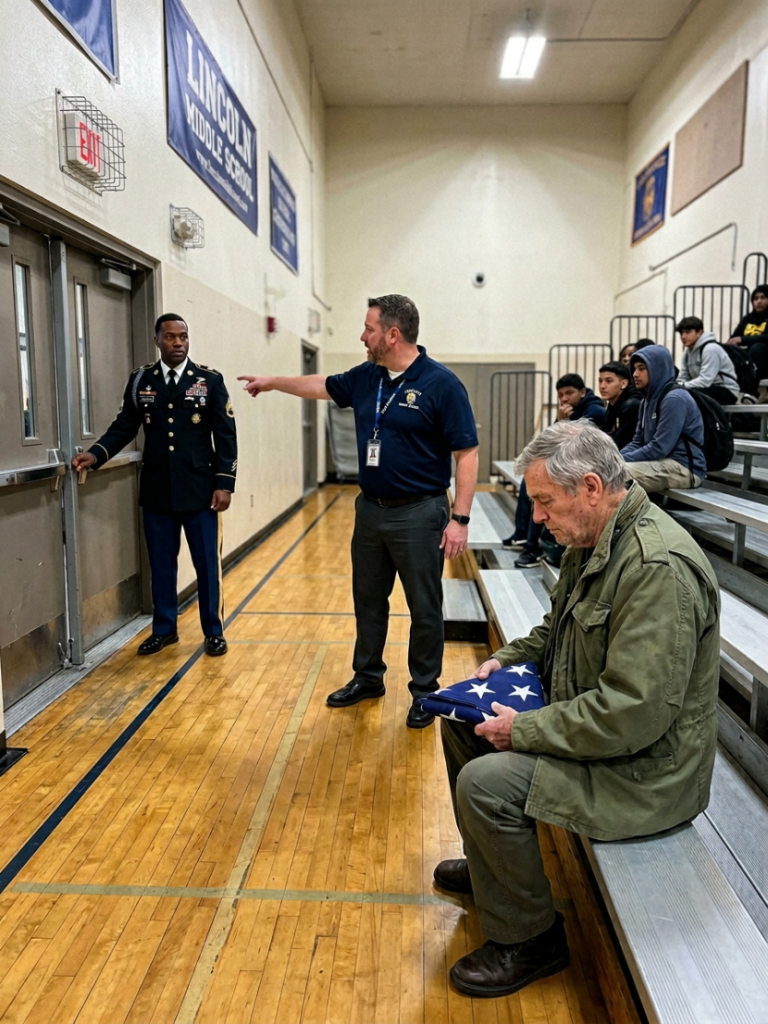
Sgt. Marcus Lee walked past Principal Garvey without permission, and Garvey’s pointing hand fell to his side.
In the Lincoln Middle School gymnasium in Tacoma, eight hundred students watched the moment split in two — the assembly they had expected, and the assembly that arrived when a decorated guest speaker ignored the script and moved toward the bottom bleacher where an old man in a worn field jacket sat with a folded burial flag on his knees.
Commander Ray Dalton, seventy-four, did not stand for applause. He stayed seated, knuckles pale against the flag fabric, expression unmoved under Friday floodlights that washed the bleachers white and unforgiving. He had chosen to stay when Garvey pointed toward the exit. He could have folded his program and disappeared like everyone wanted quiet men in old jackets to do. Dignity, he had learned long ago, was not granted by lanyards.
Garvey, forty-eight, polo shirt and staff badge, tried to recover the moment with a smile meant for cameras. “Sgt. Lee, if we could proceed to the podium—”
“No, sir,” Marcus said.
He crossed the gym floor in dress uniform, medals heavy on his chest, one hand still bearing the door handle’s memory in his palm. Students who had been whispering went silent. Teachers who had been grading on clipboards looked up as if a test they had not written had just begun.
Marcus stopped in front of Ray Dalton and saluted.
Not the casual assembly salute for show. The old kind. Held.
“Commander Ray Dalton,” Marcus said, voice carrying without microphone. “Third Battalion. Kandahar sector. 2011.”
Ray’s eyes closed once. When they opened, they were wet and steady.
“Sit down, son,” Ray said.
“I’m standing for you first.”
The gym made a sound — not quite gasp, not quite cheer — the collective breath of children who sensed history entering through a side door instead of a slideshow.
Garvey stepped into Marcus’s path with administrator confidence. “Sir, this section was reserved for faculty and honored guests. Mr. Dalton is a walk-in without clearance—”
“He cleared my squad through an ambush,” Marcus said without looking at him. “He carried me out when my legs didn’t.”
Garvey’s smile failed. “This is a middle school assembly, not—”
“Exactly,” Marcus said. “Which is why you should have asked his name before you pointed him toward the exit.”
He knelt on the hardwood beside Ray’s row, uniform knees touching varnish, and set his program down. The folded burial flag in Ray’s lap was small, triangle precise, the kind folded by honor guard hands after a name was read at a memorial Ray attended every year whether anyone remembered him or not.
“Whose flag?” Marcus asked quietly.
“Private Henley,” Ray said. “Nineteen. Didn’t make it to the second chopper.”
Marcus nodded. “You told us his mother would get it clean.”
“I still bring it.”
Garvey’s face had gone the color of gym floor wax. He turned toward the vice principal near the stage as if backup could rewrite what eight hundred phones were already recording.
Twenty minutes earlier, Ray had arrived on foot because the bus was late and parking at Lincoln was always chaos on assembly days. He wore the field jacket because wool still felt like service and because civilian coats made him invisible in ways he no longer tolerated silently. A student had held the gym door for him without asking for ID. He sat in the back bottom row because his hearing was better near an exit and because he had learned that schools put important people closer to stages.
When Garvey saw the jacket, the flag, the man who did not match the donor photo board in the lobby, he performed the small power he had — gesture toward exit, voice pitched for compliance.
Ray had seen that gesture in other uniforms, other years. He stayed.
Now Marcus stood and addressed the gym without slides. He told the ambush in plain sentences — no glory, no movie pauses. Third Battalion pinned at a dry riverbed. Radio dead. Commander Dalton directing fire with a busted collarbone and blood on his sleeve. Marcus hit at seventeen hundred hours, leg shattered, consciousness flickering. Ray hoisted him over shoulder while returning cover fire, walked four hundred meters to extraction under smoke Marcus still smelled in dreams.
“He was forty-seven then,” Marcus said. “He is seventy-four now. You pointed him at the door because he didn’t wear a lanyard.”
Students turned toward Garvey. Garvey did not raise his hand again.
Ray stood slowly, flag still folded against his chest. “I didn’t come for a speech,” he said. “I came because your school advertised a scholarship in my unit’s name and spelled Henley wrong on the banner.”
Marcus looked at the stage. The banner read HENLEY VALOR AWARD — one N missing, one letter away from forgetting a nineteen-year-old properly.
Garvey swallowed. “That was a printing error—”
“Fix it,” Ray said. Not loud. Final.
Marcus turned to the students. “This is the man your principal tried to remove before I could thank him in front of you. Remember that when someone tells you rank is a lanyard and dignity is a seating chart.”
Applause started in the back rows where veterans’ grandchildren sat, then rolled forward until even the eighth graders who had been bored stood because standing felt required by something older than assembly rules.
Garvey attempted a recovery speech about honoring all guests. The microphone squealed. Marcus unplugged it and handed Ray the handheld from his pocket.
Ray spoke for three minutes. He named Henley. He named the squad. He said courage was not medals on a stage but staying when a door is pointed at you because a boy’s flag deserved to be in the room.
When he finished, he sat again. Marcus remained standing until Ray touched his wrist and told him to sit like a stubborn private.
The assembly ran long. Nobody minded.
In Garvey’s office afterward, the superintendent on speakerphone used words like process review and community standards. Marcus, still in uniform, placed the misprinted banner on Garvey’s desk.
“New one by Monday,” he said. “Correct spelling. Commander Dalton’s name on the dedication line. Or I take this story to every news desk in Tacoma and let them spell Henley correctly.”
Garvey agreed before the superintendent finished her sentence.
Ray refused a ride home in Marcus’s staff car. They walked two blocks together in silence instead, flag under Ray’s arm, medals clicking beside him.
“You didn’t have to kneel,” Ray said.
“You couldn’t,” Marcus replied. “Not with that leg in 2011. Not today either.”
Ray laughed once — a short sound rusted by years — and stopped at the bus bench where his morning had started.
Three weeks later, Lincoln Middle School unveiled the corrected Henley Valor Scholarship banner with Ray Dalton’s name on the dedication plaque and Private David Henley’s spelled right in gold letters. Garvey read prepared remarks from the stage. Ray sat in the front row with the folded flag on his knees and did not stand when Garvey thanked donors.
Marcus gave the keynote. At the end he called Ray forward. The gym applauded again — longer this time, less confused.
Afterward a sixth grader asked Ray for an autograph on her program. Ray signed Commander Dalton below her name and added one line she would keep for years: Stay when it matters.
Garvey shook Ray’s hand in the lobby for a photographer. Ray shook back without grip pressure — courtesy without forgiveness.
On a Friday one month later, Ray boarded the same bus to Lincoln for the scholarship committee’s first meeting. The gym was empty. The banner hung straight above the stage, every letter correct.
Ray sat on the bottom bleacher with the flag in his lap and listened to the building settle — pipes, distant sneakers, the echo of children who had learned that the man their principal pointed away had once carried their honored speaker through smoke.
He did not need applause. He had needed the room to see. That was enough.