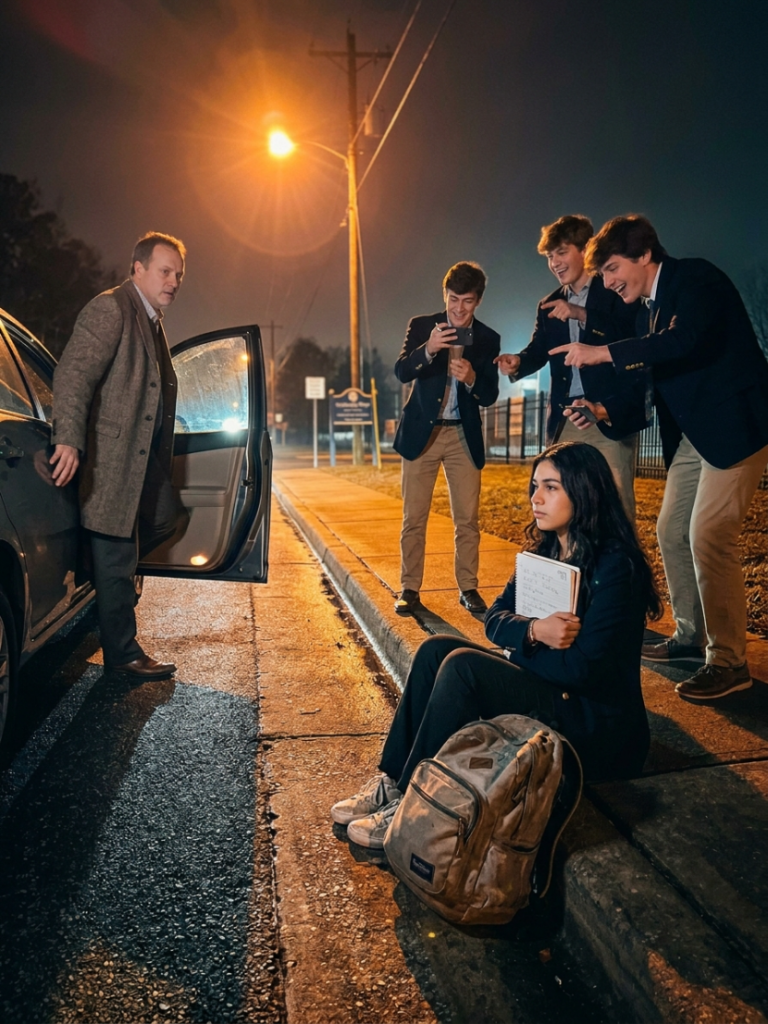
Dr. Alan Weiss closed the car door softly, and the laughing stopped for a reason none of the Oakridge Prep students understood yet.
Monday at nine under the east gate’s sodium streetlight, the wet curb held orange light like a pool Mia Torres had learned to study inside. Sixteen, worn backpack at her feet, frayed straps, pencil tucked behind her ear, she did not stand when the three blazers pointed from the sidewalk. She turned a page in the notebook pressed against her chest and kept working as if mockery were weather you could outlast with enough paper.
One student filmed with a phone held low. Another mimicked writing in the air with exaggerated flourishes. A third — Preston Hale, third-generation tuition, smile polished for social feeds — called her scholarship status like it was a joke instead of a lifeline.
“Full ride and she still can’t afford lights,” Preston said.
Mia’s jaw tightened once, then released. She had heard worse in hallways where janitor carts echoed after midnight while she copied problems from library books her father was not allowed to check out on his staff card.
Weiss stepped onto the curb from his parked sedan, tweed coat, headlights still burning behind him, and looked not at the boys but at the notebook’s exposed margin where Mia’s pencil had been moving in symbols most sixteen-year-olds never touched without a professor hovering.
He had spent eleven years on a lemma in noncommutative ring theory — a stubborn gap in an unpublished manuscript locked in his office at Duke. Colleagues called it Weiss’s ghost. Reviewers called it unfinished. He called it the reason he still woke at four to stare at blank pages.
The notation in Mia’s margin used his ghost’s exact compression trick.
Preston noticed the older man too late. “Sir, this isn’t—”
Weiss raised one hand. Not loud. Not theatrical. The hand of a man who had ended quarrels in seminar rooms with a single notation on chalkboard. “What is that symbol sequence?” he asked Mia.
Mia pulled the notebook closer like armor. “Mine.”
“I believe it is,” Weiss said quietly. “I also believe I have been trying to justify it since 2014.”
The filming student lowered his phone. Laughter without an audience dies quickly.
Two hours earlier, Mia had been locked out of the Oakridge library when the timer on the building access panel hit nine. Her father, Luis Torres, was finishing the second floor on the east wing — vacuum lines in carpet, keys on his belt, name stitched on a uniform the admissions office never read aloud in donor pamphlets. He had waved her off when she asked to wait inside.
“Study under the gate light,” he said. “Better than excuses.”
She had sat on the curb every Monday for six weeks since the scholarship committee placed her at Oakridge — the first Torres to walk those halls, the first to eat free lunch without pretending she did not notice who cleared the trays. Advanced math was the one place the blazers could not buy their way ahead of her without work. She found a mis-shelved graduate text in the discard cart last month and copied problems into her notebook margins while her father waxed floors above her head.
One margin became a proof sketch. The proof sketch became a lemma. The lemma solved a gap she did not know was famous because she did not read faculty gossip.
Weiss knelt without asking, heedless of the wet curb staining tweed. He pointed to a line of symbols. “You inverted the ideal here.”
“I had to,” Mia said. “The other path loops.”
“Yes,” Weiss breathed. “It loops. Nobody—” He stopped. Looked at her. “Who taught you this?”
“Books in discard. And guessing.”
Preston laughed once, nervous now. “She’s a janitor’s kid playing scientist.”
Weiss stood and turned on him with a coldness Preston’s parents’ donations had never encountered. “This janitor’s kid just completed a lemma I’ve presented at three failed conferences. You, Mr. Hale, completed a video filter.”
Preston’s face reddened. The other two blazers stepped back toward the gate pillars as if distance could restore hierarchy.
Mia’s fingers whitened on the notebook. “Don’t take it.”
Weiss held his palms open. “I am not taking it. I am trying not to fall over.”
He asked her name. She gave it. He asked her father’s shift schedule. She gave that too, chin lifted.
“Luis Torres cleans my department wing on Tuesdays,” Weiss said slowly. “I have walked past him for two years without looking up.”
“Most people do,” Mia replied.
Weiss took out his card — simple, academic, no flourish — and wrote on the back in small precise script: Full fellowship pending formal review. Immediate lab access. No interview required if notebook verified.
“That’s not real,” Preston said.
“It will be by morning,” Weiss said. “And you will delete whatever you filmed unless you prefer a conversation with the dean about harassment of a scholarship student on public curb property.”
Preston deleted the clip with visible trembling. The other students left without jokes.
Mia did not thank Weiss immediately. She checked that her pencil mark on the lemma page had not smeared in the humidity.
“Why me?” she asked.
“Because you solved what I couldn’t,” Weiss said. “And because talent does not wait for library hours or donor approval.”
Inside the gate ten minutes later, Luis Torres came down the service stairs with mop bucket and saw his daughter still on the curb with an older man in tweed kneeling beside her notebook like it was scripture. For one terrible second he thought trouble.
Weiss stood and introduced himself in Spanish Luis had not heard from a faculty card holder in years. Luis listened with bucket still in hand while Weiss explained the lemma, the fellowship, the harassment incident, the Hale name he would be reporting upstairs.
Luis looked at Mia’s notebook, then at Mia. “You wrote this tonight?”
“Mostly last month,” Mia said. “Tonight I fixed the part that loops.”
Luis nodded the way parents nod when pride is too large for hallways. He did not hug her in front of Weiss. He picked up her backpack instead and carried it for her across the parking lot — a small gesture that meant everything.
By Wednesday, Oakridge’s dean confirmed the fellowship. By Friday, Weiss’s unpublished manuscript included a new appendix crediting Mia Torres as co-author on the lemma — first name on a proof that had lived in margins under sodium light.
Preston Hale’s parents called the headmaster. The headmaster forwarded the call to legal. Preston apologized in a assembly Mia did not attend because she was already in Weiss’s lab learning how to cite what she had discovered alone.
Luis Torres kept his janitor shift. He also kept a copy of the fellowship letter in his locker behind cleaning supplies, laminated in plastic he paid for himself.
On a Monday three weeks later, Mia sat under the same streetlight not from necessity but habit, reviewing graduate material before walking inside to a lab that now had her name on the door schedule. Weiss passed on his way out and paused.
“You could study inside,” he said.
“I know,” Mia said. “I like remembering where the lemma started.”
Weiss nodded once and drove away, headlights cutting through gate pillars. Mia turned a page, pencil behind her ear, calm under a light that had once been mockery’s stage and was now simply hers — orange, harsh, honest, enough to see the next line of proof.