The Tiny Inheritance Envelope FULL STORY
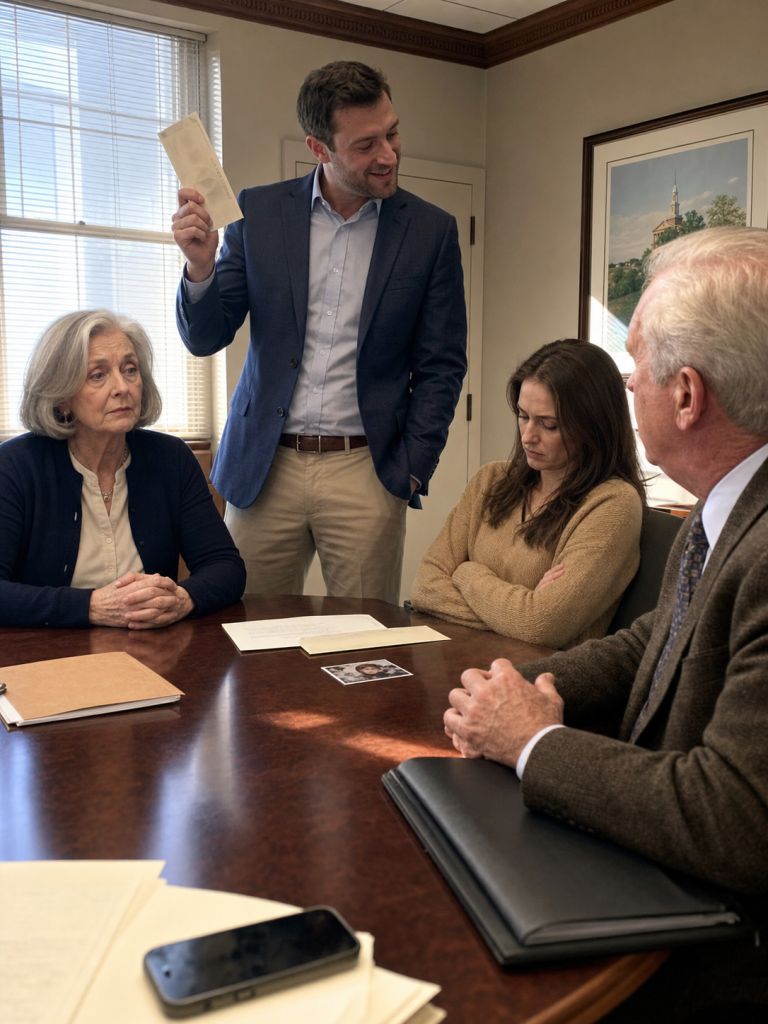
Mr. Alden did not reach for the envelope right away. He just stood there with one palm flat on the table, as if he needed the wood to keep himself steady.
Brent still had the envelope between two fingers. His smile had gone stiff.
“What does Emily have to do with this?” he asked.
Emily was my granddaughter. Eight years old. Missing two front teeth in the little school photo tucked under the flap. Brent’s daughter. The same child he adored in public and forgot to pick up from dance class when work ran late.
I looked at her picture and felt my throat close.
Frank had made me promise not to turn the will reading into an argument. “Let the paper speak,” he had told me from his hospital bed, his hand thin over mine. “You have protected this family long enough. Let them hear it from someone else, so they cannot say you made it up.”
But when Brent stood there laughing at that envelope, I almost broke the promise.
“Mom?” Claire said. Her arms were no longer crossed.
Mr. Alden finally held out his hand. “Brent, please.”
Brent dropped the envelope onto the table like it was dirty. “Fine. Explain the mystery bank envelope.”
Mr. Alden opened his folder, not the envelope. He removed three pages clipped together and set them down in front of Brent.
“Your father created a custodial trust for Emily six years ago,” he said. “It was funded through this account.”
Brent frowned. “Dad did?”
“No,” Mr. Alden said. “Your mother did. Frank added his name later for legal convenience.”
The office went so quiet I heard the old clock near the door.
Claire leaned closer to the pages. “Mom, what is this?”
I folded my hands again because they had begun to shake. “When Emily was two, Brent’s company went under for a while. He and Melissa were fighting. Bills were late. Daycare called me twice because tuition had not cleared.”
Brent’s face flushed. “That was private.”
“So was my humiliation five minutes ago,” I said softly.
He looked away.
I told them the part none of them had known. Frank and I had sold the second car. I had taken in mending from women at church, hemming pants and letting out seams for a few dollars at a time. Frank had delayed fixing the porch roof two winters in a row. Month by month, we put money aside for Emily. Not because we thought Brent was bad, but because life can turn cruel fast, and children should not pay for adult pride.
“The routing number,” Mr. Alden said, tapping the envelope, “belongs to the original account. The current trust has grown significantly. Frank’s will directs that Ruth remain trustee until Emily is twenty-five.”
Brent swallowed. “How significantly?”
Mr. Alden slid the top page toward him.
Brent read the number once. Then again.
Claire covered her mouth.
It was not millions. It was not the kind of number people shout about in movies. But it was enough for college. Enough for a first apartment. Enough for Emily to have choices no one could yank away in a divorce, a layoff, or a bad year.
Brent sat down slowly.
“You did that?” he asked me.
I nodded. “Your father and I did.”
“Why did you never tell me?”
That question could have opened a door to every cruel remark, every sigh when I used coupons, every time he called my little house depressing or said I did not understand money. But I looked at Emily’s picture instead.
“Because it was for her,” I said. “Not for praise.”
Mr. Alden then turned to the next page of the will. Frank had left Brent the cabin discussion he wanted, but not the cabin. The cabin would stay in trust too, for all grandchildren, with Ruth Marlow as the deciding vote until the youngest turned eighteen.
Brent rubbed both hands over his face.
Claire began crying first. She came around the table and knelt beside my chair, the way she used to when she was small and had done something she was sorry for. “Mom, I am sorry,” she whispered. “I should have said something. I just froze.”
Brent did not apologize right away. Pride made him fight for a few more minutes. He asked legal questions. He asked whether anything could be adjusted, whether he could be added as a co-trustee, whether the trust could be simplified. Mr. Alden answered each one with the same calm sentence: “Your father was very clear.”
At last Brent picked up Emily’s school photo. He held it carefully now, the way you hold something you almost dropped.
“She loves that picture,” he said, voice rough. “She told everyone at school her hair looked like spaghetti that day. She cried about it, then she laughed about it.”
I almost laughed too. Almost.
He set the photo back by the envelope and looked at me. “I was cruel. In there, just now. And a lot of other times.”
“Yes,” I said.
He nodded as if he deserved the plainness of it. “I’m sorry, Mom.”
I did not tell him it was fine. It was not fine yet. But I put my hand over his for one second, because Frank had also told me not to let bitterness inherit the room along with everything else.
When we left, Mr. Alden handed me the envelope. The old paper was soft in my palm. Brent walked beside me down the hall without trying to take charge of anything, without checking his phone, without a single word about assets.
Outside, the late sun hit Emily’s little photo through the plastic sleeve, and the gap where her front teeth used to be seemed to catch the light. For the first time that day, I felt Frank had kept his promise. The paper had spoken, and my son had finally heard it.