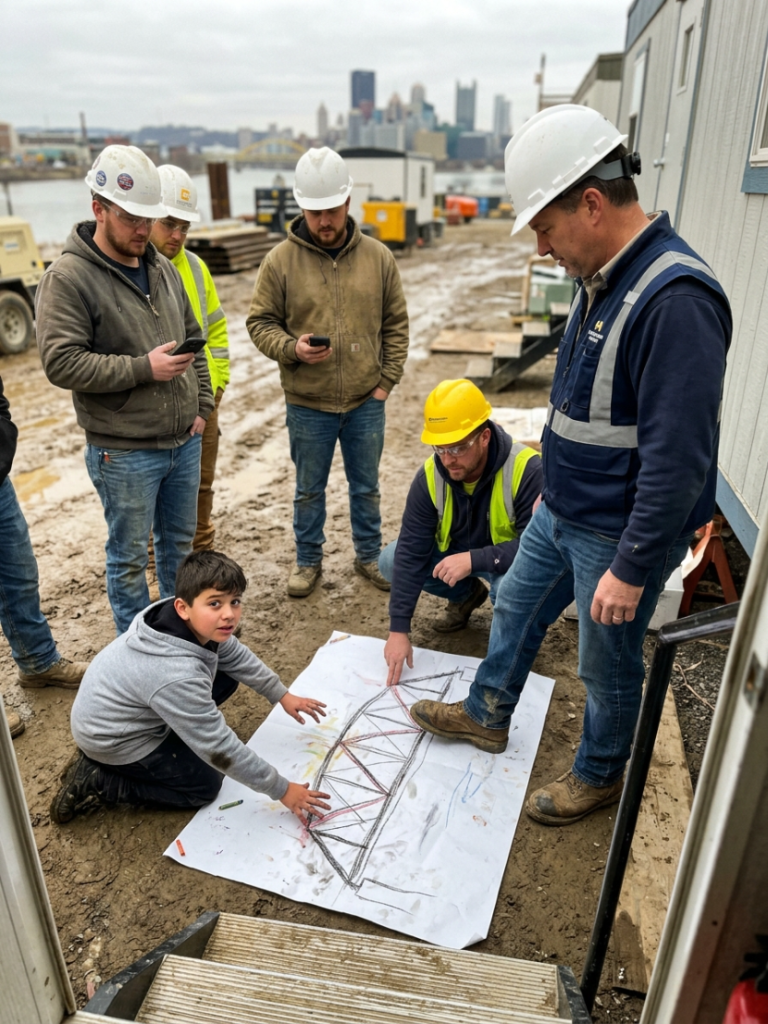
Chief Engineer Nora Klein said, “Wait — this angle solves the flaw,” and Martin Chase’s boot finally lifted.
The crayon drawing did not recover. Wax and paper had already smeared into the mud beside the Pittsburgh site trailer, blue and red truss lines bleeding together under overcast Wednesday light. Danny Ruiz, ten, gray hoodie stained with crayon, kept both hands on the ruined sheet as if holding it might reverse the crunch. His fingers trembled. Martin, fifty, white hard hat, navy executive vest, stepped back one pace and checked his sole like dirt mattered more than what he had destroyed.
The hard-hat circle around them had gone still in the way construction sites go still when money realizes it has stepped on something it cannot buy back.
“Security,” Martin said, recovering authority the way men recover hats. “Remove this kid from the active zone. No minors on Riverfront without escort.”
Danny did not stand. “It was a bridge.”
“It was trash on my two-hundred-million-dollar footprint,” Martin replied.
Nora Klein, yellow hard hat, forty-three, crouched lower instead of standing. She had spent eleven months staring at a truss intersection that would not pass load simulation — the Riverfront span, the signature project that had made Martin Chase a keynote face and made her team bleed overtime into spreadsheets that always ended in the same red cell: torsion failure at node seven.
She traced a crayon line with one gloved finger, not caring about wax on nitrile. “Node seven,” she whispered. “He drew the counterbrace offset we couldn’t derive.”
Martin laughed once. “A ten-year-old did not out-engineer my firm.”
“A ten-year-old copied what someone taught him,” Nora said, and her voice had changed — the tone engineers use when a solution appears so suddenly it feels like accusation.
Three workers lowered their phones without being asked.
Two hours earlier, Danny had been bored outside the janitor closet while his father mopped the trailer hall. Rafael Ruiz gave him scrap paper and crayons: draw the bridge you see. Danny drew a kink in the truss where his father whispered, Try putting the stress here instead of where the men who fired me put it.
Martin did not know that history. He knew only that a child had made his site look unmanaged in front of afternoon walk-through staff.
Nora photographed the drawing before mud swallowed it completely. “I need this in modeling now.”
“You’ll have my boot print,” Martin said.
“I’ll have your delay if I don’t,” Nora replied, and stood fast enough that Martin flinched.
She took Danny’s drawing — gently, asking with her eyes — and jogged toward the BIM trailer. Danny watched the paper leave his hands like a kite he was not sure would return.
Martin turned to the security contractor near the chain-link gate. “I want the father in my office in ten. Whoever let this—”
“Rafael Ruiz,” a foreman said quietly. “Night janitor. Been here since March.”
Martin’s jaw tightened at the surname like a file opening.
Inside the modeling trailer, Nora scanned the crayon sheet and overlaid it on the stalled digital truss. Her team had gone home except for one junior analyst eating cold fries. He looked up when Nora slammed the scan onto the screen.
“That’s not CAD,” he said.
“No,” Nora said. “It’s correct.”
The simulation ran. Load vectors shifted. Node seven held. The red cell turned green so fast the analyst choked on a fry.
Nora’s hands shook once. “Run it again.”
It held again.
Outside, Martin tried to resume his walk-through script for the remaining supervisors. His words came out thin. Danny sat on the gravel with crayon on his knees, watching the trailer door.
Rafael Ruiz came around the corner pushing a mop bucket, gray uniform, shoulders still shaped like a man who had once signed structural drawings instead of maintenance logs. He saw his son on the ground, saw the smeared paper in Nora’s distant hand through glass, saw Martin Chase in the executive vest he remembered from another life.
Martin saw him at the same time.
“You,” Martin said.
Rafael stopped the bucket. “Mr. Chase.”
“You worked for Hartwell before they collapsed.”
“I reported Hartwell before they collapsed,” Rafael said. “You were senior VP when they buried my memo on the Mill Creek overpass.”
The foreman who had spoken earlier went very quiet. Everyone on Riverfront knew the Mill Creek story — whistleblower ruined, firm bankrupt, executives scattered to new logos and old habits.
Martin’s face hardened. “You brought your child to sabotage my site.”
“I brought my child because daycare closed early,” Rafael said. “He drew because I taught him what your firm pretended not to know: steel tells the truth if you listen before the ribbon cutting.”
Nora burst from the trailer with a printout in her hand. She did not look at Martin first. She looked at Danny.
“It works,” she said. “Your angle works.”
Danny’s mouth opened. Rafael closed his eyes once, relief and grief mixing in the same breath.
Martin grabbed the printout. “This is my project.”
“This is a fix you couldn’t buy with six consultants,” Nora said. “Simulation confirms load tolerance within spec. Node seven revised per crayon offset. If you reject it because you stepped on the source, I document that in writing and send it to the county oversight board.”
Martin stared at the green cells on the page. Reputation counted in his world. So did schedule penalties already climbing into millions.
“Who taught him the offset?” he asked Rafael, voice low.
Rafael met him without flinching. “I did. Before you and Hartwell made sure I never stamped another drawing in Pennsylvania.”
Martin looked at Danny’s crayon-stained fingers, at the mud on the ruined paper, at the workers watching. He had built a career on controlled narratives. The site had just published one he could not delete.
“Security is not removing the boy,” Nora said. “Security is escorting that drawing to archive scanning. Danny, can I copy your picture?”
Danny nodded hard.
Martin did not apologize. Men like him often saved apologies for settlements. He did, however, lift his radio and cancel the removal order — a small surrender the hard-hat circle noticed and remembered.
By evening, the modeling team integrated the truss revision. By morning, county engineers received Nora’s report with an appendix crediting an anonymous field sketch. Rafael asked that Danny’s name stay out of public filings. Nora agreed, then quietly added Ruiz in internal logs where credit could mean college someday.
Martin called Rafael to the executive trailer at four. Rafael expected termination. Instead Martin slid a contract across the desk — limited consulting hours, no stamp authority, pay that insulted and rescued in equal measure.
“I’m using math your firm punished,” Rafael replied. He signed for Danny’s tuition and for drawings he never stopped making after midnight shifts.
Three weeks later, Riverfront’s revised truss passed inspection ahead of schedule. Danny drew the bridge again on clean paper while Rafael checked weld specs in a hard hat Nora had ordered in his size.
Martin walked past without stepping on it. At the railing he paused long enough to see the counterbrace angle rising in steel where crayon had been first. He did not thank the boy or the whistleblower. But he stopped calling security on children near the trailer, and Nora kept the muddy scan framed in her office — node seven circled in red, proof that the people you try to remove are occasionally the ones holding the answer your budget cannot buy.