Detective Speaks at the Liar’s Funeral FULL STORY
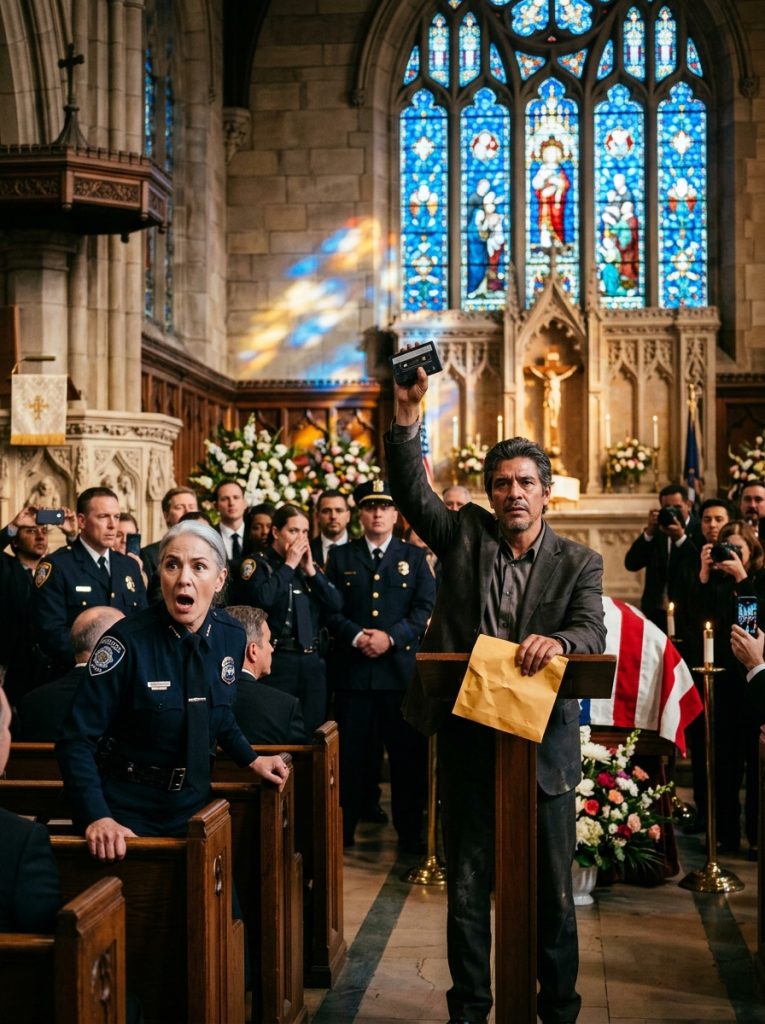
The cassette tape played for exactly two minutes and forty-seven seconds.
And in those two minutes and forty-seven seconds, fifty years of Frank Dunleavy’s reputation were destroyed in front of every person who had ever believed in him.
The church was silent — not the respectful silence of a funeral, but the stunned silence of three hundred people realizing they had been lied to for decades. Commissioner Elena Ross was still standing at the podium, her navy uniform suddenly looking like a costume, her mouth frozen open in the middle of the eulogy she would never finish.
On the tape, Dunleavy’s voice was unmistakable. That gravelly Chicago accent. That laugh. That casual cruelty.
“The evidence was planted,” the recording played. “Mendoza was clean. But the DA needed a conviction, the press needed a villain, and the department needed a fall guy. Mendoza was the easiest target. No family money. No political connections. Just a good cop who trusted the wrong people.”
A pause on the recording. The sound of ice clinking in a glass.
“You ever feel bad about it?” another voice asked — a younger detective, probably one of the ones sitting in this church right now.
“Bad?” Dunleavy laughed. “I got a promotion. I got a pension. And Mendoza got what he deserved for being naive enough to trust anyone in this department.”
The recording ended.
For three seconds, no one moved.
Then Commissioner Ross found her voice.
“Where did you get that?” she demanded.
I held up the cassette player. “A burner phone I bought six years ago. I taped every conversation I had with Dunleavy in the months after my conviction — every meeting where he promised to ‘look into it,’ every phone call where he told me to ‘stop being paranoid,’ every moment where he revealed just enough for me to know he was lying.”
“That recording could be fabricated,” someone shouted from the back.
“It’s been authenticated by three independent audio forensics labs,” I said. “The DA’s office has had copies for four months. They’ve been building a case against Dunleavy’s estate and every officer who participated in the cover-up. This funeral was just the first time the public got to hear it.”
The church erupted.
Reporters surged toward the podium. Cameras flashed. Commissioner Ross tried to restore order, but the damage was done — irreparable, irreversible, complete.
I stepped away from the podium.
An officer I used to train — a young patrol cop named Rodriguez who’d been a rookie when I went to prison — stepped into my path.
“Detective Mendoza,” he said. “I just want you to know — I never believed it. Not for a second.”
“Thank you, Rodriguez.”
“What do you want now? Your badge back? Your pension?”
I looked past him, through the stained-glass windows, toward the gray Minneapolis sky.
“I want my name cleared. I want the official record corrected. I want every cop who knew what Dunleavy did and stayed silent to face the consequences they deserve.”
“And after that?”
I hadn’t thought about ‘after that.’ For six years, my entire life had been about surviving — surviving prison, surviving homelessness, surviving the shame of being the most hated man in Minneapolis law enforcement history. I hadn’t planned a future because I didn’t believe I had one.
“After that,” I said, “I want to teach.”
Rodriguez blinked. “Teach?”
“Criminal justice. Ethics. What happens when good cops look the other way. I’ve spent six years learning exactly how the system fails. Maybe now I can teach the next generation how to make sure it doesn’t happen again.”
Commissioner Ross approached me as I was walking toward the church doors. Her face was pale, but her posture was steady.
“Detective Mendoza,” she said. “The department owes you an apology. A formal one. On the record.”
“The department owes me more than an apology.”
“I know. And you’ll get it. Starting with your pension — fully restored, plus six years of back payments. And your badge, if you want it.”
I looked at the casket at the front of the church. Frank Dunleavy’s flag-draped coffin. The flowers that now seemed to wilt under the weight of the truth.
“I don’t want my badge,” I said. “I want something better.”
“What’s that?”
“A classroom.”
I walked out of St. Michael’s Church into the Minneapolis afternoon. The snow had stopped. The sky was clearing — pale blue breaking through the gray, the first sunlight I’d felt in six years.
Behind me, the church bells began to toll.
And for the first time since my conviction, the sound didn’t feel like a funeral.
It felt like a birth.